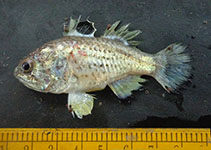
>
Kurtiformes (Nurseryfishes, cardinalfishes.) >
Apogonidae (Cardinalfishes) > Apogoninae
Eponymy: John Frederick Whitlie Quekett (1849–1913) was born in London, but emigrated to Natal (1871) and was appointed to organise the collection of the Natal Society (1886). [...] (Ref. 128868), visit book page.
Environment: milieu / climate zone / profondeur / distribution range
Écologie
marin benthopélagique; profondeur 66 - 90 m (Ref. 127989). Tropical
Western Indian Ocean: southern Red Sea, Arabian Sea and off Natal, South Africa. Reported as introduced to the Mediterraneann (Ref. 94612). First record from India (Ref. 113566).
Taille / Poids / Âge
Maturité: Lm ? range ? - ? cm
Max length : 12.3 cm TL mâle / non sexé; (Ref. 94840)
Épines dorsales (Total) : 8; Rayons mous dorsaux (Total) : 8; Épines anales: 2; Rayons mous anaux: 8. Large dark ocellus on 1st dorsal fin (Ref. 4329).
Body shape (shape guide): fusiform / normal.
Minimum depth reported taken from Ref. 57178. Maximum depth reported taken from Ref. 127989.
Life cycle and mating behavior
Maturité | Reproduction | Frai | Œufs | Fécondité | Larves
Mouthbrooders (Ref. 240). Distinct pairing during courtship and spawning (Ref. 205).
Gon, O., 1986. Apogonidae. p. 546-561. In M.M. Smith and P.C. Heemstra (eds.) Smiths' sea fishes. Springer-Verlag, Berlin. (Ref. 4329)
Statut dans la liste rouge de l'IUCN (Ref. 130435: Version 2025-1)
Menace pour l'homme
Harmless
Utilisations par l'homme
Outils
Articles particuliers
Télécharger en XML
Sources Internet
Estimates based on models
Preferred temperature (Réf.
123201): 18.5 - 26.7, mean 23.5 °C (based on 12 cells).
Phylogenetic diversity index (Réf.
82804): PD
50 = 0.5000 [Uniqueness, from 0.5 = low to 2.0 = high].
Bayesian length-weight: a=0.01023 (0.00554 - 0.01890), b=3.07 (2.91 - 3.23), in cm total length, based on LWR estimates for this species & Genus-body shape (Ref.
93245).
Niveau trophique (Réf.
69278): 3.5 ±0.6 se; based on size and trophs of closest relatives
Résilience (Réf.
120179): Haut, temps minimum de doublement de population inférieur à 15 mois (Preliminary K or Fecundity.).
Fishing Vulnerability (Ref.
59153): Low vulnerability (10 of 100).
🛈