



Cephaloscyllium silasi (Talwar, 1974)
Indian swellshark
Beobachtung melden im Fish Watcher
| Native range | All suitable habitat | Point map | Year 2050 |

|
| This map was computer-generated and has not yet been reviewed. |
| Cephaloscyllium silasi AquaMaps Data sources: GBIF OBIS |
Hochladen Photos und videos
Bilder | Google Bild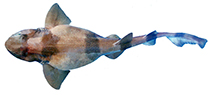 Cephaloscyllium silasi
Photo von Siripittrakul, B. & T. Krajangdara
Bilder | Google Bild
Photo von Siripittrakul, B. & T. Krajangdara
Klassifizierung / Names Namen | Synonyme | Catalog of Fishes(Gattung, Arten) | ITIS | CoL | WoRMS | Cloffa
Elasmobranchii (Haie und Rochen) (sharks and rays) > Carcharhiniformes (Ground sharks) > Scyliorhinidae (Cat sharks) > Scyliorhininae
Etymology: Cephaloscyllium: cephalus, from kephale (Gr.), head, referring to its very broad and depressed head; skylion, Greek for dogfish or small shark (See ETYFish); silasi: In honor of Eric Godwin Silas (1928-2018), Sri Lankan-born Indian ichthyologist and fisheries scientist, Director, Central Marine Fisheries Institute (India), “whose excellent publications on the ichthyofauna of the continental shelf of the south-west coast of India have added much to our knowledge of the fauna of this region” (See ETYFish).
Eponymy: Dr Eric Godwin Silas (1928–2018) was a Sri Lankan-born Indian ichthyologist and fisheries scientist. [...] (Ref. 128868), visit book page.
Etymology: Cephaloscyllium: cephalus, from kephale (Gr.), head, referring to its very broad and depressed head; skylion, Greek for dogfish or small shark (See ETYFish); silasi: In honor of Eric Godwin Silas (1928-2018), Sri Lankan-born Indian ichthyologist and fisheries scientist, Director, Central Marine Fisheries Institute (India), “whose excellent publications on the ichthyofauna of the continental shelf of the south-west coast of India have added much to our knowledge of the fauna of this region” (See ETYFish).
Eponymy: Dr Eric Godwin Silas (1928–2018) was a Sri Lankan-born Indian ichthyologist and fisheries scientist. [...] (Ref. 128868), visit book page.
Umwelt: Milieu / Klimazone / Tiefenbereich / Verbreitungsgebiet Ökologie
seewasser bathydemersal; tiefenbereich 250 - 500 m (Ref. 95495). Deep-water; 16°N - 9°N
Verbreitung Territorien | FAO Gebiete | Ökosysteme | Vorkommen | Punkt Karte | Einführungen | Faunafri
Größe / Gewicht / Alter
Geschlechtsreife: Lm ? range ? - 36.7 cm
Max length : 36.0 cm TL Männchen/unbestimmt; (Ref. 95495); 45.0 cm TL (female)
Max length : 36.0 cm TL Männchen/unbestimmt; (Ref. 95495); 45.0 cm TL (female)
Kurzbeschreibung Bestimmungsschlüssel | Morphologie | Morphometrie
This is a small shark with the following characters: stout body with expanded belly; labial furrows absent but a vestigial lower labial furrow may be present; anterior nasal flaps are broadly triangular; head depressed, flattened and broad, rounded in dorsal and ventrally; mouth large and arched; 5 gill slits, dorsolaterally placed and last two gill slits over pectorals, the 1-3 gill slits are subequal in length, 5th smallest; eyes dorsolateral and slit like; large mouth, arched or crescentic; mouth width 0.6 times HL; first dorsal origin slightly in front of pelvic insertion and placed above pelvics (Ref. 95495).
Body shape (shape guide): elongated.
Body shape (shape guide): elongated.
Found on the uppermost continental slope. Probably a dwarf species. Oviparous (Ref. 50499). This species could possibly attains a maximum size of 50.0 cm TL, with males reported (Ref. 26842) to reach length at maturity at 36.7 cm TL. A 45.0 cm female was found gravid and have two egg cases, one in each uterus, containing visible embryos (85.1-86.2 mm) with attached yolk sac. Stomach examined contains crustaceans and cephalopods (Ref. 95495).
Lebenszyklus und Paarungsverhalten Geschlechtsreife | Fortpflanzung | Ablaichen | Eier | Fruchtbarkeit | Larven
Oviparous, paired eggs are laid. Embryos feed solely on yolk (Ref. 50449).
Hauptreferenz
Laden Sie Ihre Referenzen hoch | Referenzen | Koordinator : Compagno, Leonard J.V. | Partner
Compagno, L.J.V., 1984. FAO Species Catalogue. Vol. 4. Sharks of the world. An annotated and illustrated catalogue of shark species known to date. Part 2 - Carcharhiniformes. FAO Fish. Synop. 125(4/2):251-655. Rome: FAO. (Ref. 244)
IUCN Rote Liste Status (Ref. 130435: Version 2025-2 (Global))
vom Aussterben bedroht (CR) (A2d); Date assessed: 19 November 2019
CITES
Not Evaluated
Bedrohung für Menschen
Harmless
Nutzung durch Menschen
Fischereien: nicht kommerziell
FAO - Publication: search | FishSource |
Mehr Information
Trophische Ökologie
Lebensmittel (Beutetiere)
Nahrungszusammensetzung
Nahrungsaufnahme
Lebensmittelrationen
Räuber
Lebensmittel (Beutetiere)
Nahrungszusammensetzung
Nahrungsaufnahme
Lebensmittelrationen
Räuber
Ökologie
Ökologie
Ökologie
Populationsdynamik
Wachstumsparameter
Max. Alter/Größen
Länge-Gewicht-Rel.
Länge-Länge-Verhältnis.
Längenhäufigkeiten
Massenkonvertierung
Rekrutierung
Dichte
Wachstumsparameter
Max. Alter/Größen
Länge-Gewicht-Rel.
Länge-Länge-Verhältnis.
Längenhäufigkeiten
Massenkonvertierung
Rekrutierung
Dichte
Lebenszyklus
Fortpflanzung
Geschlechtsreife
Reifung/Kiemen rel.
Fruchtbarkeit
Ablaichen
Laichaggregationen
Eier
Eientwicklung
Larven
Larven Pop.Dyn.
Fortpflanzung
Geschlechtsreife
Reifung/Kiemen rel.
Fruchtbarkeit
Ablaichen
Laichaggregationen
Eier
Eientwicklung
Larven
Larven Pop.Dyn.
Anatomie
Kiemenoberfläche
Gehirn
Otolith
Kiemenoberfläche
Gehirn
Otolith
Physiologie
Körperliche Zusammensetzung
Nährstoffe
Sauerstoffverbrauch
Schwimmart
Schwimmgeschwindigkeit
Visuelle Pigmente
Fischgeräusche
Krankheiten und Parasiten
Toxizität (LC50s)
Körperliche Zusammensetzung
Nährstoffe
Sauerstoffverbrauch
Schwimmart
Schwimmgeschwindigkeit
Visuelle Pigmente
Fischgeräusche
Krankheiten und Parasiten
Toxizität (LC50s)
Genetik
Genom
Genetik
Heterozygotie
Vererbbarkeit
Genetische Vielfalt
Genom
Genetik
Heterozygotie
Vererbbarkeit
Genetische Vielfalt
Menschenbezogen
Aquakultur-Systeme
Aquakultur Profile
Zuchtlinien
Ciguatera-Fälle
Briefmarken, Münzen, Verschiedenes.
Aquakultur-Systeme
Aquakultur Profile
Zuchtlinien
Ciguatera-Fälle
Briefmarken, Münzen, Verschiedenes.
Tools
Zusatzinformationen
Download XML
Zusammenfassung | Punktdaten | Namen | Photos
Internet Quellen
AFORO (otoliths) | Aquatic Commons | BHL | Cloffa | Websites from users | FishWatcher Einträge suchen | CISTI | Catalog of Fishes: Gattung, Arten | DiscoverLife | ECOTOX | FAO - Publication: search | Faunafri | Fishipedia | Fishtrace | GloBI | Google Books | Google Scholar | Google | IGFA World Record | OneZoom | Open Tree of Life | Otolith Atlas of Taiwan Fishes | PubMed | Reef Life Survey | Socotra Atlas | TreeBase | Tree of Life | Wikipedia: Gehe zu, Suchen | World Records Freshwater Fishing | Zoologischer Rekord
Schätzungen auf der Grundlage von Modellen
Phylogenetischer Diversitätsindex (Ref. 82804): PD50 = 0.5000 [Uniqueness, from 0.5 = low to 2.0 = high].
Bayesian length-weight: a=0.00269 (0.00140 - 0.00518), b=3.21 (3.04 - 3.38), in cm total length, based on LWR estimates for this (Sub)family-body shape (Ref. 93245).
Trophische Ebene (Ref. 69278): 4.0 ±0.5 se; based on size and trophs of closest relatives
Widerstandsfähigkeit (Ref. 120179): niedrig, Verdopplung der Population dauert 4,5 - 14 Jahre. (Fec assumed to be <100).