>
Kurtiformes (Nurseryfishes, cardinalfishes.) >
Apogonidae (Cardinalfishes) > Apogoninae
Etymology: Taeniamia: Name from feminine Latin noun 'taenia' meaning ribbon or band; and feminine Greek noun 'Amia' meaning a fish, often used with cardinalfishes genera. Here as Taeniamia referring to the vertical wide bars and near vertical to curved narrow bars as lines on most of the species in this genus.
More on author: Cuvier.
Environment: milieu / climate zone / intervalo de profundidade / distribution range
Ecologia
marinhas associadas(os) a recifes; intervalo de profundidade 1 - 20 m (Ref. 54391). Tropical
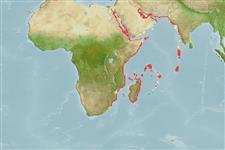
Western Indian Ocean: known only from the Red Sea. Reports outside this area are misidentifications of several other species, including bleekeri, flavofasciata, fucata, macroptera, and mozambiquensis.
Tamanho / Peso / Idade
Maturidade: Lm ? range ? - ? cm
Max length : 10.3 cm TL macho/indeterminado; (Ref. 7340)
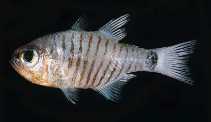
Espinhos dorsais (total) : 7; Raios dorsais moles (total) : 9; Espinhos anais: 2; Raios anais moles: 12 - 14. Diagnosis: Rays: dorsal VI + I,9; anal II,12-14; pectoral rays 14 (rarely 13 or 15). Gill rakers 6-7 + 15-17. Lateral-line scales 25+3-4. Median predorsal scales 5-7. Body depth 2.4-2.6 in SL; body width 2.3-2.4 in body depth; eye diameter 2.7-2.8 in head length; first dorsal spine 1.85-2.4 in second spine; second dorsal spine 2.4-3.0, and third dorsal spine 2.4-2.9 in head length; spine of second dorsal fin 2.3-2.8, and second anal spine 2.7-3.0 in head length; pelvic-fin length 4.7-5.1 and caudal-peduncle length 5.0-5.35 in SL; distance from insertion of pelvic spine to anal-fin origin 4.25-4.6 in SL. Usually 1-4 small teeth present on median basilingual ridge. Posterior preopercular edge completely serrate, or nearly so; ventral edge serrate on posterior half. Scaly sheath along anal-fin base well developed (Ref. 54391).
Body shape (shape guide): fusiform / normal; Cross section: compressed.
Schools with other Archamia species in coral reef lagoons (Ref. 559). Cryptic, hiding in dark crevices and caves in reefs during the day (Ref. 54391).
Life cycle and mating behavior
Maturidade | Reprodução | Desova | Ovos | Fecundidade | Larvas
Are mouthbrooders (Ref. 240). Distinct pairing during courtship and spawning (Ref. 205).
Gon, O. and J.E. Randall, 2003. Revision of the Indo-Pacific cardinalfish genus Archamia (Perciformes: Apogonidae), with description of a new species. Indo-Pac. Fish. (35):49 p. (Ref. 54391)
Categoria na Lista Vermelha da IUCN (Ref. 130435: Version 2025-1)
Ameaça para o homem
Harmless
Utilização humana
Pescarias: sem interesse
Ferramentas
Relatórios especiais
Descarregue XML
Fontes da internet
Estimates based on models
Preferred temperature (Ref.
123201): 24.7 - 28.8, mean 27 °C (based on 121 cells).
Phylogenetic diversity index (Ref.
82804): PD
50 = 0.5001 [Uniqueness, from 0.5 = low to 2.0 = high].
Bayesian length-weight: a=0.01175 (0.00712 - 0.01939), b=3.04 (2.90 - 3.18), in cm total length, based on LWR estimates for this species & (Sub)family-body (Ref.
93245).
Nível Trófico (Ref.
69278): 3.5 ±0.50 se; based on food items.
Resiliência (Ref.
120179): Elevada, tempo mínimo de duplicação da população menor que 15 meses (Preliminary K or Fecundity.).
Fishing Vulnerability (Ref.
59153): Low vulnerability (10 of 100).
🛈