分類 / Names
俗名 | 同種異名 | Catalog of Fishes(屬, 種) | ITIS | CoL | WoRMS | Cloffa
Teleostei >
Eupercaria/misc (Various families in series Eupercaria)
鱸形目 (Various families in series Eupercaria) >
Labridae (Wrasses)
隆頭魚科 (Wrasses) > Corinae
Etymology: Coris: Greek, kore, -es = pupil and also with themenaing of "maid" (Ref. 45335).
Environment: milieu / climate zone / 深度上下限 / distribution range
生態學
海洋 礁區魚類; 深度上下限 ? - 20 m (Ref. 9773), usually 2 - 50 m (Ref. 27115). 熱帶; 24°C - 27°C (Ref. 27115)
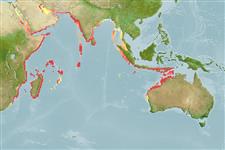
Western Indian Ocean: southern Red Sea to Natal, South Africa and east to Sri Lanka.
西印度洋: 紅海到南非的納塔爾南部而且東至斯里蘭卡。
大小 / 重量 / 年齡
成熟度: Lm ? range ? - ? cm
Max length : 60.0 cm TL 雄魚/尚未辨別雌雄; (Ref. 5213)
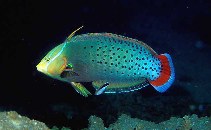
背棘 (總數) : 9; 背的軟條 (總數) : 12; 臀棘: 3; 臀鰭軟條: 12. Terminal males reddish to lavender in color; caudal with small, dark-edged, blue-green spots, posterior margin light orange-red (Ref. 4392). Juveniles orange, head and lower part of body dark brown; 3 large, vertically elongate, broadly black-edged, white spots on dorsal part of body (Ref. 4392).
Body shape (shape guide): fusiform / normal.
最後階段的雄魚淡紅的到淡紫色的顏色; 尾鰭有小的﹐黑色邊的﹐和藍綠色斑點,後緣淡的橘紅色的.(參考文獻 4392) 稚魚橘色的, 頭部與身體下半部深褐色的; 3 大的﹐細長垂直的﹐和明顯黑色的-邊緣, 白色的斑點在身體的背部部份上 (. 參考文獻 4392)
Adults found in weed, rock and coral areas; juveniles in shallow tide pools (Ref. 30573). Generally solitary (Ref. 5213). Feeds mainly on hard-shelled prey, including crustaceans, mollusks and sea urchins (Ref. 5374). Young very different (Ref. 1623).
成魚發現於雜草,岩石與珊瑚區域了; 稚魚在水淺的潮池。 (參考文獻 30573) 通常獨居性的.(參考文獻 5213) 主要吃具有硬殼的獵物,包括甲殼動物,軟體動物與海膽。 (參考文獻 5374) 幼魚非常不同的.(參考文獻 1623)
Life cycle and mating behavior
成熟度 | 繁殖 | 產卵場 | 卵 | 孕卵數 | 仔魚
Oviparous, with distinct pairing during breeding (Ref. 205).西印度洋: 紅海到南非的納塔爾南部而且東至斯里蘭卡。
Randall, J.E., 1999. Revision of the Indo-Pacific labrid fishes of the genus Coris, with descriptions of five new species. Indo-Pac. Fish. (29):74 p. (Ref. 33411)
IUCN 瀕危狀態 (Ref. 130435: Version 2025-1)
無危 (LC) ; Date assessed: 22 February 2009
人類使用
漁業: 低經濟; 水族館: 商業性
工具
特別的報告
下載 XML
網路資源
Estimates based on models
Preferred temperature (參考文獻
123201): 24.6 - 28.5, mean 27.1 °C (based on 424 cells).
Phylogenetic diversity index (參考文獻
82804): PD
50 = 0.5000 [Uniqueness, from 0.5 = low to 2.0 = high].
Bayesian length-weight: a=0.00977 (0.00466 - 0.02049), b=3.07 (2.90 - 3.24), in cm total length, based on LWR estimates for this (Sub)family-body shape (Ref.
93245).
營養階層 (參考文獻
69278): 3.8 ±0.26 se; based on food items.
回復力 (參考文獻
120179): 低的, 最小族群倍增時間4.5 - 14 年 (Preliminary K or Fecundity.).
Fishing Vulnerability (Ref.
59153): Moderate vulnerability (44 of 100).
🛈
Nutrients (Ref.
124155): Calcium = 28.2 [11.0, 72.2] mg/100g; Iron = 0.512 [0.302, 0.909] mg/100g; Protein = 18.5 [15.7, 20.7] %; Omega3 = 0.115 [0.058, 0.225] g/100g; Selenium = 38.5 [14.9, 105.3] μg/100g; VitaminA = 80.3 [25.7, 271.5] μg/100g; Zinc = 1.78 [0.84, 3.17] mg/100g (wet weight); based on
nutrient studies.