>
Beloniformes (Needle fishes) >
Hemiramphidae (Halfbeaks)
Etymology: Hemiramphus: Greek, hemi = half + Greek, rhamphos = bill, peak (Ref. 45335).
Eponymy: Count Frédéric Benjamin Lütke (1797–1882) was a Russian (of German descent) explorer and navigator. [...] (Ref. 128868), visit book page.
More on author: Valenciennes.
Environment: milieu / climate zone / Tiefenbereich / distribution range
Ökologie
seewasser; brackwasser riff-verbunden; tiefenbereich 0 - ? m. Tropical
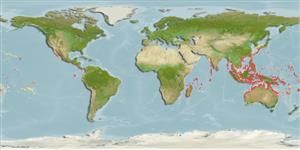
Pacific Ocean: ranging eastward to the Gilbert Islands and Samoa, north to southern Japan. Confused with Hemiramphus archipelagicus under the name Hemiramphus marginatus by many authors (Ref. 10943).
Length at first maturity / Size / Gewicht / Alter
Geschlechtsreife: Lm 22.6, range 22 - 23.6 cm
Max length : 40.0 cm SL Männchen/unbestimmt; (Ref. 54980); common length : 25.0 cm SL Männchen/unbestimmt; (Ref. 9843)
Rückenflossenstacheln (insgesamt) : 0; Rückenflossenweichstrahlen (insgesamt) : 12 - 15; Afterflossenstacheln: 0; Afterflossenweichstrahlen: 10 - 13; Wirbelzahl: 52 - 57. Greatly prolonged, beak-like lower jaw; upper jaw short, triangular and without scales; preorbital ridge absent; total number of gill rakers on first gill arch 33-46; pectoral fins long, reaching beyond anterior margin of nasal pit when folded forward; no spots or vertical bars on sides.
Body shape (shape guide): elongated.
Inhabits coastal waters rich in vegetation (Ref. 5213). Found more offshore than other species of Hemiramphus in the western central Pacific; juveniles and immature individuals are relatively common far from shore, usually among floating plants (Ref. 9843). Caught by set-net.
Life cycle and mating behavior
Geschlechtsreife | Fortpflanzung | Ablaichen | Eier | Fecundity | Larven
Collette, B.B. and J. Su, 1986. The halfbeaks (Pisces, Beloniformes, Hemiramphidae) of the Far East. Proc. Acad. Nat. Sci. Philadelphia 138(1):250-301. (Ref. 10943)
IUCN Rote Liste Status (Ref. 130435: Version 2025-1)
Bedrohung für Menschen
Harmless
Nutzung durch Menschen
Fischereien: weniger kommerziell
Tools
Zusatzinformationen
Download XML
Internet Quellen
Estimates based on models
Preferred temperature (Ref.
123201): 24.3 - 29.3, mean 28.4 °C (based on 3275 cells).
Phylogenetic diversity index (Ref.
82804): PD
50 = 0.5005 [Uniqueness, from 0.5 = low to 2.0 = high].
Bayesian length-weight: a=0.00447 (0.00196 - 0.01020), b=3.08 (2.90 - 3.26), in cm total length, based on LWR estimates for this Genus-body shape (Ref.
93245).
Trophic level (Ref.
69278): 3.4 ±0.5 se; based on size and trophs of closest relatives
Widerstandsfähigkeit (Ref.
120179): hoch, Verdopplung der Population dauert weniger als 15 Monate. (Preliminary K or Fecundity.).
Fishing Vulnerability (Ref.
59153): Moderate vulnerability (39 of 100).
🛈