



Gerres longirostris (Lacepède, 1801)
Strongspine silver-biddy
Añada su observación en Fish Watcher
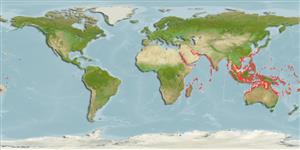
| Native range | All suitable habitat | Point map | Year 2050 |
|
| This map was computer-generated and has not yet been reviewed. |
| Gerres longirostris AquaMaps Data sources: GBIF OBIS |
Sube tu fotos y Vídeos
Imágenes | Google image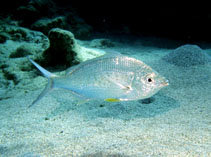 Gerres longirostris
Foto de Moosleitner, H.
Imágenes | Google image
Foto de Moosleitner, H.
Clasificación / Nombres Nombres comunes | Sinónimos | Catalog of Fishes(Género, Especie) | ITIS | CoL | WoRMS | Cloffa
> Eupercaria/misc (Various families in series Eupercaria) > Gerreidae (Mojarras)
Etymology: Gerres: Latin, gerres = a kind of anchovies; cited by Plinius.
More on author: Lacepède.
Etymology: Gerres: Latin, gerres = a kind of anchovies; cited by Plinius.
More on author: Lacepède.
Entorno: milieu / zona climática / rango de profundidad / gama de distribución Ecología
marino; agua dulce; salobre asociado a arrecife; anfidromo (Ref. 51243); rango de profundidad 0 - 50 m (Ref. 86942). Tropical; 32°N - 36°S, 24°E - 170°W
Distribución Territorios | Áreas FAO | Ecosistemas | Ocurrencias, apariciones | Mapa de puntos | Introducciones | Faunafri
Indo-Pacific: Red Sea and South Africa to the Marquesas Islands, north to the Ryukyu Islands, south to Australia. Also reported from Persian Gulf (Ref. 68964).
Longitud en la primera madurez / Tamaño / Peso / Edad
Madurez: Lm 20.6 range ? - ? cm
Max length : 44.5 cm TL macho / no sexado; (Ref. 90102); common length : 20.0 cm TL macho / no sexado; (Ref. 5450); edad máxima reportada: 9 años (Ref. 48383)
Max length : 44.5 cm TL macho / no sexado; (Ref. 90102); common length : 20.0 cm TL macho / no sexado; (Ref. 5450); edad máxima reportada: 9 años (Ref. 48383)
Descripción breve Claves de identificación | Morfología | Morfometría
Espinas dorsales (total) : 9; Radios blandos dorsales (total) : 10; Espinas anales: 3; Radios blandos anales: 7. Live specimens' head and trunk sides olive-green above, becoming silvery below; snout region blackish dorsally; dorsal fin membrane with faint black blotches or small spots at each spine and ray, just above edge of scaly basal sheath, silvery anteriorly on 1st-5th dorsal spine, grading to hyaline on spinous and soft dorsal fin; anal fin scaly basal sheath silver; distal part of pelvic fin between 1st-5th soft rays often white or hyaline for 1/5-1/3 of ray length, other parts hyaline or slightly yellowish; pectoral and anal fins hyaline. Caudal fin dusky with broad darker margin posteriorly which may be indistinct in old or poorly preserved specimens; ventral edge of lower caudal fin lobe white or bluish-white. Generally, body with prominent dark stripes along scale rows above lateral line (distinct in preserved specimens); 4-9 somewhat oblique dusky bars or columns of ovoid dark spots immediately below lateral line in specimens over 10 cm SL (dusky bars on less than 10 cm) but more apparent in preserved or stressed individuals. Scales between 5th dorsal fin spine base and lateral line 5-6.5 (modally 5.5). Upper jaw extending vertically beyond anteriormost margin of dermal eye opening, sometimes reaching to vertical at anterior margin of pupil. Second dorsal fin spine longest, 17-25% SL (Ref. 41108, 4372). Pre-opercle lower flange scaled. Body depth max 2.3-2.8 in SL. Pectoral fins reaches to or beyond level of anal-fin origin; caudal fin forked deeply (Ref. 90102). Pelvic fin of Red Sea specimens solid yellow with a narrow white distal margin; anal fin with a yellow tinge between the first rays; pectoral fin base with a dark brown spot (Horst Moosleitner, personal communication, homosub@aon.at). Examination of the meristic and morphometric data of the syntypes of G. lineolatus and G. rueppellii, and holotype of G. darnleyense showed all these are subadult or young specimens of G. longirostris (Ref. 41108).
Body shape (shape guide): fusiform / normal; Cross section: compressed.
Body shape (shape guide): fusiform / normal; Cross section: compressed.
Adults often in clear coastal waters up to about 50 m depth; juveniles often in estuaries or lagoons influenced by fresh water (Ref. 41108); they prefer shallow waters over sandy bottoms, from coral reefs to brackish waters (Ref. 30573). Fry about 10 cm in length enter the estuaries and stay until they reach maturity (Ref. 34363). Occur singly or in groups (Ref. 9710). Feed on small bottom invertebrates (Ref. 3409). In the Gilberts, the species forms spawning aggregations for a few days around the new moon (Ref. 37816). Sold fresh in markets; processed into fishmeal. Also taken with stake-nets (Ref. 3409).
Ciclo vital y comportamiento de apareamiento Madurez | Reproducción | Puesta | Huevos | Fecundidad | Larva
Referencia principal
Suba sus referencias | Referencias | Coordinador : Woodland, David J. | Colaboradores
Iwatsuki, Y., S. Kimura and T. Yoshino, 2001. Redescription of Gerres longirostris (Lacepède, 1801) and Gerres oblongus Cuvier in Cuvier and Valenciennes, 1830, included in the Gerres longirostris complex (Perciformes: Gerreidae). Copeia 2001(4):954-965. (Ref. 41108)
Situación en la Lista Roja de la UICN (Ref. 130435: Version 2025-2 (Global))
Least Concern (LC) ; Date assessed: 02 March 2015
CITES
Not Evaluated
Amenaza para el ser humano
Harmless
Usos humanos
Pesquerías: comercial
FAO - Publication: search | FishSource | Sea Around Us
Más información
Ecología Trófica
Alimentos (presas)
Composición de la dieta
consumo de alimento
Raciones de comida
Despredadores
Alimentos (presas)
Composición de la dieta
consumo de alimento
Raciones de comida
Despredadores
Dinámica de la población
Coeficiente del crecimiento para
Edades / tallas máximas
Longitud-peso rel.
Longitud-longitud rel.
Longitud-frecuencias
Conversión de masas
Reclutamiento
Abundancia
Coeficiente del crecimiento para
Edades / tallas máximas
Longitud-peso rel.
Longitud-longitud rel.
Longitud-frecuencias
Conversión de masas
Reclutamiento
Abundancia
Ciclo de vida
Reproducción
Madurez
Madurez/Gills rel.
Fecundidad
Puesta
Agregaciones de desove
Huevos
Desarrollo de los huevos
Larva
Dinámica larvaria
Reproducción
Madurez
Madurez/Gills rel.
Fecundidad
Puesta
Agregaciones de desove
Huevos
Desarrollo de los huevos
Larva
Dinámica larvaria
Distribución
Territorios
Áreas FAO
Ecosistemas
Ocurrencias, apariciones
Introducciones
BRUVS - Vídeos
Territorios
Áreas FAO
Ecosistemas
Ocurrencias, apariciones
Introducciones
BRUVS - Vídeos
Fisiología
Composición corporal
Nutrientes
Consumo del oxígeno
Tipo de natación
Velocidad de natación
Pigmentos visuales
Sonido de peces
Enfermedades y parásitos
Toxicidad (CL50)
Composición corporal
Nutrientes
Consumo del oxígeno
Tipo de natación
Velocidad de natación
Pigmentos visuales
Sonido de peces
Enfermedades y parásitos
Toxicidad (CL50)
Relacionados con el ser humano
Sistemas de acuicultura
Perfiles de acuicultura
Razas
Ciguatera cases
Sellos, monedas, varios
Sistemas de acuicultura
Perfiles de acuicultura
Razas
Ciguatera cases
Sellos, monedas, varios
Herramientas
Cuestionario orgánico | Libro electrónico | Guía de campo | Claves de identificación | Asistente para frecuencias de tallas | Herramienta de ciclo de vida | Mapa de puntos |
Catch-MSY |
Informes especiales
Comprobar el mantenimiento del acuario | Buscar fichas sobre especies | Consulte las hojas informativas sobre acuicultura
Descargar XML
Fuentes de Internet
AFORO (otoliths) | Aquatic Commons | BHL | Cloffa | Websites from users | Check FishWatcher | CISTI | Catalog of Fishes: Género, Especie | DiscoverLife | ECOTOX | FAO - Publication: search | Faunafri | Fishipedia | Fishtrace | GloBI | Google Books | Google Scholar | Google | IGFA World Record | Bases de datos nacionales | OneZoom | Open Tree of Life | Otolith Atlas of Taiwan Fishes | PubMed | Reef Life Survey | Socotra Atlas | TreeBase | Árbol de la vida | Wikipedia: Go, búsqueda | World Records Freshwater Fishing | Expediente Zoológico
Estimaciones basadas en modelos
Temperatura preferida (Referencia 123201): 24.7 - 29.3, mean 28.5 °C (based on 3461 cells).
Índice de diversidad filogenética (Referencia 82804): PD50 = 0.5000 [Uniqueness, from 0.5 = low to 2.0 = high].
Bayesian length-weight: a=0.01072 (0.00626 - 0.01833), b=3.04 (2.90 - 3.18), in cm total length, based on LWR estimates for this species & Genus-body shape (Ref. 93245).
Nivel trófico (Referencia 69278): 3.5 ±0.34 se; based on food items.
Resiliencia (Referencia 120179): Medio, población duplicada en un tiempo mínimo de 1.4-4.4 años (tmax=9; K=0.23-1.2; tm=1.5).
Nutrientes (Ref. 124155): Calcium = 41.9 [19.9, 71.8] mg/100g; Iron = 0.5 [0.2, 0.9] mg/100g; Protein = 19.5 [17.6, 21.4] %; Omega3 = 0.146 [0.083, 0.247] g/100g; Selenium = 30.9 [17.0, 54.2] μg/100g; VitaminA = 72 [19, 228] μg/100g; Zinc = 1.33 [0.91, 1.87] mg/100g (wet weight);