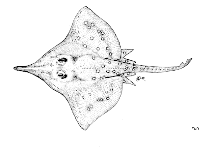
Elasmobranchii (Haie und Rochen) (sharks and rays) >
Rajiformes (Skates and rays) >
Rajidae (Skates)
Etymology: Dipturus: Greek, di = two + Greek, pteryx = fin (Ref. 45335).
More on author: Linnaeus.
Environment: milieu / climate zone / Tiefenbereich / distribution range
Ökologie
seewasser bathydemersal; tiefenbereich 70 - 1461 m (Ref. 114953), usually ? - 200 m (Ref. 114953). Deep-water; 65°N - 11°N, 19°W - 36°E (Ref. 114953)
Eastern Atlantic: central Norway to Senegal, including the Faeroes, Skagerrak, Mediterranean, and the Canary and Madeira islands.
Size / Gewicht / Alter
Geschlechtsreife: Lm ? range ? - ? cm
Max length : 150 cm TL Männchen/unbestimmt; (Ref. 4426)
Found in deeper slope waters (Ref. 4426), but mainly around 200 m (Ref. 3167, Ref. 114953). Found on sand and sand-rock bottoms (Ref. 6808). Feeds on all kinds of bottom animals (Ref. 3167), mainly cephalopods and crustaceans (Ref. 114953). Minimum depth reported taken from Ref. 6808. Become sexually mature at a length of about 120 cm (Ref. 35388); young hatch at ca. 17 cm TL (Ref. 114953). Breeds in spring and early summer (Ref. 114953). Oviparous. Distinct pairing with embrace. Young may tend to follow large objects, such as their mother (Ref. 205). Eggs are oblong capsules with stiff pointed horns at the corners deposited in sandy or muddy flats (Ref. 205). Egg capsules are 14.0-23.5 cm long and 11.0-12.0 cm wide (Ref. 41251, 41304).
Life cycle and mating behavior
Geschlechtsreife | Fortpflanzung | Ablaichen | Eier | Fecundity | Larven
Oviparous, paired eggs are laid. Embryos feed solely on yolk (Ref. 50449). Egg cases laid from spring to early summer (Ref. 3167). Distinct pairing with embrace. Young may tend to follow large objects, such as their mother (Ref. 205).
McEachran, J.D. and K.A. Dunn, 1998. Phylogenetic analysis of skates, a morphologically conservative clade of elasmobranchs (Chondrichthyes: Rajidae). Copeia 1998(2):271-290. (Ref. 27314)
IUCN Rote Liste Status (Ref. 130435: Version 2025-1)
Bedrohung für Menschen
Harmless
Nutzung durch Menschen
Fischereien: weniger kommerziell
Tools
Zusatzinformationen
Download XML
Internet Quellen
Estimates based on models
Preferred temperature (Ref.
123201): 5.4 - 14.4, mean 10.2 °C (based on 239 cells).
Phylogenetic diversity index (Ref.
82804): PD
50 = 0.5000 [Uniqueness, from 0.5 = low to 2.0 = high].
Bayesian length-weight: a=0.00138 (0.00118 - 0.00161), b=3.22 (3.18 - 3.26), in cm total length, based on LWR estimates for this species (Ref.
93245).
Trophic level (Ref.
69278): 3.5 ±0.5 se; based on diet studies.
Widerstandsfähigkeit (Ref.
120179): niedrig, Verdopplung der Population dauert 4,5 - 14 Jahre. (Assuming tm>5).
Fishing Vulnerability (Ref.
59153): Very high vulnerability (90 of 100).
🛈
Climate Vulnerability (Ref.
125649): Moderate to high vulnerability (46 of 100).
🛈
Nutrients (Ref.
124155): Calcium = 3.09 [0.44, 60.75] mg/100g; Iron = 0.268 [0.026, 3.558] mg/100g; Protein = 15.3 [13.2, 17.3] %; Omega3 = 0.393 [0.162, 0.962] g/100g; Selenium = 20.7 [3.7, 95.8] μg/100g; VitaminA = 3.17 [0.23, 43.29] μg/100g; Zinc = 0.251 [0.017, 3.009] mg/100g (wet weight);