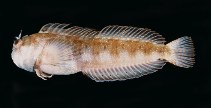
>
Blenniiformes (Blennies) >
Blenniidae (Combtooth blennies) > Salariinae
Etymology: Mimoblennius: Greek, mimos =mime + Greek, blennios = mucus (Ref. 45335).
More on author: Regan.
Environment: milieu / climate zone / गहराई सीमा / distribution range
पारिस्थितिकी
समुद्री प्रवाल-भित्ति संयुक्त; गहराई सीमा 2 - 10 m (Ref. 30874). Tropical
Eastern Indian Ocean and Western Pacific: Sri Lanka and Christmas Island in the Indian Ocean, southern Japan and Hong Kong.
आकार / वज़न / Age
परिपक्व अवधि: Lm ? range ? - ? cm
Max length : 5.0 cm TL पुल्लिंग / अलिंग; (Ref. 30874)
पृष्ठीय रीढ़ (सम्पूर्ण) : 13; पृष्ठीय सौफट रेज़ (सम्पूर्ण) : 18 - 19; गुदा कांटा: 2; ऐनल सौफट रेज़: 21 - 22. Closely related to Rhabdoblennius, but differs by 13 dorsal spines. Nasal and nuchal cirri palmate. Supraorbital with 2 long, slender cirri.
Body shape (shape guide): elongated; Cross section: circular.
A rare species (Ref. 559). Adults live in abandoned worm tubes, solitary or in loose groups (Ref. 90102). Oviparous. Eggs are demersal and adhesive (Ref. 205), and are attached to the substrate via a filamentous, adhesive pad or pedestal (Ref. 94114). Larvae are planktonic, often found in shallow, coastal waters (Ref. 94114).
Life cycle and mating behavior
परिपक्व अवधि | पुनरुत्पत्ति | मछलीऔ का अंडे देना | अंडे | Fecundity | लार्वा
Oviparous, distinct pairing (Ref. 205).
Masuda, H., K. Amaoka, C. Araga, T. Uyeno and T. Yoshino, 1984. The fishes of the Japanese Archipelago. Vol. 1. Tokai University Press, Tokyo, Japan. 437 p. (text). (Ref. 559)
IUCN Red List Status (Ref. 130435: Version 2025-1)
Threat to humans
Harmless
Human uses
मात्स्यिकी: कोई रुचि बग़ैर
साधन
Special reports
Download XML
इंटरनेट स्रोत
Estimates based on models
Preferred temperature (संदर्भ
123201): 24.5 - 29.2, mean 28.4 °C (based on 2109 cells).
Phylogenetic diversity index (संदर्भ
82804): PD
50 = 0.5312 [Uniqueness, from 0.5 = low to 2.0 = high].
Bayesian length-weight: a=0.00776 (0.00356 - 0.01695), b=3.00 (2.81 - 3.19), in cm total length, based on LWR estimates for this (Sub)family-body shape (Ref.
93245).
लौटाव (संदर्भ
120179): ऊंचा, न्यूनतम जनसंख्या दुगनी समय अवलागत 15 महीने। (Preliminary K or Fecundity.).
Fishing Vulnerability (Ref.
59153): Low vulnerability (10 of 100).
🛈