>
Siluriformes (Catfishes) >
Aspredinidae (Banjo catfishes) > Aspredininae
Etymology: Aspredinichthys: Latin, aspredo, asperitas = roughness + Greek, ichthys = fish (Ref. 45335).
More on author: Valenciennes.
Issue
See Mees (1987: 190) for detailed description.
Environment: milieu / climate zone / profondeur / distribution range
Écologie
; eau douce; saumâtre démersal. Tropical
South America: lower portions of coastal rivers and in coastal waters in Venezuela to Brazil.
Taille / Poids / Âge
Maturité: Lm ? range ? - ? cm
Max length : 21.8 cm SL mâle / non sexé; (Ref. 36695); common length : 15.0 cm TL mâle / non sexé; (Ref. 5217)
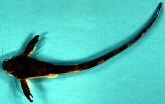
Benthic fish which lives on sandy-muddy littoral waters, estuaries and flooded zones of rivers. Reproduction takes place in April and June (Ref. 35381). The species has a peculiar mode of egg incubation wherein the female banjo catfish carries the eggs firmly attached to the underside of the body. This seems to be an adaptation to facilitate the oxygenation of the eggs in muddy environments (Ref. 35381). It is captured in coastal traps of stakes driven into the tidal mud (Chinese fish traps) (Ref. 6868).
Life cycle and mating behavior
Maturité | Reproduction | Frai | Œufs | Fécondité | Larves
Cervigón, F., R. Cipriani, W. Fischer, L. Garibaldi, M. Hendrickx, A.J. Lemus, R. Márquez, J.M. Poutiers, G. Robaina and B. Rodriguez, 1992. Fichas FAO de identificación de especies para los fines de la pesca. Guía de campo de las especies comerciales marinas y de aquas salobres de la costa septentrional de Sur América. FAO, Rome. 513 p. Preparado con el financiamento de la Comisión de Comunidades Europeas y de NORAD. (Ref. 5217)
Statut dans la liste rouge de l'IUCN (Ref. 130435: Version 2025-1)
Menace pour l'homme
Harmless
Utilisations par l'homme
Pêcheries: commercial; Aquarium: Commercial
Outils
Articles particuliers
Télécharger en XML
Sources Internet
Estimates based on models
Phylogenetic diversity index (Réf.
82804): PD
50 = 0.7500 [Uniqueness, from 0.5 = low to 2.0 = high].
Bayesian length-weight: a=0.00112 (0.00043 - 0.00295), b=3.07 (2.84 - 3.30), in cm total length, based on LWR estimates for this (Sub)family-body shape (Ref.
93245).
Niveau trophique (Réf.
69278): 3.2 ±0.4 se; based on size and trophs of closest relatives
Résilience (Réf.
120179): Haut, temps minimum de doublement de population inférieur à 15 mois (K=0.65).
Fishing Vulnerability (Ref.
59153): Low vulnerability (17 of 100).
🛈