



Pyronotanthias smithvanizi (Randall & Lubbock, 1981)
Princess anthias
Envoyez vos Photos et vidéos
Images | vidéos | Timbres, pièces de monnaie, divers | Images Google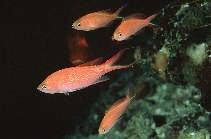 Pyronotanthias smithvanizi
Photo de Randall, J.E.
Images | vidéos | Timbres, pièces de monnaie, divers | Images Google
Photo de Randall, J.E.
Classification / Noms Noms communs | Synonymes | Catalog of Fishes(Genre, Espèce) | ITIS | CoL | WoRMS | Cloffa
> Perciformes/Serranoidei (Groupers) > Anthiadidae (Fairy basslets or Streamer basses)
Etymology: Pyronotanthias: Name from Greek πυρ, fire, νοτος, back, and Anthias. It ; referring to the characteristic red blotches or stripes on the upper caudal peduncle and beneath the posterior part of the dorsal fin of the included species. is masculine.
Eponymy: Dr William Farr ‘Bill’ Smith-Vaniz (d: 1941) is a Research Associate of the Florida Museum of Natural History, researching into the diversity and evolutionary relationships of fishes. [...] (Ref. 128868), visit book page.
More on authors: Randall & Lubbock.
Etymology: Pyronotanthias: Name from Greek πυρ, fire, νοτος, back, and Anthias. It ; referring to the characteristic red blotches or stripes on the upper caudal peduncle and beneath the posterior part of the dorsal fin of the included species. is masculine.
Eponymy: Dr William Farr ‘Bill’ Smith-Vaniz (d: 1941) is a Research Associate of the Florida Museum of Natural History, researching into the diversity and evolutionary relationships of fishes. [...] (Ref. 128868), visit book page.
More on authors: Randall & Lubbock.
Taxonomic Remarks
Ref. 2334 explains the current genus name.
Environnement : milieu / zone climatique / profondeur / gamme de distribution Écologie
marin récifal; profondeur 6 - 110 m (Ref. 9710), usually 6 - 70 m (Ref. 27115). Tropical; 22°C - 27°C (Ref. 27115); 19°N - 24°S
Distribution Territoires | Zones FAO | Écosystèmes | Occurrences | Carte par point | Introductions | Faunafri
Indo-Pacific: Cocos-Keeling Islands, north to Japan and south to the Great Barrier Reef; Palau and southern Marshall Islands in Micronesia.
Taille / Poids / Âge
Description synthétique Clés d'identification | Morphologie | Morphométrie
Épines dorsales (Total) : 10; Rayons mous dorsaux (Total) : 15 - 17; Épines anales: 3; Rayons mous anaux: 7 - 8. Appears more blue underwater and recognized by the yellow scribbles along the body (Ref. 48635).
Body shape (shape guide): fusiform / normal; Cross section: compressed.
Body shape (shape guide): fusiform / normal; Cross section: compressed.
Large aggregations occur on steep outer reef slopes and drop-offs (Ref. 4538, 48635). Maximum depth reported taken from Ref. 128797.
Cycle de vie et comportement reproducteur Maturité | Reproduction | Frai | Œufs | Fécondité | Larves
Référence principale
Téléchargez vos références | Références | Coordinateur | Collaborateurs
Gill, A.C., 2022. Revised definitions of the anthiadine fish genera Mirolabrichthys Herre and Nemanthias Smith, with description of a new genus (Teleostei: Serranidae). Zootaxa 5092(1):041-066. (Ref. 127988)
Statut dans la liste rouge de l'IUCN (Ref. 130435: Version 2025-2 (Global))
Préoccupation mineure (LC) ; Date assessed: 12 May 2015
CITES
Not Evaluated
Menace pour l'homme
Harmless
Utilisations par l'homme
Pêcheries: commercial; Aquarium: Commercial
FAO - Publication: search | FishSource |
Plus d'informations
Écologie trophique
Aliments (proies)
Composition du régime alimentaire
Consommation alimentaire
Rations alimentaires
Prédateurs
Aliments (proies)
Composition du régime alimentaire
Consommation alimentaire
Rations alimentaires
Prédateurs
Dynamique des populations
Paramètres de croissance
Âges / tailles maximales
Longueur-poids rel.
Rel. longueur-longueur.
Fréquences de longueurs
Conversion de masse
Recrutement
Abondance
Paramètres de croissance
Âges / tailles maximales
Longueur-poids rel.
Rel. longueur-longueur.
Fréquences de longueurs
Conversion de masse
Recrutement
Abondance
Cycle de vie
Reproduction
Maturité
Maturité/épines rel.
Fécondité
Frai
Agrégats de frai
Œufs
Développement de l'œuf
Larves
Dynamique des populations larvaires
Reproduction
Maturité
Maturité/épines rel.
Fécondité
Frai
Agrégats de frai
Œufs
Développement de l'œuf
Larves
Dynamique des populations larvaires
Anatomie
Surface branchiale
Cerveau
Otolithe
Surface branchiale
Cerveau
Otolithe
Physiologie
Composition corporelle
Nutriments
Consommation d'oxygène
Type de natation
Vitesse de nage
Pigments visuels
Son de poisson
Maladies et parasites
Toxicité (CL50)
Composition corporelle
Nutriments
Consommation d'oxygène
Type de natation
Vitesse de nage
Pigments visuels
Son de poisson
Maladies et parasites
Toxicité (CL50)
Génétique
génôme
Génétique
Hétérozygotie
Héritabilité
Diversité génétique
génôme
Génétique
Hétérozygotie
Héritabilité
Diversité génétique
Liées à l'homme
Systèmes d'aquaculture
Profils d'aquaculture
Souches
Cas de ciguatera
Timbres, pièces de monnaie, divers
Systèmes d'aquaculture
Profils d'aquaculture
Souches
Cas de ciguatera
Timbres, pièces de monnaie, divers
Outils
Quiz bio | E-book | Guide de terrain | Clés d'identification | Générateur de fréquences de longueur | Outil de dynamique de population | Carte par point |
Capture-MSY |
Articles particuliers
Télécharger en XML
Sources Internet
AFORO (otoliths) | Aquatic Commons | BHL | Cloffa | Websites from users | FishWatcher | CISTI | Catalog of Fishes: Genre, Espèce | DiscoverLife | ECOTOX | FAO - Publication: search | Faunafri | Fishipedia | Fishtrace | GloBI | Google Books | Google Scholar | Google | IGFA World Record | OneZoom | Open Tree of Life | Otolith Atlas of Taiwan Fishes | PubMed | Reef Life Survey | Socotra Atlas | TreeBase | Arbre de Vie | Wikipedia: aller à, chercher | World Records Freshwater Fishing | Zoological Record
Estimations basées sur des modèles
Température préférée (Réf. 123201): 26.2 - 29, mean 27.8 °C (based on 402 cells).
Indice de diversité phylogénétique (Réf. 82804): PD50 = 0.5020 [Uniqueness, from 0.5 = low to 2.0 = high].
Bayesian length-weight: a=0.01413 (0.00621 - 0.03212), b=3.00 (2.81 - 3.19), in cm total length, based on LWR estimates for this (Sub)family-body shape (Ref. 93245).
Niveau trophique (Réf. 69278): 3.4 ±0.45 se; based on food items.
Résilience (Réf. 120179): Haut, temps minimum de doublement de population inférieur à 15 mois (Preliminary K or Fecundity.).
Nutriments (Ref. 124155): Calcium = 120 [63, 243] mg/100g; Iron = 0.962 [0.522, 1.708] mg/100g; Protein = 17.9 [16.1, 19.6] %; Omega3 = 0.182 [0.106, 0.307] g/100g; Selenium = 28.6 [15.4, 57.3] μg/100g; VitaminA = 213 [72, 688] μg/100g; Zinc = 1.79 [1.17, 2.63] mg/100g (wet weight);