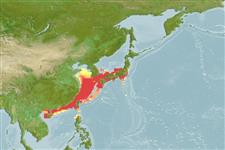
Environment: milieu / climate zone / distribuzione batimetrica / distribution range
Ecologia
marino associati a barriera corallina; distribuzione batimetrica 20 - 200 m (Ref. 5222). Tropical; 38°N - 18°N, 108°E - 142°E (Ref. 5222)
Northwest Pacific: Korea, Japan (north to Hegura-jima Island), China (south to Hong Kong and Hainan Island), and Taiwan.
Length at first maturity / Size / Peso / Age
Maturità: Lm ?, range 54 - ? cm
Max length : 136 cm TL maschio/sesso non determinato; (Ref. 89707); common length : 60.0 cm TL maschio/sesso non determinato; (Ref. 9137); peso massimo pubblicato: 33.0 kg (Ref. 40637)
Spine dorsali (totale) : 11; Raggi dorsali molli (totale) : 14 - 16; Spine anali: 3; Raggi anali molli: 8 - 9; Vertebre: 23 - 24. This species is distinguished from its congeners by the following characters: the serrae at angle of preopercle gradually and weakly enlarged from dorsal to ventral direction, 2-11 (usually 4-7); D 14-16 (usually 15); A 8-9; caudal fin rounded; ctenoid scales on lateral body. Colouration: back and side with six irregular broad oblique transverse bars, second bar directed forward becoming nearly horizontal ventral to lateral line and reaching opercular margin only dorsal to its posterior tip; third bar with an anterior branch connecting with second bar and reaching opercular margin; fourth band of head broader than eye diameter (Ref. 132424).
Body shape (shape guide): fusiform / normal; Cross section: compressed.
Inhabits rocky reefs; also found on muddy grounds (Ref. 089707). Juveniles occur in shallow waters. Commercially cultured in Japan.
Life cycle and mating behavior
Maturità | Riproduzione | Deposizione | Uova | Fecundity | Larve
Heemstra, P.C. and J.E. Randall, 1993. FAO Species Catalogue. Vol. 16. Groupers of the world (family Serranidae, subfamily Epinephelinae). An annotated and illustrated catalogue of the grouper, rockcod, hind, coral grouper and lyretail species known to date. Rome: FAO. FAO Fish. Synop. 125(16):382 p. (Ref. 5222)
IUCN Red List Status (Ref. 130435: Version 2025-1)
Threat to humans
Harmless
Human uses
Pesca: commerciale; Acquacoltura: commerciale; Pesce da pesca sportiva: si
Strumenti
Special reports
Download XML
Fonti Internet
Estimates based on models
Preferred temperature (Fonte Biblio.
123201): 17.7 - 23.7, mean 20.5 °C (based on 94 cells).
Phylogenetic diversity index (Fonte Biblio.
82804): PD
50 = 0.5000 [Uniqueness, from 0.5 = low to 2.0 = high].
Bayesian length-weight: a=0.01148 (0.00668 - 0.01973), b=3.06 (2.92 - 3.20), in cm total length, based on LWR estimates for this species & Genus-body shape (Ref.
93245).
Trophic level (Fonte Biblio.
69278): 4.0 ±0.66 se; based on food items.
Resilienza (Fonte Biblio.
120179): Molto basso, tempo minimo di raddoppiamento della popolazione più di 14 anni (Preliminary K or Fecundity.).
Fishing Vulnerability (Ref.
59153): Very high vulnerability (82 of 100).
🛈