>
Gobiiformes (Gobies) >
Gobiidae (Gobies) > Gobiinae
Etymology: Eviota: No etymology given, suggested by Christopher Scharpt: from Latin 'eu' for 'true' and 'iota' for anything very small, in combination 'truly very small' referring to it as being the smallest vertebrate at the time it has benn described by Jenkins (thus, making the suggestion by Scharpt plausible.
More on authors: Jordan & Seale.
Environment: milieu / climate zone / intervalo de profundidade / distribution range
Ecologia
marinhas associadas(os) a recifes; intervalo de profundidade 1 - 30 m (Ref. 86942). Tropical; 10°N - 23°S
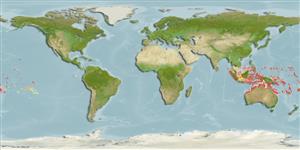
Western Pacific: Vietnam, Indonesia (Moluccas), east and northward to Japan (Ryukyu Islands); east through Micronesia (Palau, Guam, Federated States of Micronesia [Yap], Kiribati [Gilbert Islands]); including New Caledonia, Samoa, and French Polynesia; south through Melanesia to Australia (Great Barrier Reef).
Tamanho / Peso / Idade
Maturidade: Lm ? range ? - ? cm
Max length : 3.0 cm SL macho/indeterminado; (Ref. 48637)
Descrição breve
Chaves de identificação | Morfologia | Morfometria
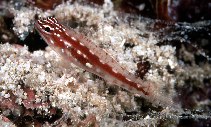
Espinhos dorsais (total) : 7; Raios dorsais moles (total) : 8 - 9; Espinhos anais: 1; Raios anais moles: 6 - 7. This species is distinguished by the following characters: cephalic sensory-canal pore system lacks the IT pore (pattern 2); unbranched pectoral-fin rays; dorsal/anal-fin formula is 8/7; fifth pelvic-fin ray 40% of fourth ray; abdomen without the black peritoneum clearly visible externally; upper portion of pectoral-fin base with a dark spot when dead, and which is lacking or less visible in life; when alive. there is a distinctive red line running from the tip of the lower jaw back under the eye across the cheek (Ref. 107299).
Body shape (shape guide): elongated; Cross section: oval.
Inhabits rubble of lagoon reefs (Ref. 37816). Also occurs in various reef habitats to about 15 meters depth (Ref. 48637). Occurs in small groups (Ref 90102).
Life cycle and mating behavior
Maturidade | Reprodução | Desova | Ovos | Fecundidade | Larvas
Myers, R.F., 1991. Micronesian reef fishes. Second Ed. Coral Graphics, Barrigada, Guam. 298 p. (Ref. 1602)
Categoria na Lista Vermelha da IUCN (Ref. 130435: Version 2025-1)
Ameaça para o homem
Harmless
Utilização humana
Ferramentas
Relatórios especiais
Descarregue XML
Fontes da internet
Estimates based on models
Phylogenetic diversity index (Ref.
82804): PD
50 = 0.5000 [Uniqueness, from 0.5 = low to 2.0 = high].
Bayesian length-weight: a=0.00692 (0.00284 - 0.01683), b=3.10 (2.92 - 3.28), in cm total length, based on LWR estimates for this Genus-body shape (Ref.
93245).
Nível Trófico (Ref.
69278): 3.1 ±0.3 se; based on size and trophs of closest relatives
Resiliência (Ref.
120179): Elevada, tempo mínimo de duplicação da população menor que 15 meses (Preliminary K or Fecundity.).
Fishing Vulnerability (Ref.
59153): Low vulnerability (10 of 100).
🛈
Nutrients (Ref.
124155): Calcium = 355 [149, 895] mg/100g; Iron = 1.37 [0.61, 2.93] mg/100g; Protein = 17.7 [15.6, 19.5] %; Omega3 = 0.108 [0.040, 0.268] g/100g; Selenium = 29.9 [10.2, 81.7] μg/100g; VitaminA = 129 [28, 558] μg/100g; Zinc = 3.63 [2.11, 5.88] mg/100g (wet weight);