>
Gobiiformes (Gobies) >
Gobiidae (Gobies) > Gobiinae
Etymology: Eviota: No etymology given, suggested by Christopher Scharpt: from Latin 'eu' for 'true' and 'iota' for anything very small, in combination 'truly very small' referring to it as being the smallest vertebrate at the time it has benn described by Jenkins (thus, making the suggestion by Scharpt plausible.
More on authors: Jordan & Seale.
Environment: milieu / climate zone / rango de profundidad / distribution range
Ecología
marino asociado a arrecife; rango de profundidad 1 - 10 m (Ref. 90102). Tropical; 30°N - 25°S
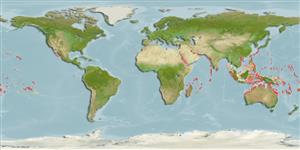
Indo-Pacific:from the Red Sea, MaIdives and eastern Indonesia; north to Japan (Ryukyu and Ogasawara islands), through Micronesia to Line Is. across Polynesia (eastward to Pitcairns); south to Australia (west coast of Great Barrier Reef). New Caledonia, and across to the Tuamotus and Pitcairn Islands.
Tamaño / Peso / Age
Madurez: Lm ? range ? - ? cm
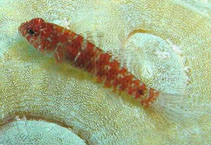
Max length : 2.0 cm SL macho / no sexado; (Ref. 1602)
Short description
Claves de identificación | Morfología | Morfometría
Espinas dorsales (total) : 7; Radios blandos dorsales (total) : 7 - 9; Espinas anales: 1; Radios blandos anales: 7 - 8. Dorsal to anal fin-ray formula 8/8.
Body shape (shape guide): elongated; Cross section: compressed.
Inhabits inshore reefs in 1-10 m (Ref 90102).
Life cycle and mating behavior
Madurez | Reproducción | Puesta | Huevos | Fecundidad | Larva
Myers, R.F., 1991. Micronesian reef fishes. Second Ed. Coral Graphics, Barrigada, Guam. 298 p. (Ref. 1602)
IUCN Red List Status (Ref. 130435: Version 2025-1)
Threat to humans
Harmless
Human uses
Herramientas
Special reports
Download XML
Fuentes de Internet
Estimates based on models
Preferred temperature (Referencia
123201): 25.1 - 29.3, mean 28.4 °C (based on 2948 cells).
Phylogenetic diversity index (Referencia
82804): PD
50 = 0.5000 [Uniqueness, from 0.5 = low to 2.0 = high].
Bayesian length-weight: a=0.00794 (0.00404 - 0.01563), b=3.07 (2.91 - 3.23), in cm total length, based on LWR estimates for this species & Genus-body shape (Ref.
93245).
Nivel trófico (Referencia
69278): 3.0 ±0.3 se; based on size and trophs of closest relatives
Resiliencia (Referencia
120179): Alto, población duplicada en un tiempo mínimo inferior a 15 meses (Preliminary K or Fecundity.).
Fishing Vulnerability (Ref.
59153): Low vulnerability (10 of 100).
🛈
Nutrients (Ref.
124155): Calcium = 531 [215, 1,876] mg/100g; Iron = 1.9 [0.7, 4.5] mg/100g; Protein = 17.6 [15.4, 19.5] %; Omega3 = 0.0962 [, ] g/100g; Selenium = 31.6 [7.8, 110.2] μg/100g; VitaminA = 105 [17, 608] μg/100g; Zinc = 5.42 [2.72, 9.52] mg/100g (wet weight);