>
Gobiiformes (Gobies) >
Gobiidae (Gobies) > Gobiinae
Etymology: Ctenogobiops: Greek, kteis, ktenos = comb + Latin, gobius = gudgeon + Greek, ops = appearance (Ref. 45335).
Environment: milieu / climate zone / profondeur / distribution range
Écologie
marin récifal; profondeur 1 - 20 m (Ref. 48637), usually 1 - 5 m (Ref. 90102). Tropical; 30°N - 23°S
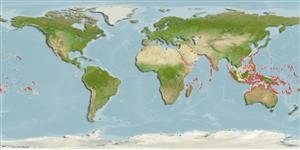
Indo-West Pacific: Red Sea to New Caledonia, north to the Ryukyu Islands; Truk and Guam in Micronesia.
Taille / Poids / Âge
Maturité: Lm ? range ? - ? cm
Max length : 8.0 cm SL mâle / non sexé; (Ref. 48637)
Description synthétique
Clés d'identification | Morphologie | Morphométrie
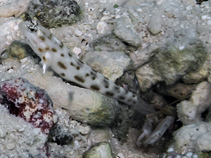
Épines dorsales (Total) : 7; Rayons mous dorsaux (Total) : 10 - 12; Épines anales: 1; Rayons mous anaux: 10 - 11. Characterized by whitish body color with three longitudinal rows of large brown spots; dark blotch behind eye; head with small dark spots/streaks; white spots on basal portion of pectoral fin; longitudinal scale series 54-57; opening of gill extending to vertical at posterior edge of preopercle; greatest depth of body 4.7-5.5 in SL; rounded caudal fin, about equal to head length (Ref. 90102).
Body shape (shape guide): elongated; Cross section: circular.
Occurs in sand and rubble bottoms of shallow lagoons (Ref. 9710) and subtidal reef flats. Often with Ctenogobiops pomastictus. Usually in pairs and use the burrow of alpheid prawns for refuge. Lives in clear coastal and inner reefs on rubble flats and slopes in 6 to 20 meters depth range (Ref. 48637). Feeds on small benthic invertebrates (Ref. 89972).
Life cycle and mating behavior
Maturité | Reproduction | Frai | Œufs | Fécondité | Larves
Myers, R.F., 1991. Micronesian reef fishes. Second Ed. Coral Graphics, Barrigada, Guam. 298 p. (Ref. 1602)
Statut dans la liste rouge de l'IUCN (Ref. 130435: Version 2025-1)
Menace pour l'homme
Harmless
Utilisations par l'homme
Outils
Articles particuliers
Télécharger en XML
Sources Internet
Estimates based on models
Preferred temperature (Réf.
123201): 25.2 - 29.3, mean 28.3 °C (based on 2585 cells).
Phylogenetic diversity index (Réf.
82804): PD
50 = 0.5020 [Uniqueness, from 0.5 = low to 2.0 = high].
Bayesian length-weight: a=0.00724 (0.00339 - 0.01546), b=3.10 (2.92 - 3.28), in cm total length, based on LWR estimates for this (Sub)family-body shape (Ref.
93245).
Niveau trophique (Réf.
69278): 3.4 ±0.4 se; based on size and trophs of closest relatives
Résilience (Réf.
120179): Haut, temps minimum de doublement de population inférieur à 15 mois (Preliminary K or Fecundity.).
Fishing Vulnerability (Ref.
59153): Low vulnerability (10 of 100).
🛈
Nutrients (Ref.
124155): Calcium = 158 [71, 315] mg/100g; Iron = 0.805 [0.414, 1.573] mg/100g; Protein = 17.9 [15.9, 19.6] %; Omega3 = 0.093 [0.040, 0.183] g/100g; Selenium = 22.2 [10.0, 51.1] μg/100g; VitaminA = 143 [38, 504] μg/100g; Zinc = 2.18 [1.41, 3.28] mg/100g (wet weight);