>
Gobiiformes (Gobies) >
Gobiidae (Gobies) > Gobiinae
Etymology: Valenciennea: From Achille Valenciennes 1794-1865; he worked with Duméril, Cuvier and Lacepède since 1815; malacologist, author of a "Histoire naturelle des poissons" (Ref. 45335).
Eponymy: Achille Valenciennes (1794–1865) was a French zoologist; primarily an ichthyologist and conchologist. [...] (Ref. 128868), visit book page.
More on authors: Lay & Bennett.
Environment: milieu / climate zone / kisaran kedalaman / distribution range
Ekologi
laut berasosiasi dengan karang; kisaran kedalaman 2 - 30 m (Ref. 27115), usually ? - 6 m (Ref. 8527). Tropical; 22°C - 27°C (Ref. 27115)
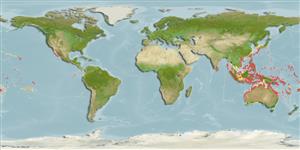
Indo-West Pacific.
Size / Weight / umur
Kematangan: Lm ? range ? - ? cm
Max length : 18.0 cm SL jantan/; (Ref. 48637)
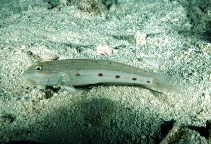
Duri punggung (Keseluruhan (total)) : 6 - 7; duri punggung lunak (Keseluruhan (total)) : 12 - 13; Duri dubur: 1; Sirip dubur lunak: 11 - 13. Characterized by pale grey body color, grading to white ventrally; presence of five, blue-edged bars extending ventrally to middle of side, each bar containing reddish brown to black blotch at bottom; blue bands; spots on head; pectoral fin base with a pair of pink stripes; dorsal fin with narrow pink bands and blue to reddish spots on second dorsal and caudal fins; without dorsal filamentous spines; rhomboid caudal fin, longer than head; length of caudal fin 2.7 in SL; longitudinal scale series 80-121; ctenoid body scales , becoming cycloid anteriorly below first or second dorsal spine; head or midline of nape without scales; side of nape with scales extending forward to above middle of operculum; usually scaled pectoral fin base in adult; partly or fully scaled prepelvic area of adult; depth of body 6.0-6.7 in SL (Ref. 90102).
Body shape (shape guide): elongated.
Occurs in areas of fine sand and shallow lagoon reefs at depths less than 3 m, rarely at depths greater than 6 m. Adults usually in pairs, constructing burrows under rubble. Monogamous (Ref. 52884, 48637). Feeds on small invertebrates (e.g. copepods, amphipods, ostracods, nematodes, and foraminiferans) by sifting mouthfuls of sand.
After spawning, a paired female constructs a mound on the burrow made up of dead coral fragments while the male watches over the eggs in the burrow (Ref. 85149). The mound promotes water-exchange in the burrow which helps the male in tending the eggs (Ref. 85149). The amount of female parental investment is displayed by the height of the constructed mound (Ref. 85149). Consequently, larger females build higher mounds which affects male mating preference (Ref. 85149). Monogamous mating is observed as both obligate and social (Ref. 52884).
Hoese, D.F. and H.K. Larson, 1994. Revision of the Indo-Pacific gobiid fish genus Valenciennea, with descriptions of seven new species. Indo-Pac. Fish. (23):71 p. (Ref. 8527)
Status IUCN Red List (Ref. 130435: Version 2025-1)
ancaman kepada manusia
Harmless
penggunaan manusia
Perikanan: nilai komersial kecil; Akuarium: Komersial
Alat, peralatan
laporan khas
muat turun XML
Sumber internet
Estimates based on models
Preferred temperature (Acuan
123201): 24.3 - 29.3, mean 28.5 °C (based on 2431 cells).
Phylogenetic diversity index (Acuan
82804): PD
50 = 0.5000 [Uniqueness, from 0.5 = low to 2.0 = high].
Bayesian length-weight: a=0.00676 (0.00373 - 0.01227), b=3.09 (2.94 - 3.24), in cm total length, based on LWR estimates for this species & (Sub)family-body (Ref.
93245).
Trophic level (Acuan
69278): 3.0 ±0.1 se; based on diet studies.
Daya lenting (Acuan
120179): sedang, Waktu penggandaan populasi minimum 1.4 - 4.4 tahun (Preliminary K or Fecundity.).
Fishing Vulnerability (Ref.
59153): Low vulnerability (12 of 100).
🛈
Nutrients (Ref.
124155): Calcium = 90 [40, 161] mg/100g; Iron = 0.623 [0.325, 1.187] mg/100g; Protein = 17.9 [16.0, 19.6] %; Omega3 = 0.082 [0.037, 0.153] g/100g; Selenium = 26.9 [13.7, 56.3] μg/100g; VitaminA = 110 [28, 381] μg/100g; Zinc = 1.74 [1.15, 2.55] mg/100g (wet weight);