



Uploaden van uw Foto's en video's
Google afbeelding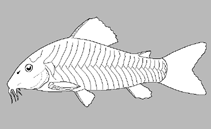 No image available for this species;
drawing shows typical species in Callichthyidae.
Google afbeelding
drawing shows typical species in Callichthyidae.
Classificatie / Namen Lokale namen | Synoniemen | Catalog of Fishes(Genus, Soort(en)) | ITIS | CoL | WoRMS | Cloffa
> Siluriformes (Catfishes) > Callichthyidae (Callichthyid armored catfishes) > Corydoradinae
Etymology: Aspidoras: Greek, aspis, -idos = shield + Greek, dora = skin (Ref. 45335); azaghal: The epithet ‘azaghal’ refers to a fictional character Azaghâl, the king of the Broadbeam Dwarves, one of the seven dwarf clans, and Lord of the dwarven realm of Belegost in the Blue Mountains during Middle Earth's First Age. The name is a double allusion: first about the region where the species was found, Terra do Meio, freely translated as ‘Middle Earth’ in English (fictional world of Tolkien's legendarium), and second by the fact that the new species occurs in a mountainous region and presents a relatively small size, which are both typical features of the fictional dwarves; noun in apposition.
Eponymy: Azaghâl was a king of the Dwarves in Tolkien’s Middle Earth stories. [...] (Ref. 128868), visit book page.
Etymology: Aspidoras: Greek, aspis, -idos = shield + Greek, dora = skin (Ref. 45335); azaghal: The epithet ‘azaghal’ refers to a fictional character Azaghâl, the king of the Broadbeam Dwarves, one of the seven dwarf clans, and Lord of the dwarven realm of Belegost in the Blue Mountains during Middle Earth's First Age. The name is a double allusion: first about the region where the species was found, Terra do Meio, freely translated as ‘Middle Earth’ in English (fictional world of Tolkien's legendarium), and second by the fact that the new species occurs in a mountainous region and presents a relatively small size, which are both typical features of the fictional dwarves; noun in apposition.
Eponymy: Azaghâl was a king of the Dwarves in Tolkien’s Middle Earth stories. [...] (Ref. 128868), visit book page.
Milieu: milieu / Klimaatzone / Diepte / verspreidingsgebied Ecologie
; zoet water demersaal. Tropical
Verspreiding Gebieden | FAO regio's | Ecosystemen | Voorkomen | Verspreidingskaart | Introducties | Faunafri
South America: Brazil,
Grootte / Gewicht / Leeftijd
Korte beschrijving Determinatiesleutels | Morfologie | Morfometrie
This species is distinguished from its congeners by the following characters: absence of the median foramen at the dorsal-fin spine base; absence of the first dorsal-fin element, the spinelet; parieto-supraoccipital fontanel located medially on bone; lacks a longitudinal dark brown or black stripe along flank midline and ventral surface of trunk covered by relatively small irregular and/or roundish platelets; inner laminar expansion of infraorbital 1 well developed; with relatively wide frontal bone, its width equal to half of entire length; poorly developed serrations on posterior margin of the pectoral-fin spine (Ref. 123754).
Body shape (shape guide): elongated; Cross section: oval.
Body shape (shape guide): elongated; Cross section: oval.
The streams where this species was found were narrow (less than 2.0 m width) to moderately large (up to 20 m width), with low riffles alternating with smoothly running stretches; where the substrate was composed by white silica sand stretches mixed with pebbles, rock slabs and ledges, as well as large rocks of up to 2.0 m diameter; some coarse litter patches and submerged macrophyte banks found close to the margins and in backwaters. The banks were covered by thick riparian vegetation composed by trees, palms (mostly the buriti Mauritia flexuosa, Arecaceae) and herbaceous plants dominated by Spatiphyllum sp. (Araceae) in some stretches; the water clear to yellowish and relatively cold (24-25°C). The species was found in abundance in the main streams of the upper area of Serra do Pardo ridge, occupying moderate- to fast-flowing and shallow (less than 1 m deep) stretches. Individuals in groups (up to a dozen) were observed actively foraging during the day by sifting food particles amidst the upper layer of the sand substrate in shallow areas close to the margins. Associated fishes found sharing the streams were Callichthys callichthys and one species each of Laimosemion, Synbranchus, Astyanax and Characidium, all still unidentified and possibly new to science. The presence of a large waterfall of nearly 30 m height in the type locality may possibly be a barrier to the fish fauna inhabiting the lower portions of the Igarapé do Pontal basin, to which the streams of the upper portions of the Serra do Pardo are connected, which may explain the apparently depauperate local fish fauna (Ref. 123754).
Levenscyclus en paargedrag Maturiteit | Voortplanting | Paaien | Eieren | Fecunditeit | Larven
Hoofdreferentie
Upload uw referenties | Referenties | Coördinator : Reis, Roberto E. | Medewerkers
Tencatt, L.F.C., M.R. Britto, I.J.H. Isbrücker and C.S. Pavanelli, 2022. Taxonomy of the armored catfish genus Aspidoras (Siluriformes: Callichthyidae) revisited, with the description of a new species. Neotropical Ichthyology 20(3):1-159. (Ref. 129024)
CITES
Not Evaluated
Gevaar voor de mens
Harmless
Gebruik door de mens
FAO - Publication: search | FishSource |
Meer informatie
Trofische ecologie
Voedsel (prooien)
Dieetsamenstelling
Voedselconsumptie
Voedselrantsoenen
Predatoren
Voedsel (prooien)
Dieetsamenstelling
Voedselconsumptie
Voedselrantsoenen
Predatoren
Ecologie
Ecologie
Ecologie
Populatiedynamica
Groeiparameters
Max. leeftijden / maten
Lengte-gewicht rel.
Lengte-lengte rel.
Lengtefrequenties
Massaconversie
Rekrutering
Abundantie
Groeiparameters
Max. leeftijden / maten
Lengte-gewicht rel.
Lengte-lengte rel.
Lengtefrequenties
Massaconversie
Rekrutering
Abundantie
Levenscyclus
Voortplanting
Maturiteit
Rijpheid/kieuwen rel.
Fecunditeit
Paaien
Paaibestanden
Eieren
Ontwikkeling van de eieren
Larven
Larvale populatiedynamiek
Voortplanting
Maturiteit
Rijpheid/kieuwen rel.
Fecunditeit
Paaien
Paaibestanden
Eieren
Ontwikkeling van de eieren
Larven
Larvale populatiedynamiek
Anatomie
Kieuwoppervlak
Hersenen
Otoliet
Kieuwoppervlak
Hersenen
Otoliet
Fysiologie
Lichaamssamenstelling
Voedingsstoffen
Zuurstofverbruik
Type zwemmen
Zwemsnelheid
Visuele pigmenten
Vis geluid
Ziekten en parasieten
Toxiciteit (LC50)
Lichaamssamenstelling
Voedingsstoffen
Zuurstofverbruik
Type zwemmen
Zwemsnelheid
Visuele pigmenten
Vis geluid
Ziekten en parasieten
Toxiciteit (LC50)
Genetica
genoom
Genetica
Heterozygositeit
Erfelijkheid
Genetische diversiteit
genoom
Genetica
Heterozygositeit
Erfelijkheid
Genetische diversiteit
Menselijk gerelateerd
Aquacultuursystemen
Aquacultuurprofielen
Kweeklijnen
Ciguatera gevallen
Postzegels, munten, diversen.
Aquacultuursystemen
Aquacultuurprofielen
Kweeklijnen
Ciguatera gevallen
Postzegels, munten, diversen.
Tools
Speciale rapporten
Bekijk gegevens voor het houden in een aquarium | Bekijk Fact Sheets voor de soort | Bekijk Aquacultuur Fact Sheets
Download XML
Internetbronnen
AFORO (otoliths) | Aquatic Commons | BHL | Cloffa | Websites from users | Bekijk FishWatcher | CISTI | Catalog of Fishes: Genus, Soort(en) | DiscoverLife | ECOTOX | FAO - Publication: search | Faunafri | Fishipedia | Fishtrace | GloBI | Google Books | Google Scholar | Google | IGFA World Record | OneZoom | Open Tree of Life | Otolith Atlas of Taiwan Fishes | PubMed | Reef Life Survey | Socotra Atlas | TreeBase | Tree of Life | Wikipedia: ga naar, zoek | World Records Freshwater Fishing | Zoobank | Zoological Record
Schattingen op basis van modellen
Fylogenetische diversiteitsindex (Ref. 82804): PD50 = 0.5000 [Uniqueness, from 0.5 = low to 2.0 = high].
Bayesian length-weight: a=0.00741 (0.00287 - 0.01912), b=3.14 (2.92 - 3.36), in cm total length, based on LWR estimates for this (Sub)family-body shape (Ref. 93245).
Trofisch niveau (Ref. 69278): 3.0 ±0.3 se; based on size and trophs of closest relatives
Weerstandsvermogen (Ref. 120179): Hoog, minimale populatieverdubbelingstijd minder dan 15 maanden (Preliminary K or Fecundity.).