



Horaglanis populi Raghavan, Sundar, Arjun, Britz & Dahanukar, 2023
Загрузить свой Фото и Видео
Изображение на Google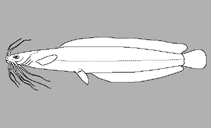 No image available for this species;
drawing shows typical species in Clariidae.
Изображение на Google
drawing shows typical species in Clariidae.
Классификация / Имена народные названия | синонимы | Catalog of Fishes(род, виды) | ITIS | CoL | WoRMS | Cloffa
> Siluriformes (Catfishes) > Clariidae (Airbreathing catfishes)
Etymology: Horaglanis: Taken from mister S.L.Hora, director of Zoological Survey of India + Latin, glanis = a cat fish (Ref. 45335); populi: Name 'populi' from the Latin words 'populus', meaning 'people', in honor of the invaluable contributions made by interested members of the public in the southern Indian state of Kerala in documenting the biodiversity of subterranean and groundwater systems, including this novel species.
Eponymy: Dr Sunder Lal Hora (1896–1955) was a distinguished Indian ichthyologist and biologist who held a doctorate in science from both the Punjab University (1922) and Edinburgh University (1928), having studied for his master’s at the Government College, [...] (Ref. 128868), visit book page.
Etymology: Horaglanis: Taken from mister S.L.Hora, director of Zoological Survey of India + Latin, glanis = a cat fish (Ref. 45335); populi: Name 'populi' from the Latin words 'populus', meaning 'people', in honor of the invaluable contributions made by interested members of the public in the southern Indian state of Kerala in documenting the biodiversity of subterranean and groundwater systems, including this novel species.
Eponymy: Dr Sunder Lal Hora (1896–1955) was a distinguished Indian ichthyologist and biologist who held a doctorate in science from both the Punjab University (1922) and Edinburgh University (1928), having studied for his master’s at the Government College, [...] (Ref. 128868), visit book page.
Окружающая среда: среда / климатическая зона / пределы глубины / диапазон распространения экология
; пресноводный демерсальный. Tropical
распространение Территории | регионы FAO | Экосистемы | места находок | карта точек | интродукции | Faunafri
Asia: India.
Размер / Вес / Возраст
Краткое описание определительные ключи | морфология | морфометрия
This species is distinguished from its congeners by the following set of characters: body elongated, round in cross section anteriorly, laterally compressed posteriorly, dorsal profile slightly convex to start of dorsal fin, straight more posteriorly; ventral profile convex in head region, then straight posteriorly; head large, 15.7-20.4% standard length, with dorsally and laterally bulging adductor muscles; snout truncated; mouth wide, terminal; absence of eye; 4 pairs of barbels; 2 mandibular, 1 maxillary and 1 nasal barbel pair; nasal and inner mandibular barbels shorter than maxillary and outer mandibular barbels; maxillary and outer mandibular barbels reaching posterior border of pectoral fins when folded back; large gill opening, extending to slightly above pectoral-fin base; gill membranes united with isthmus; absence of scales; caudal peduncle laterally compressed, 9.3-16.9% of standard length; dorsal fin long, with 22-23 soft rays (xiii-xiv unbranched/8-9 branched), originating in advance of pelvic fin origin; anal fin long, with xiii-xvii unbranched rays, starting opposite dorsal fin ray number 9, ending opposite base of last dorsal fin ray; pectoral fin vestigial, consisting only of modified pectoral fin spine covered by thickened skin; pelvic fin short, wide, with rounded margin, with ii-iv unbranched and 2-4 branched rays; caudal fin with rounded posterior margin, with 8-9 branched and 2-4 dorsal unbranched and 2-4 ventral unbranched rays; head skeleton well ossified; neurocranium with a single large cranial fontanelle, no epiphyseal bridge connecting frontals in dorsal midline; lateral neurocranium wall with large trigeminofacial foramen; supraoccipital with long, narrow and pointed crest; opercle small and subtriangular; and jaws massive, dentary and premaxilla studded with numerous rows of closely set, recurved villiform teeth (Ref. 137782).
Body shape (shape guide): elongated; Cross section: circular.
Body shape (shape guide): elongated; Cross section: circular.
Жизненный цикл и брачное поведение половая зрелость | размножение | нерест | икра | Плодовитость | личинки
Основная ссылка
Загрузите свои рекомендации | ссылки | координатор | соавторы
Raghavan, R., R.L. Sundar, C.P. Arjun, R. Britz and N. Dahanukar, 2023. Evolution in the dark: Unexpected genetic diversity and morphological stasis in the blind, aquifer-dwelling catfish Horaglanis. Vertebrate Zoology 73:57-74. (Ref. 137782)
CITES
Not Evaluated
Угроза для людей
Harmless
Использование человеком
рыболовство: интереса не представляет
FAO - Publication: search | FishSource |
дополнительная информация
Трофическая экология
Пищевые предметы (добыча)
состав пищи
потребление пищи
Продовольственные пайки
хищники
Пищевые предметы (добыча)
состав пищи
потребление пищи
Продовольственные пайки
хищники
экология
экология
экология
Динамика численности населения
Параметры роста
Макс. возраст / размер
Отношение длины к весу.
Отношение длины к длине.
Размерный состав
Преобразование массы
пополнение
численность
Параметры роста
Макс. возраст / размер
Отношение длины к весу.
Отношение длины к длине.
Размерный состав
Преобразование массы
пополнение
численность
Жизненный цикл
размножение
половая зрелость
Зрелость/Жиры относительно.
Плодовитость
нерест
Нерестовые скопления
икра
Развитие икры
личинки
динамика численности личинок
размножение
половая зрелость
Зрелость/Жиры относительно.
Плодовитость
нерест
Нерестовые скопления
икра
Развитие икры
личинки
динамика численности личинок
Анатомия
жаберная область
Мозг
Отолит
жаберная область
Мозг
Отолит
Физиология
Состав тела
Питательные вещества
Потребление кислорода
Тип плавания
Скорость плавания
Зрительные пигменты
Звук рыбы
Болезни и паразиты
Токсичность (LC50s)
Состав тела
Питательные вещества
Потребление кислорода
Тип плавания
Скорость плавания
Зрительные пигменты
Звук рыбы
Болезни и паразиты
Токсичность (LC50s)
генетика
Геном
генетика
Гетерозиготность
наследуемость
Генетическое разнообразие
Геном
генетика
Гетерозиготность
наследуемость
Генетическое разнообразие
Связанные с человеком
Системы аквакультуры
особенности рыбоводства
степень растяжения
Случаи заболевания сигуатерой
Марки, монеты и прочее.
Системы аквакультуры
особенности рыбоводства
степень растяжения
Случаи заболевания сигуатерой
Марки, монеты и прочее.
инструменты
Специальные отчеты
Проверить содержание в аквариумах | Проверить опубликованные видовые данные | Проверить опубликованные данные по аквакультуре
Скачать в формате XML
ресурсы в Интернет
AFORO (otoliths) | Aquatic Commons | BHL | Cloffa | Websites from users | Проверить FishWatcher | CISTI | Catalog of Fishes: род, виды | DiscoverLife | ECOTOX | FAO - Publication: search | Faunafri | Fishipedia | Fishtrace | GloBI | Google Books | Google Scholar | Google | IGFA World Record | OneZoom | Open Tree of Life | Otolith Atlas of Taiwan Fishes | PubMed | Reef Life Survey | Socotra Atlas | TreeBase | Tree of Life | Wikipedia: Вперёд, поиск | World Records Freshwater Fishing | Zoobank | Зоологическая летопись
Оценки, основанные на моделях
Индекс филогенетического разнообразия (ссылка 82804): PD50 = 0.5625 [Uniqueness, from 0.5 = low to 2.0 = high].
Bayesian length-weight: a=0.00741 (0.00344 - 0.01597), b=2.97 (2.79 - 3.15), in cm total length, based on LWR estimates for this (Sub)family-body shape (Ref. 93245).
Трофический уровень (ссылка 69278): 3.1 ±0.6 se; based on size and trophs of closest relatives
устойчивость к внешним воздействиям (ссылка 120179): высокий, минимальное время удвоения популяции до 15 месяцев (Preliminary K or Fecundity.).