



Stalix albonotata Wada, Suzuki, Kobayashi & Senou, 2025
Snowflake jawfish
Uploaden van uw Foto's en video's
Google afbeelding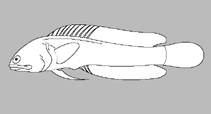 No image available for this species;
drawing shows typical species in Opistognathidae.
Google afbeelding
drawing shows typical species in Opistognathidae.
Classificatie / Namen Lokale namen | Synoniemen | Catalog of Fishes(Genus, Soort(en)) | ITIS | CoL | WoRMS | Cloffa
> Ovalentaria/misc (Various families in series Ovalentaria) > Opistognathidae (Jawfishes)
Etymology: Stalix: Greek, stalix, -ikos = a stake used for holding nets (Ref. 45335); albonotata: Named for the fine white vermiculation on the body and the irregular white blotches on the dorsal fin of this species.
Etymology: Stalix: Greek, stalix, -ikos = a stake used for holding nets (Ref. 45335); albonotata: Named for the fine white vermiculation on the body and the irregular white blotches on the dorsal fin of this species.
Milieu: milieu / Klimaatzone / Diepte / verspreidingsgebied Ecologie
marien rifbewoner; diepte 7 - 18 m (Ref. 137491). Temperate
Verspreiding Gebieden | FAO regio's | Ecosystemen | Voorkomen | Verspreidingskaart | Introducties | Faunafri
Northwest Pacific: Japan (Ryukyu Is.).
Grootte / Gewicht / Leeftijd
Korte beschrijving Determinatiesleutels | Morfologie | Morfometrie
Dorsale stekels (totaal) : 11; Dorsale zachte stralen (totaal) : 11; Anale stekels: 2; Anale zachte stralen: 11. This species is distinguished by the following characters: D 11; pectoral fin 22-23; longitudinal scale rows 45-46; gill rakers on first gill arch of adults 15-16 + 25-26 = 40-42; orbit diameter 10.0-10.4 % of SL; sensory pores 2 (I4 and I5) present on the posterior half of the interorbital space; first 2 mandibular pores (M1 and M2) well-spaced, fifth pore (M5) with single opening;
lateral line terminating below the 2nd or 3rd dorsal-fin soft ray base (dorsal fin element 13 or 14); distal incision of 3rd to 5th dorsal-fin spines is moderate; anteroventral margin of upper lip crenulate. Colouration: body grayish-yellow, with fine brown and white vermiculations; lateral surface of the head grayish green, with rough gray vermiculation; dorsal-fin membrane is grayish-yellow, with several irregular white blotches when fresh; anterior gular region not pigmented (chin and area adjacent to anterior two mandibular pores with a few scattered melanophores (Ref. 137491).
Body shape (shape guide): elongated; Cross section: compressed.
Body shape (shape guide): elongated; Cross section: compressed.
Specimens were collected by handnet in an inner bay of the type locality with silty sand bottom. The paratype was also observed with five gobioids, Myersina nigrivirgata, Oplopomus oplopomus, Oxyurichthys papuensis, Taenioides kentalleni, and unidentified Tomiyamichthys species (Ref. 137491).
Levenscyclus en paargedrag Maturiteit | Voortplanting | Paaien | Eieren | Fecunditeit | Larven
Hoofdreferentie
Upload uw referenties | Referenties | Coördinator | Medewerkers
Wada, H., T. Kobayashi, H. Suzuki and H. Senou, 2025. Two new jawfishes, Stalix albonotata sp. nov. and S. yanoi sp. nov., from the Ryukyu Islands, Japan (Perciformes: Opistognathidae). Bull. of the Kanagawa Prefectural Mus. (Natural Science) (54):205-217, (Ref. 137491)
CITES
Not Evaluated
Gevaar voor de mens
Harmless
Gebruik door de mens
Visserij: van geen belang
FAO - Publication: search | FishSource |
Meer informatie
Trofische ecologie
Voedsel (prooien)
Dieetsamenstelling
Voedselconsumptie
Voedselrantsoenen
Predatoren
Voedsel (prooien)
Dieetsamenstelling
Voedselconsumptie
Voedselrantsoenen
Predatoren
Ecologie
Ecologie
Ecologie
Populatiedynamica
Groeiparameters
Max. leeftijden / maten
Lengte-gewicht rel.
Lengte-lengte rel.
Lengtefrequenties
Massaconversie
Rekrutering
Abundantie
Groeiparameters
Max. leeftijden / maten
Lengte-gewicht rel.
Lengte-lengte rel.
Lengtefrequenties
Massaconversie
Rekrutering
Abundantie
Levenscyclus
Voortplanting
Maturiteit
Rijpheid/kieuwen rel.
Fecunditeit
Paaien
Paaibestanden
Eieren
Ontwikkeling van de eieren
Larven
Larvale populatiedynamiek
Voortplanting
Maturiteit
Rijpheid/kieuwen rel.
Fecunditeit
Paaien
Paaibestanden
Eieren
Ontwikkeling van de eieren
Larven
Larvale populatiedynamiek
Anatomie
Kieuwoppervlak
Hersenen
Otoliet
Kieuwoppervlak
Hersenen
Otoliet
Fysiologie
Lichaamssamenstelling
Voedingsstoffen
Zuurstofverbruik
Type zwemmen
Zwemsnelheid
Visuele pigmenten
Vis geluid
Ziekten en parasieten
Toxiciteit (LC50)
Lichaamssamenstelling
Voedingsstoffen
Zuurstofverbruik
Type zwemmen
Zwemsnelheid
Visuele pigmenten
Vis geluid
Ziekten en parasieten
Toxiciteit (LC50)
Genetica
genoom
Genetica
Heterozygositeit
Erfelijkheid
Genetische diversiteit
genoom
Genetica
Heterozygositeit
Erfelijkheid
Genetische diversiteit
Menselijk gerelateerd
Aquacultuursystemen
Aquacultuurprofielen
Kweeklijnen
Ciguatera gevallen
Postzegels, munten, diversen.
Aquacultuursystemen
Aquacultuurprofielen
Kweeklijnen
Ciguatera gevallen
Postzegels, munten, diversen.
Tools
Speciale rapporten
Bekijk gegevens voor het houden in een aquarium | Bekijk Fact Sheets voor de soort | Bekijk Aquacultuur Fact Sheets
Download XML
Internetbronnen
AFORO (otoliths) | Aquatic Commons | BHL | Cloffa | Websites from users | Bekijk FishWatcher | CISTI | Catalog of Fishes: Genus, Soort(en) | DiscoverLife | ECOTOX | FAO - Publication: search | Faunafri | Fishipedia | Fishtrace | GloBI | Google Books | Google Scholar | Google | IGFA World Record | OneZoom | Open Tree of Life | Otolith Atlas of Taiwan Fishes | PubMed | Reef Life Survey | Socotra Atlas | TreeBase | Tree of Life | Wikipedia: ga naar, zoek | World Records Freshwater Fishing | Zoobank | Zoological Record
Schattingen op basis van modellen
Fylogenetische diversiteitsindex (Ref. 82804): PD50 = 0.5001 [Uniqueness, from 0.5 = low to 2.0 = high].
Bayesian length-weight: a=0.00389 (0.00180 - 0.00842), b=3.12 (2.94 - 3.30), in cm total length, based on all LWR estimates for this body shape (Ref. 93245).
Trofisch niveau (Ref. 69278): 3.2 ±0.5 se; based on size and trophs of closest relatives