



Ladda upp din foton och Videor
Google image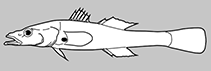 No image available for this species;
drawing shows typical species in Butidae.
Google image
drawing shows typical species in Butidae.
Klassificering / Namn Populärnamn | synonymer | Catalog of Fishes(Släkte, Arter) | ITIS | CoL | WoRMS | Cloffa
> Gobiiformes (Gobies) > Butidae (Gudgeon gobies)
Etymology: Ophiocara: Greek, ophis = serpent + Greek, kara = face (Ref. 45335); gigas: Name 'gigas' refers to the adult maximum size in this species, being greater than those of congeners.
Etymology: Ophiocara: Greek, ophis = serpent + Greek, kara = face (Ref. 45335); gigas: Name 'gigas' refers to the adult maximum size in this species, being greater than those of congeners.
Miljö: miljö / Klimatzon / djupintervall / distributionsområde Ekologi
marina; sötvatten; brackvatten bottenlevande; amfidrom (Ref. 133165). Subtropical
Utbredning Territorier | FAO områden | Ekosystem | Förekomster | Prickkarta | Utplanteringar | Faunafri
West Pacific: Japan (Ryukyu Archipelago), the Philippines, Palau, Micronesia, Indonesia, the Solomon Islands, Fiji, Vanuatu, and New Caledonia; including Papua New Guinea (New Ireland).
Storlek / Vikt / Ålder
Könsmognad: Lm ? range ? - ? cm
Max length : 13.7 cm SL hane/ej könsbestämd; (Ref. 133165); 13.5 cm SL (female)
Max length : 13.7 cm SL hane/ej könsbestämd; (Ref. 133165); 13.5 cm SL (female)
Kort beskrivning Bestämningsnycklar | Morfologi | Morfometri
Taggstrålar i ryggfenan (totalt) : 7; Mjukstrålar i ryggfenan (totalt) : 7; Taggstrålar i analfenan: 1; Mjukstrålar i analfenan: 7 - 8; Ryggkotor: 25 - 26. This species is distinguished from its congeners by the following set of characters: longitudinal row scales 32-36; predorsal scales 21-26; snout length 10.3-12.0% of SL; upper jaw length 13.6-16.2% of SL; pectoral fin length in young specimens (< 97.7 mm SL) 25.0-27.6% of SL; caudal fin length 28.3-36.7% of SL; opercular scales cycloid; infraorbital neuromast rows from the eye are usually seven. Colouration: trunk with two beige oblique bands; dorsal and caudal fins with dark brown spots; juveniles with white or light brown markings on middle and ventral parts of caudal fin base (Ref. 133165).
Body shape (shape guide): fusiform / normal; Cross section: oval.
Body shape (shape guide): fusiform / normal; Cross section: oval.
Often collected from lower freshwater streams and tidal estuaries in mangrove forests, especially near the upper limits of estuary reaches with freshwater inflow and low salinity (0-14‰, 3 sites). The adults and juveniles were usually found on emergent plants in daytime, motionless near riverbanks at night, with the latter also occurring in tide pools with muddy or gravel bottoms. Associated with other amphidromous eleotrids, Eleotris fusca and Giuris tolsoni, inhabiting the same site. Also often observed with Eleotris acanthopomus and Redigobius bikolanus. Consumed in Japan (Ref. 133165).
Livscykel och parningsbeteende Könsmognad | Reproduktion | Lek | Ägg | Fekunditet | Larver
Huvudreferens
Ladda upp dina referenser | referenser | Koordinator | Medarbetare
Kobayashi, H. and M. Sato, 2023. The genus Ophiocara (Teleostei: Butidae) in Japan, with descriptions of two new species. Ichthyol. Res. 71(1):119-153. (Ref. 133165)
Status på IUCN:s rödlista (Ref. 130435: Version 2025-2 (Global))
Least Concern (LC) ; Date assessed: 18 March 2024
CITES
Not Evaluated
Hot mot människor
Harmless
Mänskliga användningsområden
Fiskeri: kommersiell
FAO - Publication: search | FishSource |
Ytterligare information
Trofisk ekologi
Livsmedelsartiklar (preys)
Födosammansättning
Födointag
Matransoner
Predatorer
Livsmedelsartiklar (preys)
Födosammansättning
Födointag
Matransoner
Predatorer
Ekologi
Ekologi
Ekologi
Populationsdynamik
Tillväxtparametrar
Max. åldrar / storlekar
Längd-vikt rel.
Längd-längd rel.
Längd-frekvenser
Massakonvertering
Rekrytering
Abundans
Tillväxtparametrar
Max. åldrar / storlekar
Längd-vikt rel.
Längd-längd rel.
Längd-frekvenser
Massakonvertering
Rekrytering
Abundans
Livscykel
Reproduktion
Könsmognad
Mognad/Gills rel.
Fekunditet
Lek
Lekande aggregat
Ägg
Utveckling av ägg
Larver
Larvdynamik
Reproduktion
Könsmognad
Mognad/Gills rel.
Fekunditet
Lek
Lekande aggregat
Ägg
Utveckling av ägg
Larver
Larvdynamik
Anatomi
Gälyta
Hjärna
Otolit
Gälyta
Hjärna
Otolit
Fysiologi
Kroppssammansättning
Näringsämnen
Syreförbrukning
Typ av simning
Simhastighet
Visuella pigment
Ljud från fisk
Sjukdomar & Parasiter
Toxicitet (LC50)
Kroppssammansättning
Näringsämnen
Syreförbrukning
Typ av simning
Simhastighet
Visuella pigment
Ljud från fisk
Sjukdomar & Parasiter
Toxicitet (LC50)
Genetik
Genom
Genetik
Heterozygositet
Ärftlighet
Genetisk mångfald
Genom
Genetik
Heterozygositet
Ärftlighet
Genetisk mångfald
Människorelaterad
Vattenbrukssystem
Vattenbruksprofiler
Avelslinjer
Ciguatera-fall
Frimärken, mynt, diverse.
Vattenbrukssystem
Vattenbruksprofiler
Avelslinjer
Ciguatera-fall
Frimärken, mynt, diverse.
Verktyg
Särskilda rapporter
Kontrollera för underhåll av akvarium | Kontrollera om det finns faktablad om arter | Kontrollera om det finns faktablad om vattenbruk
Ladda ner XML
Internet-källor
AFORO (otoliths) | Aquatic Commons | BHL | Cloffa | Websites from users | Check FishWatcher | CISTI | Catalog of Fishes: Släkte, Arter | DiscoverLife | ECOTOX | FAO - Publication: search | Faunafri | Fishipedia | Fishtrace | GloBI | Google Books | Google Scholar | Google | IGFA World Record | OneZoom | Open Tree of Life | Otolith Atlas of Taiwan Fishes | PubMed | Reef Life Survey | Socotra Atlas | TreeBase | Tree of Life | Wikipedia: Go, sök | World Records Freshwater Fishing | Zoobank | Zoologiskt register
Uppskattningar baserade på modeller
Index för fylogenetisk mångfald (Ref. 82804): PD50 = 0.5156 [Uniqueness, from 0.5 = low to 2.0 = high].
Bayesian length-weight: a=0.00933 (0.00414 - 0.02103), b=3.06 (2.86 - 3.26), in cm total length, based on LWR estimates for this (Sub)family-body shape (Ref. 93245).
Trofisk nivå (Ref. 69278): 3.8 ±0.6 se; based on size and trophs of closest relatives
Resiliens (Ref. 120179): Hög, lägsta populationsfördubblingstid mindre än 15 månader (Preliminary K or Fecundity.).