



Cyprinella leptocheilus Tracy, Rohde & Jenkins, 2024
Siouan thinlip chub
Carregue seu(sua) Fotos e vídeos
Imagem do Google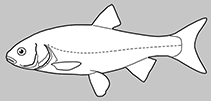 No image available for this species;
drawing shows typical species in Leuciscidae.
Imagem do Google
drawing shows typical species in Leuciscidae.
Classificação / Nomes Nomes comuns | Sinônimos | Catalog of Fishes(Gênero, Espécies) | ITIS | CoL | WoRMS | Cloffa
> Cypriniformes (Carps) > Leuciscidae (Minnows) > Pogonichthyinae
Etymology: Cyprinella: Latin, cyprinus = carp (Ref. 45335); leptocheilus: Name from Greek 'leptocheilus', combination of 'leptós' (Greek λεπτός), meaning fine or thin and 'cheilus' from cheíl̄os (Greek χεῖλος), for thin lip; this was proposed by Drs. Robert E. Jenkins and Ernest A. Lachner in the early 1970s.
Etymology: Cyprinella: Latin, cyprinus = carp (Ref. 45335); leptocheilus: Name from Greek 'leptocheilus', combination of 'leptós' (Greek λεπτός), meaning fine or thin and 'cheilus' from cheíl̄os (Greek χεῖλος), for thin lip; this was proposed by Drs. Robert E. Jenkins and Ernest A. Lachner in the early 1970s.
Meio ambiente: milieu / Zona climática / intervalo de profundidade / faixa de distribuição Ecologia
; Água doce bentopelágico; intervalo de profundidade 1 - 3 m (Ref. 132547). Subtropical
Distribuição Territórios | Áreas da FAO | Ecossistemas | Ocorrências | Mapa de pontos | Introduções | Faunafri
North America: USA.
Tamanho / Peso / Idade
Maturidade: Lm ? range ? - ? cm
Max length : 7.1 cm TL macho/indeterminado; (Ref. 132547); idade máx. registrada: 4 anos
Max length : 7.1 cm TL macho/indeterminado; (Ref. 132547); idade máx. registrada: 4 anos
Descrição suscinta Chaves de identificação | Morfologia | Morfometria
Raios dorsais (total) : 8; Raios anais : 8. This species is distinguished from its congeners except C. labrosa and C. zanema by the following characters: with maxillary barbels; differs from labrosa the number of modally 40 lateral-line scales (vs. 37), no dark blotches or cross hatching on back and side (vs. small, dark blotches and cross hatching on back and side), no white spot at anterior base of dorsal fin (vs. white spot present), side of body well pigmented below lateral line (vs. minimal pigmentation), with a line drawn from the posterior corner of the upper lip, immediately anterior to the barbel, extending vertically posterior to the anterior edge of the bony orbit (line drawn from the posterior corner of the upper lip, immediately anterior to the barbel, extending vertically anterior to the anterior edge of the bony orbit: differs from zanema by having the dorsal-fin origin positioned modally 1.5 scales posterior to the pelvic-fin origin (vs. positioned modally 2.5 scales posterior to the pelvic-fin origin0 with mean upper lip width at midpoint 2.1% of head length (vs. 3.5% of HL), mean upper lip width at midline 2.9% of HL (vs. 4.1% ofHL), mean maxillary barbel length 3.5% of HL (vs. 8.0% of HL) (Ref. 132547).
Cross section: oval.
Cross section: oval.
This species prefers shallow pool areas of medium-sized, from clear to turbid to tannin-stained to dark blackwater, warm water creeks and rivers with moderate velocity, over clean, sandy and gravelly substrates. Usually form schools near stumps or other cover but can also be found mid-channel. In the Lynches River, this fish was reported to have been taken over gravel-bottom riffles and more commonly, in sand-bottom runs. In the Lumber and Black rivers, schools were observed moving along the edges of sandbars, also in sand-bottomed runs. In the Lower Little River (Cape Fear River basin) in late July to mid-August 2021, it was found in low specific conductance waters, 25–50 μS/cm . It has also been observed in the Lynches River in moderately swift current, mid-stream, over a sandy substrate at a depth of 1-3 ft; and associated with C. nivea, C. pyrrhomelas, and Notropis scepticus. In other collections over the years from the Lynches River, it has been collected alongside Alburnops petersoni, C. analostana, Hybognathus regius, Miniellus procne, N. leptocephalus, Notemigonus crysoleucas, Notropis amoenus, Pteronotropis cummingsae and in the Black River with A. petersoni, C. nivea, H. regius, and N. amoenus. Stomach contents of this fish from the Lynches River in May 1996 contained primarily dipteran larvae; mayfly and stonefly nymphs and caddisfly larvae were of minor importance. Reported maximum longevity is estimated to be four years (Ref. 132547).
Ciclo de vida ou comportamento de acasalamento Maturidade | Reprodução | Desova | Ovos | Fecundidade | Larvas
Referência principal
Carregar suas referências | Referências | Coordenador | Colaboradores
Tracy, B. H., F.C. Rohde, M.A. Perkins, L.M. Lee, K.B. Carlson, M. McCutcheon, Jones. B.K. and H.K. Evans, 2024. A long-recognized but undescribed new species of Cyprinella (Cypriniformes: Leuciscidae) from North Carolina and South Carolina, United States. Southeastern Fisheries Council Proceedings 1(64):35-76. (Ref. 132547)
CITES
Not Evaluated
Ameaça para os humanos
Harmless
Uso pelos humanos
FAO - Publication: search | FishSource |
Mais informação
Ecologia Trófica
Itens alimentares (presas)
Composição da dieta
Consumo alimentar
Rações alimentares
Predadores
Itens alimentares (presas)
Composição da dieta
Consumo alimentar
Rações alimentares
Predadores
Ecologia
Ecologia
Ecologia
Dinâmica populacional
Parâmetros de crescimento
Idade máxima / tamanhos
Relação comprimento-peso.
Relação comprimento-comprimento.
Frequências de comprimento
Conversão de massa
Recrutamento
Abundância
Parâmetros de crescimento
Idade máxima / tamanhos
Relação comprimento-peso.
Relação comprimento-comprimento.
Frequências de comprimento
Conversão de massa
Recrutamento
Abundância
Ciclo de vida
Reprodução
Maturidade
Maturidade/Rel. das guelras
Fecundidade
Desova
Agregações de desova
Ovos
Desenvolvimento dos ovos
Larvas
Dinâmica larval
Reprodução
Maturidade
Maturidade/Rel. das guelras
Fecundidade
Desova
Agregações de desova
Ovos
Desenvolvimento dos ovos
Larvas
Dinâmica larval
Anatomia
Área branquial
Cérebro
Otólito
Área branquial
Cérebro
Otólito
Fisiologia
Composição corporal
Nutrientes
Consumo de oxigênio
Tipo de natação
Velocidade de natação
Pigmentos visuais
Som de peixe
Doenças e Parasitas
Toxicidade (LC50s)
Composição corporal
Nutrientes
Consumo de oxigênio
Tipo de natação
Velocidade de natação
Pigmentos visuais
Som de peixe
Doenças e Parasitas
Toxicidade (LC50s)
Genética
genoma
Genética
Heterozigosidade
Hereditariedade
Diversidade genética
genoma
Genética
Heterozigosidade
Hereditariedade
Diversidade genética
Relacionado a humanos
Sistemas de aquicultura
Perfis para aquacultura
Estirpes
Casos de Ciguatera
Selos, moedas, diversos.
Sistemas de aquicultura
Perfis para aquacultura
Estirpes
Casos de Ciguatera
Selos, moedas, diversos.
Ferramentas
Livro eletrônico | Guia de campo | Ferramenta auxiliar de frequências de comprimento | Ferramenta sobre a história de vida | Mapa de pontos |
Catch-MSY |
Relatórios especiais
Checar Manutenção em Aquário | Checar Planilhas de Fatos sobre as Espécies | Checar Planilhas de Fatos sobre Aquicultura
Baixar XML
Fontes da internet
AFORO (otoliths) | Aquatic Commons | BHL | Cloffa | Websites from users | Checar Observador de Peixes (FishWatcher) | CISTI | Catalog of Fishes: Gênero, Espécies | DiscoverLife | ECOTOX | FAO - Publication: search | Faunafri | Fishipedia | Fishtrace | GloBI | Google Books | Google Scholar | Google | IGFA World Record | OneZoom | Open Tree of Life | Otolith Atlas of Taiwan Fishes | PubMed | Reef Life Survey | Socotra Atlas | TreeBase | Árvore da vida | Wikipedia: Ir para, procura | World Records Freshwater Fishing | Zoobank | Registro zoológico
Estimativas baseadas em modelos
Índice de diversidade filogenética (Ref. 82804): PD50 = 0.5000 [Uniqueness, from 0.5 = low to 2.0 = high].
Bayesian length-weight: a=0.00537 (0.00266 - 0.01086), b=3.10 (2.92 - 3.28), in cm total length, based on LWR estimates for this (Sub)family-body shape (Ref. 93245).
Nível Trófico (Ref. 69278): 3.1 ±0.4 se; based on size and trophs of closest relatives
Resiliência (Ref. 120179): Elevada, tempo mínimo de duplicação da população menor que 15 meses (Preliminary K or Fecundity.).