>
Perciformes/Notothenioidei (Icefishes) >
Nototheniidae (Cod icefishes) > Nototheniinae
Etymology: Paranotothenia: Greek, para = near + Greek, noton = back + Greek, adverbial particle, then, that denotes distance or removal (Ref. 45335); magellanica: magellanica for the straits of Magellan, the type locality (Ref. 11892).
More on author: Forster.
Environment: milieu / climate zone / Tiefenbereich / distribution range
Ökologie
seewasser pelagic-oceanic; tiefenbereich 0 - 255 m (Ref. 11892), usually 0 - 20 m (Ref. 11892). Temperate; 43°S - 78°S
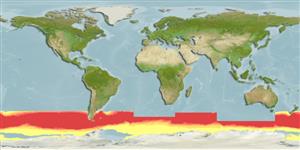
Southern Ocean: southern tip of South America. Also found in Falkland, South Georgia, South Orkney, South Shetland, Prince Edward, Crozet, Kerguelen, Heard and Macquarie islands, southern New Zealand and associated islands, rarely in the Ross Sea. New Zealand and Argentina (Patagonia) (Ref. 4537)
Size / Gewicht / Alter
Geschlechtsreife: Lm ? range ? - ? cm
Max length : 43.0 cm TL Männchen/unbestimmt; (Ref. 124534); max. veröff. Gewicht: 1.5 kg (Ref. 124534)
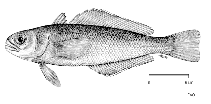
Rückenflossenstacheln (insgesamt) : 3 - 6; Rückenflossenweichstrahlen (insgesamt) : 28 - 31; Afterflossenweichstrahlen: 22 - 25. Greyish olive above, yellowish below. Pug-nosed snout, well developed supraoccipital crest, highly sculptured cranial bones. Short jaw, the maxillary not reaching the orbit, and adults with pelagic coloration as well as large epurals (Ref. 11892). Upper lateral line with 36-48 tubular scales, total number of scales in upper and middle lateral lines 45-57; caudal peduncle longer than deep, 37.0-45.5% HL; preoperculo-mandibular canal not connected with the temporal canal; dorsal surface of head without prominent ridges; pelvic length much shorter than pectorals (Ref. 37311).
Body shape (shape guide): fusiform / normal.
Utilized as a food fish.
Dewitt, H.H., P.C. Heemstra and O. Gon, 1990. Nototheniidae. p. 279-331. In O. Gon and P.C. Heemstra (eds.) Fishes of the Southern Ocean. J.L.B. Smith Institute of Ichthyology, Grahamstown, South Africa. (Ref. 5179)
IUCN Rote Liste Status (Ref. 130435: Version 2025-1)
Bedrohung für Menschen
Harmless
Nutzung durch Menschen
Fischereien: kommerziell
Tools
Zusatzinformationen
Download XML
Internet Quellen
Estimates based on models
Preferred temperature (Ref.
123201): 3.4 - 10.8, mean 7.9 °C (based on 130 cells).
Phylogenetic diversity index (Ref.
82804): PD
50 = 0.7500 [Uniqueness, from 0.5 = low to 2.0 = high].
Bayesian length-weight: a=0.00692 (0.00410 - 0.01168), b=3.23 (3.08 - 3.38), in cm total length, based on LWR estimates for this species & (Sub)family-body (Ref.
93245).
Trophic level (Ref.
69278): 3.5 ±0.5 se; based on size and trophs of closest relatives
Generation time: 4.2 ( na - na) years. Estimated as median ln(3)/K based on 1
growth studies.
Widerstandsfähigkeit (Ref.
120179): mittel, Verdopplung der Population dauert 1,4 - 4,4 Jahre. (K=0.26; Fec > 10,000).
Fishing Vulnerability (Ref.
59153): Moderate vulnerability (40 of 100).
🛈
Nutrients (Ref.
124155): Calcium = 38.5 [21.9, 66.7] mg/100g; Iron = 0.43 [0.26, 0.70] mg/100g; Protein = 18.2 [16.8, 19.5] %; Omega3 = 0.724 [0.440, 1.207] g/100g; Selenium = 11.9 [6.1, 23.1] μg/100g; VitaminA = 16.5 [5.2, 52.5] μg/100g; Zinc = 0.645 [0.461, 0.919] mg/100g (wet weight);