Classification / Names
ชื่อสามัญ | ชื่อพ้อง | Catalog of Fishes(สกุล, ชนิด) | ITIS | CoL | WoRMS | Cloffa
>
Perciformes/Notothenioidei (Icefishes) >
Artedidraconidae (Barbled plunderfishes)
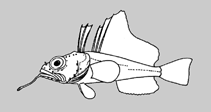
Etymology: Artedidraco: Petrus (Peter) Artedi, (10 Mar.) 1705-35 (28 Sep.), a son of a clergyman from Anundsjö named Olaus Arctaedius, in the northern part of Sweden.In 1729 he changed his name from Arctaedius to Arctædi, a name still later simplified to Artedi (Ref. 45335); longibarbatus: Name from Latin, 'longus' for long and 'barba' for beard, referring to the extremely long mental barbel of this species.
among the longest of any artedidraconid.
Environment: milieu / climate zone / ระดับความลึก / distribution range
นิเวศวิทยา
เกี่ยวกับทะเล,น้ำเค็ม สัตว์น้ำหน้าดิน. Temperate
Antarctica: Weddell Sea.
ขนาด / น้ำหนัก / Age
วัยเจริญพันธุ์: Lm ? range ? - ? cm
Max length : 7.5 cm SL (female)
Short description
เครื่องมือที่ใช้ในการแยกชนิดสัตว์,สิ่งมีชีวิตออกจากกัน | สัณฐานวิทยา | ความยาวต่างๆ
เงี่ยงครีบหลัง (รวม) : 3; ก้านครีบอ่อนที่หาง (รวม) : 26; ก้านครีบอ่อนที่ก้น: 16 - 17; สัตว์มีกระดูกสันหลัง: 37. This species is distinguished from its congeners by the following characters: with a very long, slender mental barbel (about 25-26 % SL, measurements from holotype and photograph of lost aboard ship specimen) vs. about 4-14 % SL (A. glareobarbatus has the second longest barbel, ranging from about 11-14 % SL and with an inconspicuous terminal expansion (14.7 % of
barbel length in holotype) composed of short, blunt processes; anal fin rays 16-17; second dorsal fin rays 26; vertebrae 37; tubular upper lateral-line scales 7-8 (Ref. 117898).
Cross section: oval.
Life cycle and mating behavior
วัยเจริญพันธุ์ | การสืบพันธุ์ | การวางไข่ | เซลสืบพันธ์ของเพศเมีย(ไข่) | ความดกของไข่ | ตัวอ่อน
Eakin, R.R., E. Riginella and M. La Mesa, 2015. A new species of Artedidraco (Pisces: Artedidraconidae) from the Weddell Sea, Antarctica. Polar. Biol. 38:1597-1603. (Ref. 117898)
IUCN Red List Status (Ref. 130435: Version 2025-1)
Threat to humans
Harmless
Human uses
เครื่องมือ
Special reports
Download XML
แหล่งที่มาจากอินเตอร์เน็ต
Estimates based on models
Phylogenetic diversity index (อ้างอิง
82804): PD
50 = 0.5312 [Uniqueness, from 0.5 = low to 2.0 = high].
Bayesian length-weight: a=0.00501 (0.00240 - 0.01046), b=3.13 (2.94 - 3.32), in cm total length, based on LWR estimates for this (Sub)family-body shape (Ref.
93245).
ระดับชั้นอาหาร (อ้างอิง
69278): 3.2 ±0.4 se; based on size and trophs of closest relatives
Fishing Vulnerability (Ref.
59153): Low vulnerability (10 of 100).
🛈