



Argolebias guarani AlonsoCalviñoTeránSerraMontesGarcíaBarnecheAlmirónCioteket al., 2023
Загрузить свой Фото и Видео
Изображение на Google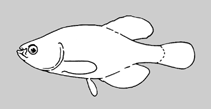 No image available for this species;
drawing shows typical species in Rivulidae.
Изображение на Google
drawing shows typical species in Rivulidae.
Классификация / Имена народные названия | синонимы | Catalog of Fishes(род, виды) | ITIS | CoL | WoRMS | Cloffa
> Cyprinodontiformes (Rivulines, killifishes and live bearers) > Rivulidae (Rivulines) > Cynolebiinae
Etymology: guarani: Named for the Guaraní indigenous people, who live in several settlements very close to the type locality of this species, as a vindication of their culture and history.
Etymology: guarani: Named for the Guaraní indigenous people, who live in several settlements very close to the type locality of this species, as a vindication of their culture and history.
Окружающая среда: среда / климатическая зона / пределы глубины / диапазон распространения экология
; пресноводный пелагический; пределы глубины 0 - 1 m (Ref. 129129). Tropical
распространение Территории | регионы FAO | Экосистемы | места находок | карта точек | интродукции | Faunafri
South America: Argentina.
Размер / Вес / Возраст
половая зрелость: Lm ? range ? - ? cm
Max length : 5.5 cm SL самец/пол неопределен; (Ref. 129129); 3.8 cm SL (female)
Max length : 5.5 cm SL самец/пол неопределен; (Ref. 129129); 3.8 cm SL (female)
Краткое описание определительные ключи | морфология | морфометрия
This species is distinguished from its congeners by having a unique colour pattern consisting of the following: mature males when alive with scattered small dark brown to grey irregular blotches on the laterodorsal surface of head and anterior portion of trunk, with many and relatively big sub-square irregular iridescent turquoise to light blue blotches on unpaired fins, evenly distributed, and those in the distal portion are elongated and merging, the trunk and tail with anterocentral part of scales iridescent turquoise with grey borders generating a reticulated pattern, the thin external border of the scales in the dorsal part of trunk, below the dorsal fin, are iridescent turquoise, and orange-yellowish background coloration on the base of unpaired fins and yellowish belly; in juveniles and young adults, anterior nostrils are ventrolaterally directed (Ref. 129129).
Body shape (shape guide): elongated; Cross section: compressed.
Body shape (shape guide): elongated; Cross section: compressed.
Found only in its type locality which is a seasonal pond, mainly covered with grass, in the Paraná Forest at ca.185 m a.s.l.. It is in an open space, in the surrounding jungle, with abundant palm trees. Maximum depth measured was ca. 80 cm, and the water was clear and no submerged aquatic vegetation was observed. The bottom is of soft sediment, with abundant organic
matter (Ref. 129129).
Жизненный цикл и брачное поведение половая зрелость | размножение | нерест | икра | Плодовитость | личинки
Основная ссылка
Загрузите свои рекомендации | ссылки | координатор : Costa, Wilson J.E.M. | соавторы
Alonso, F., G.E. Terán, W.S. Serra Alanís, P. Calviño, M.M. Montes, I.D. García, J.A. Barneche, A. Almirón, L. Ciotek, P. Giorgis and J. Casciotta, 2023. From the mud to the tree: phylogeny of Austrolebias killifishes, new generic structure and description of a new species (Cyprinodontiformes: Rivulidae). Zool. J. Linn. Soc. 199:280-309. (Ref. 129129)
CITES
Not Evaluated
Угроза для людей
Harmless
Использование человеком
рыболовство: интереса не представляет
FAO - Publication: search | FishSource |
дополнительная информация
Трофическая экология
Пищевые предметы (добыча)
состав пищи
потребление пищи
Продовольственные пайки
хищники
Пищевые предметы (добыча)
состав пищи
потребление пищи
Продовольственные пайки
хищники
экология
экология
экология
Динамика численности населения
Параметры роста
Макс. возраст / размер
Отношение длины к весу.
Отношение длины к длине.
Размерный состав
Преобразование массы
пополнение
численность
Параметры роста
Макс. возраст / размер
Отношение длины к весу.
Отношение длины к длине.
Размерный состав
Преобразование массы
пополнение
численность
Жизненный цикл
размножение
половая зрелость
Зрелость/Жиры относительно.
Плодовитость
нерест
Нерестовые скопления
икра
Развитие икры
личинки
динамика численности личинок
размножение
половая зрелость
Зрелость/Жиры относительно.
Плодовитость
нерест
Нерестовые скопления
икра
Развитие икры
личинки
динамика численности личинок
Анатомия
жаберная область
Мозг
Отолит
жаберная область
Мозг
Отолит
Физиология
Состав тела
Питательные вещества
Потребление кислорода
Тип плавания
Скорость плавания
Зрительные пигменты
Звук рыбы
Болезни и паразиты
Токсичность (LC50s)
Состав тела
Питательные вещества
Потребление кислорода
Тип плавания
Скорость плавания
Зрительные пигменты
Звук рыбы
Болезни и паразиты
Токсичность (LC50s)
генетика
Геном
генетика
Гетерозиготность
наследуемость
Генетическое разнообразие
Геном
генетика
Гетерозиготность
наследуемость
Генетическое разнообразие
Связанные с человеком
Системы аквакультуры
особенности рыбоводства
степень растяжения
Случаи заболевания сигуатерой
Марки, монеты и прочее.
Системы аквакультуры
особенности рыбоводства
степень растяжения
Случаи заболевания сигуатерой
Марки, монеты и прочее.
инструменты
Специальные отчеты
Проверить содержание в аквариумах | Проверить опубликованные видовые данные | Проверить опубликованные данные по аквакультуре
Скачать в формате XML
ресурсы в Интернет
AFORO (otoliths) | Aquatic Commons | BHL | Cloffa | Websites from users | Проверить FishWatcher | CISTI | Catalog of Fishes: род, виды | DiscoverLife | ECOTOX | FAO - Publication: search | Faunafri | Fishipedia | Fishtrace | GloBI | Google Books | Google Scholar | Google | IGFA World Record | OneZoom | Open Tree of Life | Otolith Atlas of Taiwan Fishes | PubMed | Reef Life Survey | Socotra Atlas | TreeBase | Tree of Life | Wikipedia: Вперёд, поиск | World Records Freshwater Fishing | Zoobank | Зоологическая летопись
Оценки, основанные на моделях
Индекс филогенетического разнообразия (ссылка 82804): PD50 = 0.5625 [Uniqueness, from 0.5 = low to 2.0 = high].
Bayesian length-weight: a=0.00617 (0.00266 - 0.01427), b=3.13 (2.93 - 3.33), in cm total length, based on LWR estimates for this (Sub)family-body shape (Ref. 93245).
Трофический уровень (ссылка 69278): 3.2 ±0.4 se; based on size and trophs of closest relatives
устойчивость к внешним воздействиям (ссылка 120179): высокий, минимальное время удвоения популяции до 15 месяцев (Preliminary K or Fecundity.).