This website uses cookies to enhance your browsing experience and ensure the functionality of our site. For more detailed information about the types of cookies we use and how we protect your privacy, please visit our Privacy Information page.
×
Cookie Settings
This website uses different types of cookies to enhance your experience. Please select your preferences below:
Western Atlantic: Puerto Rico to Brazil, through the Lesser Antilles in the Caribbean.
Tamaño / Peso / Edad
Madurez: Lm? range ? - ? cm Max length : 16.1 cm SL macho / no sexado; (Ref. 128874)
Descripción breve Claves de identificación | Morfología | Morfometría
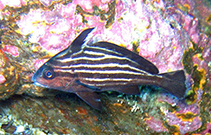
Espinas dorsales (total) : 10; Radios blandos dorsales (total) : 37 - 40; Espinas anales: 2; Radios blandos anales: 7. This species is distinguished from its congeners by the following characters: lateral-line scales 50-55; scales from lateral line to origin of dorsal fin 8-9 and from lateral line to first anal fin spine 9-10; chin with 5 pores. Colouration: adults brownish with 5-7 longitudinal, irregular white stripes thinner than dark ones and by without submarginal white stripe on soft dorsal fin; no dark bar between eyes in adults and without the wide, transverse dark bar from dorsal-fin origin almost to pelvic-fin base (Ref. 128874). Cross section: compressed.
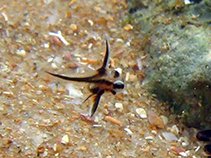
Occurs in rocky and coral reefs from one to about 100 meters deep, and usually between three and 30 meters. Juveniles of about the same age, often in groups of 3-7, were observed in very shallow water under ledges or near sand pockets close to reef crevices, The young are usually found in small groups of up to three individuals in 5-20 m, while adults are in groups of three to at least 25 individuals, among rocks, under ledges, inside caves and, at daylight, in the water column, mixing schools with fishes of similar size, such as haemulids. The species is mainly nocturnal, spending the day sheltered and feeding at night on sand, grass beds, mud, and rubble bottoms close to the reef, feeding on crustaceans, polychaetes, small bony fishes, zooplankton, and algae. In Aracaju, Sergipe, Brazil, a group of about 20 adults was observed cleaning and picking mucus or parasites off a large stingray, Hypanus berthalutzae, that stayed quietly at the bottom (Ref. 128874).
Ciclo vital y comportamiento de apareamiento Madurez | Reproducción | Puesta | Huevos | Fecundidad | Larva
Carvalho-Filho, A., C. Oliveira, L. Maximiano, J. Tavera, A.P. Acero and A.P. Marceniuk, 2022. Review of the Pareques acuminatus (Bloch & Schneider, 1801) species complex, with revalidation of Pareques lineatus (Cuvier, 1830) from the Western Atlantic (Percomorphacea: Sciaenidae). Zootaxa 5195(5):401-418. (Ref. 128874)
Situación en la Lista Roja de la UICN (Ref. 130435: Version 2025-2 (Global))
Dinámica de la población Coeficiente del crecimiento para Edades / tallas máximas Longitud-peso rel. Longitud-longitud rel. Longitud-frecuencias Conversión de masas Reclutamiento Abundancia
Ciclo de vida Reproducción Madurez Madurez/Gills rel. Fecundidad Puesta Agregaciones de desove Huevos Desarrollo de los huevos Larva Dinámica larvaria
Fisiología Composición corporal Nutrientes Consumo del oxígeno Tipo de natación Velocidad de natación Pigmentos visuales Sonido de peces Enfermedades y parásitos Toxicidad (CL50)
Índice de diversidad filogenética (Referencia 82804): PD50 = 0.5039 [Uniqueness, from 0.5 = low to 2.0 = high].
Bayesian length-weight: a=0.00871 (0.00427 - 0.01777), b=3.08 (2.91 - 3.25), in cm total length, based on LWR estimates for this (Sub)family-body shape (Ref. 93245).
Nivel trófico (Referencia 69278): 3.4 ±0.4 se; based on size and trophs of closest relatives
Resiliencia (Referencia 120179): Alto, población duplicada en un tiempo mínimo inferior a 15 meses (Preliminary K or Fecundity.).
Vulnerabilidad pesquera (Ref. 59153): Low vulnerability (10 of 100). 🛈