



Labeotropheus obscurus Phiri & Pauers, 2023
Ladda upp din foton och Videor
Google image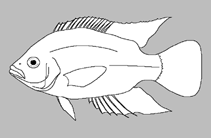 No image available for this species;
drawing shows typical species in Cichlidae.
Google image
drawing shows typical species in Cichlidae.
Klassificering / Namn Populärnamn | synonymer | Catalog of Fishes(Släkte, Arter) | ITIS | CoL | WoRMS | Cloffa
> Cichliformes (Cichlids, convict blennies) > Cichlidae (Cichlids) > Pseudocrenilabrinae
Etymology: Labeotropheus: Latin, labeo = one who has large lips + Greek, tropaion = defeat, a memorial of a fighting war, trophy; because of their specialized teeth were such an obvious feeding adaptation (Ref. 45335); obscurus: The specific epithet is the masculine form of the Latin adjective obscurus, meaning dark, dusky, or shadowy, in reference to the muted and mostly grey male nuptial colour pattern, which is unusual for a species of Labeotropheus (Ref. 128773).
Etymology: Labeotropheus: Latin, labeo = one who has large lips + Greek, tropaion = defeat, a memorial of a fighting war, trophy; because of their specialized teeth were such an obvious feeding adaptation (Ref. 45335); obscurus: The specific epithet is the masculine form of the Latin adjective obscurus, meaning dark, dusky, or shadowy, in reference to the muted and mostly grey male nuptial colour pattern, which is unusual for a species of Labeotropheus (Ref. 128773).
Miljö: miljö / Klimatzon / djupintervall / distributionsområde Ekologi
; sötvatten bentopelagisk. Tropical
Utbredning Territorier | FAO områden | Ekosystem | Förekomster | Prickkarta | Utplanteringar | Faunafri
Africa: Malawi.
Storlek / Vikt / Ålder
Kort beskrivning Bestämningsnycklar | Morfologi | Morfometri
Taggstrålar i ryggfenan (totalt) : 16 - 18; Mjukstrålar i ryggfenan (totalt) : 7 - 9; Taggstrålar i analfenan: 3; Mjukstrålar i analfenan: 7 - 8. Diagnosis: Labeotropheus obscurus differs from all other species of Labeotropheus due to the unusually drab and muted colouration of sexually mature males; male nuptial colour pattern dominated by grey and brown pigmentation, with some blue and orange highlights on scales and fins, as opposed to a nuptial colour pattern dominated by blue, orange, or red pigmentation (Ref. 128773). Labeotropheus obscurus differs from the slender-bodied Labeotropheus species, L. trewavasae, L. simoneae, and L. chirangali, but not L. rubidorsalis, due to its greater body depth, 35.2-41.5% of standard length vs. 26.3-33.4% in L. trewavasae, 26.9-30.8% in L. simoneae and 26.6-33.2% in L. chirangali; it typically has a greater body depth than L. rubidorsalis, although the ranges slightly overlap, 31.6-36.1% of standard length in L. rubidorsalis; overall, L. obscurus does have a deeper body than L. rubidorsalis as indicated by several other measurements akin to body depth, including the distance between the origin of the dorsal fin and the origin of the anal fin, 50.8-56.3% of standard length vs. 45.6-50.3%, the distance between the insertion of the dorsal fin and the insertion of the anal fin, 15.8-17.8% of standard length vs. 13.5-15.7%, the distance between the insertion of the dorsal fin and the origin of the anal fin, 30.3-33.2% of standard length vs. 27.6-30.3%, and the distance between the origin of the dorsal fin and the attachment of the pelvic fins, 35.4-40.5% of standard length vs. 31.5-35.4% (Ref. 128773). Labeotropheus obscurus has a distinctly larger eye diameter than several of the robust species of L.abeotropheus, 27.3-32.4% of head length vs. 23.7-26.6% in L. fuelleborni, 22.6-25.5% in L. chlorosiglos, and 24.9-27.5% in L. alticodia; it also has fewer rows of teeth in the upper jaw than all robust Labeotropheus except L. alticodia, 3-4 vs. 4-5 in L. fuelleborni, 5-7 in L. chlorosiglos, 5-8 in L. artatorostris, 4-6 in L. aurantinfra, and 4-6 in L. candipygia, and fewer teeth in the left side of the lower jaw, 20-26 vs. 31-43 in L. fuelleborni, 30-37 in L. chlorosiglos and 29-35 in L. alticodia (Ref. 128773).
Livscykel och parningsbeteende Könsmognad | Reproduktion | Lek | Ägg | Fekunditet | Larver
Huvudreferens
Ladda upp dina referenser | referenser | Koordinator : Kullander, Sven O. | Medarbetare
Pauers, M.J. and T.B. Phiri, 2023. Six new species of Labeotropheus (Cichliformes: Cichlidae) from the Malawian shore of Lake Malawi, Africa. Ichthyology & Herpetology 111(2):264-292. (Ref. 128773)
CITES
Not Evaluated
Hot mot människor
Harmless
Mänskliga användningsområden
Fiskeri: saknar intresse
FAO - Publication: search | FishSource |
Ytterligare information
Trofisk ekologi
Livsmedelsartiklar (preys)
Födosammansättning
Födointag
Matransoner
Predatorer
Livsmedelsartiklar (preys)
Födosammansättning
Födointag
Matransoner
Predatorer
Populationsdynamik
Tillväxtparametrar
Max. åldrar / storlekar
Längd-vikt rel.
Längd-längd rel.
Längd-frekvenser
Massakonvertering
Rekrytering
Abundans
Tillväxtparametrar
Max. åldrar / storlekar
Längd-vikt rel.
Längd-längd rel.
Längd-frekvenser
Massakonvertering
Rekrytering
Abundans
Livscykel
Reproduktion
Könsmognad
Mognad/Gills rel.
Fekunditet
Lek
Lekande aggregat
Ägg
Utveckling av ägg
Larver
Larvdynamik
Reproduktion
Könsmognad
Mognad/Gills rel.
Fekunditet
Lek
Lekande aggregat
Ägg
Utveckling av ägg
Larver
Larvdynamik
Anatomi
Gälyta
Hjärna
Otolit
Gälyta
Hjärna
Otolit
Fysiologi
Kroppssammansättning
Näringsämnen
Syreförbrukning
Typ av simning
Simhastighet
Visuella pigment
Ljud från fisk
Sjukdomar & Parasiter
Toxicitet (LC50)
Kroppssammansättning
Näringsämnen
Syreförbrukning
Typ av simning
Simhastighet
Visuella pigment
Ljud från fisk
Sjukdomar & Parasiter
Toxicitet (LC50)
Genetik
Genom
Genetik
Heterozygositet
Ärftlighet
Genetisk mångfald
Genom
Genetik
Heterozygositet
Ärftlighet
Genetisk mångfald
Människorelaterad
Vattenbrukssystem
Vattenbruksprofiler
Avelslinjer
Ciguatera-fall
Frimärken, mynt, diverse.
Vattenbrukssystem
Vattenbruksprofiler
Avelslinjer
Ciguatera-fall
Frimärken, mynt, diverse.
Verktyg
Särskilda rapporter
Kontrollera för underhåll av akvarium | Kontrollera om det finns faktablad om arter | Kontrollera om det finns faktablad om vattenbruk
Ladda ner XML
Internet-källor
AFORO (otoliths) | Aquatic Commons | BHL | Cloffa | Websites from users | Check FishWatcher | CISTI | Catalog of Fishes: Släkte, Arter | DiscoverLife | ECOTOX | FAO - Publication: search | Faunafri | Fishipedia | Fishtrace | GloBI | Google Books | Google Scholar | Google | IGFA World Record | OneZoom | Open Tree of Life | Otolith Atlas of Taiwan Fishes | PubMed | Reef Life Survey | Socotra Atlas | TreeBase | Tree of Life | Wikipedia: Go, sök | World Records Freshwater Fishing | Zoobank | Zoologiskt register
Uppskattningar baserade på modeller
Index för fylogenetisk mångfald (Ref. 82804): PD50 = 0.5005 [Uniqueness, from 0.5 = low to 2.0 = high].
Bayesian length-weight: a=0.01445 (0.00671 - 0.03113), b=2.99 (2.82 - 3.16), in cm total length, based on LWR estimates for this (Sub)family-body shape (Ref. 93245).
Trofisk nivå (Ref. 69278): 3.3 ±0.4 se; based on size and trophs of closest relatives
Resiliens (Ref. 120179): Hög, lägsta populationsfördubblingstid mindre än 15 månader (Preliminary K or Fecundity.).