



Labeotropheus aurantinfra Phiri & Pauers, 2023
分类 / 名称 俗名 | 同种异名 | Catalog of Fishes(属, 种) | ITIS | CoL | WoRMS | Cloffa
Teleostei > Cichliformes (Cichlids, convict blennies) 鱸形目 (Cichlids, convict blennies) > Cichlidae (Cichlids) 麗魚科 (Cichlids) > Pseudocrenilabrinae
Etymology: Labeotropheus: Latin, labeo = one who has large lips + Greek, tropaion = defeat, a memorial of a fighting war, trophy; because of their specialized teeth were such an obvious feeding adaptation (Ref. 45335); aurantinfra: The specific epithet is a composite of the Latin adjective aurantiacum, meaning orange coloured, and a second Latin adjective infra, meaning below or underneath; this is in reference to the unique male nuptial colour pattern, in which the ventrum, anterior abdomen, and branchiostegals feature orange colouration (Ref. 128773).
Etymology: Labeotropheus: Latin, labeo = one who has large lips + Greek, tropaion = defeat, a memorial of a fighting war, trophy; because of their specialized teeth were such an obvious feeding adaptation (Ref. 45335); aurantinfra: The specific epithet is a composite of the Latin adjective aurantiacum, meaning orange coloured, and a second Latin adjective infra, meaning below or underneath; this is in reference to the unique male nuptial colour pattern, in which the ventrum, anterior abdomen, and branchiostegals feature orange colouration (Ref. 128773).
环境:氛围 / 气候带 / 深度上下限 / 分布范围 生态学
; 淡水 底中水层性.
分布 领土 | FAO区域 | 生态系 | 标本纪录 | 分布图 | 简介 | Faunafri
Africa: Malawi.
大小 / 重量 / 年龄
简单描述 检索表 | 型态特徵 | 形态测量图
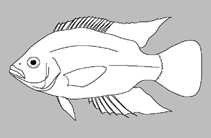
背棘 (总数) : 17 - 19; 背的软条 (总数) : 7 - 10; 臀棘: 3; 臀鳍软条: 7 - 9. Diagnosis: Labeotropheus aurantinfra differs from all other Labeotropheus due to the extensive distribution of orange pigmentation throughout the body, including the maxilla, the preopercular margin, the branchiostegals, the gular and anterior abdomen region, and the flanks; although orange pigmentation is more common and more extensive in males, it is also present in the same body regions in females (Ref. 128773). It differs from the slender-bodied Labeotropheus, L. trewavasae, L. simoneae, L. chirangali, but not L. rubidorsalis, due to its greater body depth, 33.8-41.5% of standard length vs. 26.3-33.4% in L. trewavasae, 26.9-30.8% in L. simoneae and 26.6-33.2% in L. chirangali; while L. aurantinfra does have a deeper body than L. rubidorsalis, the ranges overlap, 33.8-41.5% of standard length vs. 31.6-36.1%; Labeotropheus aurantinfra has a greater distance between the origin of the dorsal fin and the attachment of the pelvic fins, 33.4-40.4% of standard length vs. 31.5-35.4%, a shorter lower jaw, 22.5-31.6% of head length vs. 29.9-38.5%, more rows of teeth in the upper jaw, 4-6 vs. 3-4, and a greater total number of gillrakers, 10-15 vs. 9-11, than L. rubidorsalis (Ref. 128773). The primary distinction between L. aurantinfra and the other robust-bodied Labeotropheus is the unique distribution of yellow-orange pigmentation across the body, especially in the males; the morphometric and meristic values largely overlap with the other robust Labeotropheus, although there are some distinctions; Labeotropheus aurantinfra has a typically greater distance between the tip of the snout and the origin of the dorsal fin than L. fuelleborni, 31.8-37.4% of standard length vs. 30.7-33.8%, a typically greater distance between the origin of the dorsal fin and the insertion of the anal fin than L. fuelleborni, 60.8-69.5% of standard length vs. 55.1-64.9%, and typically more anal-fin rays than L. fuelleborni, 7-9 vs. 6-7; compared to L. chlorosiglos, L. aurantinfra has a greater eye diameter, 23.5-32.4% of head length vs. 22.6-25.5%, a longer rostral length, 36.1-51.1% of head length vs. 34.7-41.1%, a greater pectoral width, 13.2-18.9% of standard length vs. 12.7-14.3%, and a greater number of scale rows between the pectoral and pelvic fins, 9-12 vs. 6-9; it differs from L. artatorostris due to its greater rostral length, 36.1-51.1% of head length vs. 22.9-43.7%, a larger snout pad, 10.5-19.4% of head length vs. 7.4-16.1%, and more infraorbital neuromasts, 25-40 vs. 12-36; it differs from L. obscurus due to a typically shorter lower jaw, 22.5-31.6% of head length vs. 27.6-40.4%, a greater number of rows of teeth in the upper jaw, 4-6 vs. 3-4, and a greater number of teeth in the left half of the lower jaw, 24-37 vs. 20-26; it differs from L. candipygia due to a greater distance between the origin of the dorsal fin and the insertion of the anal fin, 60.7-69.6% of standard length vs. 50.6-66.8%, and a greater head depth, 86.0-116.6% of head length vs. 87.9-108.1% (Ref. 128773).
生命周期和交配行为 成熟度 | 繁殖 | 产卵场 | 卵 | 孕卵数 | 仔鱼
主要参考文献
上传您的参考资料 | 参考文献 | 合作者 : Kullander, Sven O. | 合作者
Pauers, M.J. and T.B. Phiri, 2023. Six new species of Labeotropheus (Cichliformes: Cichlidae) from the Malawian shore of Lake Malawi, Africa. Ichthyology & Herpetology 111(2):264-292. (Ref. 128773)
CITES
Not Evaluated
对人类的威胁
人类利用
渔业: 没有兴趣
FAO - Publication: search | FishSource |
更多信息
解剖学
鳃区
大脑
耳石
鳃区
大脑
耳石
生理学
身体成分
营养素
耗氧量
游泳类型
游泳速度
视觉色素
鱼声
疾病与寄生虫
毒性(半数致死浓度)
身体成分
营养素
耗氧量
游泳类型
游泳速度
视觉色素
鱼声
疾病与寄生虫
毒性(半数致死浓度)
遗传学
基因组
遗传学
异质性
遗传率
基因多样性
基因组
遗传学
异质性
遗传率
基因多样性
工具
特别资料
下载 XML
网络资源
AFORO (otoliths) | Aquatic Commons | BHL | Cloffa | Websites from users | 核实 FishWatcher | CISTI | Catalog of Fishes: 属, 种 | DiscoverLife | ECOTOX | FAO - Publication: search | Faunafri | Fishipedia | Fishtrace | GloBI | Google Books | Google Scholar | Google | IGFA World Record | OneZoom | Open Tree of Life | Otolith Atlas of Taiwan Fishes | PubMed | Reef Life Survey | Socotra Atlas | TreeBase | 树状分类阶层 | Wikipedia: 转至, 搜寻 | World Records Freshwater Fishing | Zoobank | 动物学的记录
基于模型的估算
系统发育多样性指数 (参考文献 82804): PD50 = 0.5005 [Uniqueness, from 0.5 = low to 2.0 = high].
Bayesian length-weight: a=0.01445 (0.00671 - 0.03113), b=2.99 (2.82 - 3.16), in cm total length, based on LWR estimates for this (Sub)family-body shape (Ref. 93245).
营养阶层 (参考文献 69278): 3.4 ±0.4 se; based on size and trophs of closest relatives
回复力 (参考文献 120179): 高度, 族群倍增时间少于 15个月 (Preliminary K or Fecundity.).