



Enteromius radari Kisekelwa, Snoeks, Decru, Schedel, Isumbisho & Vreven, 2022
Sube tu fotos y Vídeos
Google image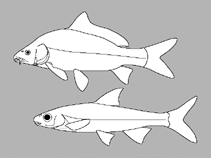 No image available for this species;
drawing shows typical species in Cyprinidae.
Google image
drawing shows typical species in Cyprinidae.
Clasificación / Nombres Nombres comunes | Sinónimos | Catalog of Fishes(Género, Especie) | ITIS | CoL | WoRMS | Cloffa
> Cypriniformes (Carps) > Cyprinidae (Minnows or carps) > Smiliogastrinae
Etymology: Enteromius: Greek, enteron = intestine + Greek, myo, mys = muscle (Ref. 45335); radari: This species is dedicated to Dr. Honoris Radar Nishilu, former chief manager of the Kahuzi-Biega National Park (2008-2016), in recognition of his commitment to and support for biodiversity assessments and scientific research in the park and particularly for the investigations (Ref. 128600).
Etymology: Enteromius: Greek, enteron = intestine + Greek, myo, mys = muscle (Ref. 45335); radari: This species is dedicated to Dr. Honoris Radar Nishilu, former chief manager of the Kahuzi-Biega National Park (2008-2016), in recognition of his commitment to and support for biodiversity assessments and scientific research in the park and particularly for the investigations (Ref. 128600).
Entorno: milieu / zona climática / rango de profundidad / gama de distribución Ecología
; agua dulce bentopelágico; pH range: 6.5 - 7.0. Tropical; 23°C - 23°C (Ref. 128600)
Distribución Territorios | Áreas FAO | Ecosistemas | Ocurrencias, apariciones | Mapa de puntos | Introducciones | Faunafri
Africa: Democratic Republic of the Congo.
Tamaño / Peso / Edad
Descripción breve Claves de identificación | Morfología | Morfometría
Espinas dorsales (total) : 0; Radios blandos dorsales (total) : 10 - 11; Espinas anales: 0; Radios blandos anales: 8; Vértebra: 31 - 33. Diagnosis: Within the Congo basin, Enteromius radari belongs to the group of sawfin minnows with a thickened last unbranched dorsal-fin ray and is thereby distinguished from all congeners from the Congo basin with a soft last unbranched dorsal-fin ray (Ref. 128600). It differs from other species with a weakly thickened spine, notably E. mediosquamatus, E. taeniurus and E. tomiensis, by its serrations on the spine vs. unserrated dorsal spine (Ref. 128600). Within the group of the sawfin minnows, having a thickened spine with serrations, it differs from E. afrovernayi, E. apleurogramma, E. oligogrammus and E. petchkovskyi by its complete lateral line vs. incomplete; in addition, it differs from E. apleurogramma and E. oligogrammus by its weakly thickened dorsal spine vs. a strongly thickened, and further by its lower number of lateral line scales from E. afrovernayi, 22-26 vs. 29-32; it differs from the remaining sawfin minnows by its weakly thickened, thin dorsal spine of which only the middle part is weakly serrated, vs. a strongly thickened, stout spine, well serrated over almost its entire length in E. ansorgii, E. eutaenia, E. kerstenii as well as E. tangandensis, E. mattozi, E. miiolepis, E.neumayeri, E. pellegrini and E. trinotatus; it can further be distinguished from E. pellegrini by its lower number of lateral line scales, 22-26 vs. 28-30; it can be distinguished from E. afrohamiltoni, E. lukindae, E. neumayeri, E. paludinosus, E. trimaculatus and E. vanderysti by its lower number of lateral line scales, 22-26 vs. 29-33, 29-30, 30-31, 34-39, 30-36 and 29, respectively (Ref. 128600). Furthermore, based on its colour pattern, E. radari can be distinguished from E. eutaenia, E. devosi, E. miolepis and E. luikae by the presence of three or four blotces along the flanks, situated just above the lateral line, and interconnected or not by a narrow, sometimes inconspicuous, black stripe vs. a permanent, continuous, black mid-lateral band; E. radari can be distinguished from E. guirali and E. machadoi as well, by the presence of these black markings along the body flanks vs. absence; E. radari can be distinguished from E. multilineatus and E. trinotatus also, by the above black marking character vs. a large black, mid-lateral band on the body but with several thin longitudinal black bands above and below this main band, and three elongated, narrow black spots respectively (Ref. 128600). Within the group of Enteromius species with a weakly thickened, serrated spine, it differs from E. chicapaensis and E. chiumbeensis by its higher number of lateral line scales, 22-26 vs. 21-23 and 20-21, respectively; in addition, it differs from E. chicapaensis by the presence of a series of three or four black blotches just above the mid-lateral line of the body vs. absence; furthermore, within this group it differs from E. holotaenia and E. martorelli by a series of three or four black blotches just above the mid-lateral line of the body vs. a continuous black band; finally, E. radari differs clearly from E. janssensi by the absence of cephalic pitlines vs. presence, and by the presence of blotches vs. indistinct black band larger on the anterior part and narrowing at mid-body level, by its lower number of lateral line scales, 22-26 vs. 24-27, and its lower number of circumpeduncular scales, 10-12 vs. 12 (Ref. 128600).
Found in shallow areas, about 1 m of depth, of small streams, about 1-10 m width, under tree canopy cover; the bottom is composed of either silt, sand, gravel, or a combination with mud and detritus (Ref. 128600).
Ciclo vital y comportamiento de apareamiento Madurez | Reproducción | Puesta | Huevos | Fecundidad | Larva
Referencia principal
Suba sus referencias | Referencias | Coordinador | Colaboradores
Kisekelwa, T., J. Snoeks, E. Decru, F.B.D. Schedel, M. Isumbisho and E. Vreven, 2022. A mismatch between morphological and molecular data in lineages of Enteromius (Cypriniformes: Cyprinidae) from the Lowa basin (East Democratic Republic of the Congo: DRC) with the description of a new species. Syst. Biodivers. 20(1,2135630):1-22. (Ref. 128600)
CITES
Not Evaluated
Amenaza para el ser humano
Harmless
Usos humanos
Pesquerías: sin interés
FAO - Publication: search | FishSource |
Más información
Ecología Trófica
Alimentos (presas)
Composición de la dieta
consumo de alimento
Raciones de comida
Despredadores
Alimentos (presas)
Composición de la dieta
consumo de alimento
Raciones de comida
Despredadores
Dinámica de la población
Coeficiente del crecimiento para
Edades / tallas máximas
Longitud-peso rel.
Longitud-longitud rel.
Longitud-frecuencias
Conversión de masas
Reclutamiento
Abundancia
Coeficiente del crecimiento para
Edades / tallas máximas
Longitud-peso rel.
Longitud-longitud rel.
Longitud-frecuencias
Conversión de masas
Reclutamiento
Abundancia
Ciclo de vida
Reproducción
Madurez
Madurez/Gills rel.
Fecundidad
Puesta
Agregaciones de desove
Huevos
Desarrollo de los huevos
Larva
Dinámica larvaria
Reproducción
Madurez
Madurez/Gills rel.
Fecundidad
Puesta
Agregaciones de desove
Huevos
Desarrollo de los huevos
Larva
Dinámica larvaria
Distribución
Territorios
Áreas FAO
Ecosistemas
Ocurrencias, apariciones
Introducciones
BRUVS - Vídeos
Territorios
Áreas FAO
Ecosistemas
Ocurrencias, apariciones
Introducciones
BRUVS - Vídeos
Anatomía
Superficie branquial
Cerebro
Otolito
Superficie branquial
Cerebro
Otolito
Fisiología
Composición corporal
Nutrientes
Consumo del oxígeno
Tipo de natación
Velocidad de natación
Pigmentos visuales
Sonido de peces
Enfermedades y parásitos
Toxicidad (CL50)
Composición corporal
Nutrientes
Consumo del oxígeno
Tipo de natación
Velocidad de natación
Pigmentos visuales
Sonido de peces
Enfermedades y parásitos
Toxicidad (CL50)
Genética
Genoma
Genética
Heterocigosidad
heritabilidad
Diversidad genética
Genoma
Genética
Heterocigosidad
heritabilidad
Diversidad genética
Relacionados con el ser humano
Sistemas de acuicultura
Perfiles de acuicultura
Razas
Ciguatera cases
Sellos, monedas, varios
Sistemas de acuicultura
Perfiles de acuicultura
Razas
Ciguatera cases
Sellos, monedas, varios
Herramientas
Libro electrónico | Guía de campo | Asistente para frecuencias de tallas | Herramienta de ciclo de vida | Mapa de puntos |
Catch-MSY |
Informes especiales
Comprobar el mantenimiento del acuario | Buscar fichas sobre especies | Consulte las hojas informativas sobre acuicultura
Descargar XML
Fuentes de Internet
AFORO (otoliths) | Aquatic Commons | BHL | Cloffa | Websites from users | Check FishWatcher | CISTI | Catalog of Fishes: Género, Especie | DiscoverLife | ECOTOX | FAO - Publication: search | Faunafri | Fishipedia | Fishtrace | GloBI | Google Books | Google Scholar | Google | IGFA World Record | OneZoom | Open Tree of Life | Otolith Atlas of Taiwan Fishes | PubMed | Reef Life Survey | Socotra Atlas | TreeBase | Árbol de la vida | Wikipedia: Go, búsqueda | World Records Freshwater Fishing | Zoobank | Expediente Zoológico
Estimaciones basadas en modelos
Índice de diversidad filogenética (Referencia 82804): PD50 = 0.5000 [Uniqueness, from 0.5 = low to 2.0 = high].
Bayesian length-weight: a=0.01122 (0.00521 - 0.02417), b=3.01 (2.84 - 3.18), in cm total length, based on LWR estimates for this Genus-body shape (Ref. 93245).
Nivel trófico (Referencia 69278): 3.0 ±0.3 se; based on size and trophs of closest relatives
Resiliencia (Referencia 120179): Alto, población duplicada en un tiempo mínimo inferior a 15 meses (Preliminary K or Fecundity.).