



Envoyez vos Photos et vidéos
Images | Images Google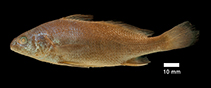 Stellifer menezesi
Photo de Chao et al., 2021
Images | Images Google
Photo de Chao et al., 2021
Classification / Noms Noms communs | Synonymes | Catalog of Fishes(Genre, Espèce) | ITIS | CoL | WoRMS | Cloffa
> Eupercaria/misc (Various families in series Eupercaria) > Sciaenidae (Drums or croakers)
Etymology: Stellifer: Latin, stella = satr + latin, fero = to carry (Ref. 45335); menezesi: Named for Dr. Naércio A. Menezes, Professor Emeritus, Museum of Zoology, University of São Paulo.
Eponymy: Professor Dr Naércio Aquino Menezes (d: 1937) is a Brazilian zoologist who is Professor, Department of Zoology, Institute of Biosciences, University of São Paulo and at Museu de Zoologia da Universidade de São Paulo. [...] (Ref. 128868), visit book page.
Etymology: Stellifer: Latin, stella = satr + latin, fero = to carry (Ref. 45335); menezesi: Named for Dr. Naércio A. Menezes, Professor Emeritus, Museum of Zoology, University of São Paulo.
Eponymy: Professor Dr Naércio Aquino Menezes (d: 1937) is a Brazilian zoologist who is Professor, Department of Zoology, Institute of Biosciences, University of São Paulo and at Museu de Zoologia da Universidade de São Paulo. [...] (Ref. 128868), visit book page.
Environnement : milieu / zone climatique / profondeur / gamme de distribution Écologie
marin benthopélagique. Tropical
Distribution Territoires | Zones FAO | Écosystèmes | Occurrences | Carte par point | Introductions | Faunafri
Southwest Atlantic: Brazil.
Taille / Poids / Âge
Description synthétique Clés d'identification | Morphologie | Morphométrie
Épines dorsales (Total) : 11; Rayons mous dorsaux (Total) : 23 - 24; Épines anales: 2; Rayons mous anaux: 6 - 8. This species is distinguished from its congeners in the Atlantic with a terminal or oblique mouth by the following characters: with an inferior mouth and elongated body; absence of diverticula on the posterior margin of anterior gas bladder chamber (distinguishes it from microps, naso, venezuelae); body depth slightly greater than HL and the snout length is shorter than the eye diameter; anterior nostril is slightly oval and forward directed, and the posterior nostril is bean-shaped forming an angle between them (Ref. 125562).
Cross section: compressed.
Cross section: compressed.
This species is rather common in inshore waters, from the surf zone to estuaries along the
northeastern Brazilian coast. Occurs near beaches with accumulations of detached macrophytes, mostly between September and February, feeding on amphipods and other crustaceans (Ref. 125562).
Cycle de vie et comportement reproducteur Maturité | Reproduction | Frai | Œufs | Fécondité | Larves
Référence principale
Téléchargez vos références | Références | Coordinateur | Collaborateurs
Chao, N.L., A. Carvalho-Filho and J. de Andrade Santos, 2021. Five new species of Western Atlantic stardrums, Stellifer (Perciformes: Sciaenidae) with a key to Atlantic Stellifer species. Zootaxa 4991(3):434-466. (Ref. 125562)
Statut dans la liste rouge de l'IUCN (Ref. 130435: Version 2025-2 (Global))
Préoccupation mineure (LC) ; Date assessed: 11 July 2023
CITES
Not Evaluated
Menace pour l'homme
Harmless
Utilisations par l'homme
FAO - Publication: search | FishSource |
Plus d'informations
Écologie trophique
Aliments (proies)
Composition du régime alimentaire
Consommation alimentaire
Rations alimentaires
Prédateurs
Aliments (proies)
Composition du régime alimentaire
Consommation alimentaire
Rations alimentaires
Prédateurs
Écologie
Écologie
Écologie
Dynamique des populations
Paramètres de croissance
Âges / tailles maximales
Longueur-poids rel.
Rel. longueur-longueur.
Fréquences de longueurs
Conversion de masse
Recrutement
Abondance
Paramètres de croissance
Âges / tailles maximales
Longueur-poids rel.
Rel. longueur-longueur.
Fréquences de longueurs
Conversion de masse
Recrutement
Abondance
Cycle de vie
Reproduction
Maturité
Maturité/épines rel.
Fécondité
Frai
Agrégats de frai
Œufs
Développement de l'œuf
Larves
Dynamique des populations larvaires
Reproduction
Maturité
Maturité/épines rel.
Fécondité
Frai
Agrégats de frai
Œufs
Développement de l'œuf
Larves
Dynamique des populations larvaires
Anatomie
Surface branchiale
Cerveau
Otolithe
Surface branchiale
Cerveau
Otolithe
Physiologie
Composition corporelle
Nutriments
Consommation d'oxygène
Type de natation
Vitesse de nage
Pigments visuels
Son de poisson
Maladies et parasites
Toxicité (CL50)
Composition corporelle
Nutriments
Consommation d'oxygène
Type de natation
Vitesse de nage
Pigments visuels
Son de poisson
Maladies et parasites
Toxicité (CL50)
Génétique
génôme
Génétique
Hétérozygotie
Héritabilité
Diversité génétique
génôme
Génétique
Hétérozygotie
Héritabilité
Diversité génétique
Liées à l'homme
Systèmes d'aquaculture
Profils d'aquaculture
Souches
Cas de ciguatera
Timbres, pièces de monnaie, divers
Systèmes d'aquaculture
Profils d'aquaculture
Souches
Cas de ciguatera
Timbres, pièces de monnaie, divers
Outils
E-book | Guide de terrain | Générateur de fréquences de longueur | Outil de dynamique de population | Carte par point |
Capture-MSY |
Articles particuliers
Télécharger en XML
Sources Internet
AFORO (otoliths) | Aquatic Commons | BHL | Cloffa | Websites from users | FishWatcher | CISTI | Catalog of Fishes: Genre, Espèce | DiscoverLife | ECOTOX | FAO - Publication: search | Faunafri | Fishipedia | Fishtrace | GloBI | Google Books | Google Scholar | Google | IGFA World Record | OneZoom | Open Tree of Life | Otolith Atlas of Taiwan Fishes | PubMed | Reef Life Survey | Socotra Atlas | TreeBase | Arbre de Vie | Wikipedia: aller à, chercher | World Records Freshwater Fishing | Zoobank | Zoological Record
Estimations basées sur des modèles
Indice de diversité phylogénétique (Réf. 82804): PD50 = 0.5000 [Uniqueness, from 0.5 = low to 2.0 = high].
Bayesian length-weight: a=0.00813 (0.00381 - 0.01735), b=3.09 (2.92 - 3.26), in cm total length, based on LWR estimates for this Genus-body shape (Ref. 93245).
Niveau trophique (Réf. 69278): 3.3 ±0.2 se; based on size and trophs of closest relatives
Résilience (Réf. 120179): Haut, temps minimum de doublement de population inférieur à 15 mois (Preliminary K or Fecundity.).