



Teleocichla preta Varella, Zuanon, Kullander & López-Fernández, 2016
Black pin cichlid
Uploaden van uw Foto's en video's
Afbeeldingen | Google afbeelding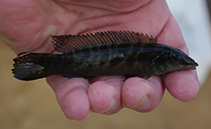 Teleocichla preta
Afbeelding van Petersen, P.
Afbeeldingen | Google afbeelding
Afbeelding van Petersen, P.
Classificatie / Namen Lokale namen | Synoniemen | Catalog of Fishes(Genus, Soort(en)) | ITIS | CoL | WoRMS | Cloffa
> Cichliformes (Cichlids, convict blennies) > Cichlidae (Cichlids) > Cichlinae
Etymology: Teleocichla: Greek, tele, telos = perfect + Greek, kichle = wrasse (Ref. 45335); preta: Adjective in Portuguese meaning black; refers to the diagnostic dark overall colouration of the body and to the previous denominations for the species in the scientific and aquarium literature, as well as among fishermen of the Rio Xingu. Noun in apposition.
Etymology: Teleocichla: Greek, tele, telos = perfect + Greek, kichle = wrasse (Ref. 45335); preta: Adjective in Portuguese meaning black; refers to the diagnostic dark overall colouration of the body and to the previous denominations for the species in the scientific and aquarium literature, as well as among fishermen of the Rio Xingu. Noun in apposition.
Milieu: milieu / Klimaatzone / Diepte / verspreidingsgebied Ecologie
; zoet water benthopelagisch. Tropical; 0°S - 10°S, 55°W - 50°W (Ref. 108975)
Verspreiding Gebieden | FAO regio's | Ecosystemen | Voorkomen | Verspreidingskaart | Introducties | Faunafri
South America: Brazil, Amazon basin, Rios Xingu and Iriri (Ref. 108975).
Grootte / Gewicht / Leeftijd
Maturiteit: Lm ? range ? - ? cm
Max length : 24.5 cm TL mannelijk / geslacht onbekend; (Ref. 126097); max. gepubliceerd gewicht: 178.00 g (Ref. 126097)
Max length : 24.5 cm TL mannelijk / geslacht onbekend; (Ref. 126097); max. gepubliceerd gewicht: 178.00 g (Ref. 126097)
Korte beschrijving Determinatiesleutels | Morfologie | Morfometrie
Dorsale stekels (totaal) : 21 - 23; Dorsale zachte stralen (totaal) : 7 - 10; Anale stekels: 3; Anale zachte stralen: 8 - 9; Wervels: 35 - 37. This species is distinguished from all its congeners by the following characters: a unique blackish (in live specimens) or dark brown (preserved specimens) general body colouration, which masks the faint vertical bars or a zig-zag pattern of blotches on the flanks; a deeper and posteriorly strongly compressed caudal peduncle, its depth 11.7-14.9 % SL, mean 13% (vs. < 10.9% SL); a deeper body, its depth 17.9-21.6% SL, mean 19.9% (vs. less or equal to 18.3%); stout lower pharyngeal tooth plate bearing molariform teeth on its median area (vs. conical); with maximum size 12.13 cm SL (vs. 8.15 cm SL in the largest known specimen of prionogenys and 8.78 cm SL in wajapi); differs from centrarchus and wajapi by having 3 anal-fin spines (vs. 4); differs from monogramma and centisquama by having the anterior and posterior branches of the lateral line separated by 2 horizontal scale rows (vs. lateral line continuous); differs from gephyrogramma by the absence of a caudal-fin blotch (vs. present, rounded and conspicuous); differs from cinderella by the absence of small dark spots scattered on flanks (vs. presence at least in specimens up to 6.0 cm SL) and by the absence of filamentous dorsal-fin prolongation in sexually dimorphic males (Ref. 108975).
Cross section: compressed.
Cross section: compressed.
In moderate to fast, shallow rapids, with clear water and the riverbed composed mainly of large rocks and little accumulated sediment. Feeds predominantly on of caddisfly larvae (Trichoptera) and other hard-shelled invertebrates (gastropods and bivalves), as well as midges (Diptera: Chironomidae) and mayfly larvae (Ephemeroptera) (Ref. 108975).
Levenscyclus en paargedrag Maturiteit | Voortplanting | Paaien | Eieren | Fecunditeit | Larven
Hoofdreferentie
Upload uw referenties | Referenties | Coördinator : Kullander, Sven O. | Medewerkers
Varella, H.R., J. Zuanon, S.O. Kullander and H. López-Fernández, 2016. Teleocichla preta, a new species of cichlid from the Rio Xingu basin in Brazil (Teleostei: Cichlidae). J. Fish Biol. 89(3):1551-1569. (Ref. 108975)
CITES
Not Evaluated
Gevaar voor de mens
Harmless
Gebruik door de mens
FAO - Publication: search | FishSource |
Meer informatie
Trofische ecologie
Voedsel (prooien)
Dieetsamenstelling
Voedselconsumptie
Voedselrantsoenen
Predatoren
Voedsel (prooien)
Dieetsamenstelling
Voedselconsumptie
Voedselrantsoenen
Predatoren
Ecologie
Ecologie
Ecologie
Populatiedynamica
Groeiparameters
Max. leeftijden / maten
Lengte-gewicht rel.
Lengte-lengte rel.
Lengtefrequenties
Massaconversie
Rekrutering
Abundantie
Groeiparameters
Max. leeftijden / maten
Lengte-gewicht rel.
Lengte-lengte rel.
Lengtefrequenties
Massaconversie
Rekrutering
Abundantie
Levenscyclus
Voortplanting
Maturiteit
Rijpheid/kieuwen rel.
Fecunditeit
Paaien
Paaibestanden
Eieren
Ontwikkeling van de eieren
Larven
Larvale populatiedynamiek
Voortplanting
Maturiteit
Rijpheid/kieuwen rel.
Fecunditeit
Paaien
Paaibestanden
Eieren
Ontwikkeling van de eieren
Larven
Larvale populatiedynamiek
Anatomie
Kieuwoppervlak
Hersenen
Otoliet
Kieuwoppervlak
Hersenen
Otoliet
Fysiologie
Lichaamssamenstelling
Voedingsstoffen
Zuurstofverbruik
Type zwemmen
Zwemsnelheid
Visuele pigmenten
Vis geluid
Ziekten en parasieten
Toxiciteit (LC50)
Lichaamssamenstelling
Voedingsstoffen
Zuurstofverbruik
Type zwemmen
Zwemsnelheid
Visuele pigmenten
Vis geluid
Ziekten en parasieten
Toxiciteit (LC50)
Genetica
genoom
Genetica
Heterozygositeit
Erfelijkheid
Genetische diversiteit
genoom
Genetica
Heterozygositeit
Erfelijkheid
Genetische diversiteit
Menselijk gerelateerd
Aquacultuursystemen
Aquacultuurprofielen
Kweeklijnen
Ciguatera gevallen
Postzegels, munten, diversen.
Aquacultuursystemen
Aquacultuurprofielen
Kweeklijnen
Ciguatera gevallen
Postzegels, munten, diversen.
Tools
Speciale rapporten
Bekijk gegevens voor het houden in een aquarium | Bekijk Fact Sheets voor de soort | Bekijk Aquacultuur Fact Sheets
Download XML
Internetbronnen
AFORO (otoliths) | Aquatic Commons | BHL | Cloffa | Websites from users | Bekijk FishWatcher | CISTI | Catalog of Fishes: Genus, Soort(en) | DiscoverLife | ECOTOX | FAO - Publication: search | Faunafri | Fishipedia | Fishtrace | GloBI | Google Books | Google Scholar | Google | IGFA World Record | OneZoom | Open Tree of Life | Otolith Atlas of Taiwan Fishes | PubMed | Reef Life Survey | Socotra Atlas | TreeBase | Tree of Life | Wikipedia: ga naar, zoek | World Records Freshwater Fishing | Zoobank | Zoological Record
Schattingen op basis van modellen
Fylogenetische diversiteitsindex (Ref. 82804): PD50 = 0.5020 [Uniqueness, from 0.5 = low to 2.0 = high].
Bayesian length-weight: a=0.00794 (0.00430 - 0.01467), b=3.10 (2.94 - 3.26), in cm total length, based on LWR estimates for this species & (Sub)family-body (Ref. 93245).
Trofisch niveau (Ref. 69278): 3.3 ±0.5 se; based on size and trophs of closest relatives
Weerstandsvermogen (Ref. 120179): Hoog, minimale populatieverdubbelingstijd minder dan 15 maanden (Preliminary K or Fecundity.).