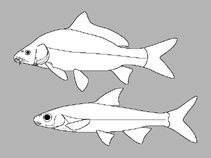
Klassifizierung / Names
Namen | Synonyme | Catalog of Fishes(Gattung, Arten) | ITIS | CoL | WoRMS | Cloffa
>
Cypriniformes (Carps) >
Cyprinidae (Minnows or carps) > Smiliogastrinae
Etymology: Enteromius: Greek, enteron = intestine + Greek, myo, mys = muscle (Ref. 45335); thespesios: From the Greek thespesios meaning ineffable, divine, wondrous and referring to the sense of wonder that this little fish evokes by its delicate beauty (Ref. 122753).
Environment: milieu / climate zone / Tiefenbereich / distribution range
Ökologie
; süßwasser benthopelagisch; pH range: 7.9 - 8.7. Tropical; 25°C - 28°C (Ref. 122753)
Africa: southeastern part of the Upper Congo River basin in Democratic Republic of the Congo and Zambia (Ref. 122753).
Size / Gewicht / Alter
Geschlechtsreife: Lm ? range ? - ? cm
Max length : 6.1 cm SL Männchen/unbestimmt; (Ref. 122753); 6.2 cm SL (female)
Kurzbeschreibung
Bestimmungsschlüssel | Morphologie | Morphometrie
Rückenflossenstacheln (insgesamt) : 0; Rückenflossenweichstrahlen (insgesamt) : 11; Afterflossenstacheln: 0; Afterflossenweichstrahlen: 8; Wirbelzahl: 34. Diagnosis: Enteromius thespesios belongs to the group of Enteromius species from the Congo basin of which the last unbranched dorsal-fin ray is weakly ossified, flexible and lacking serrations along its posterior edge (Ref. 122753). It can be easily distinguished from all other members of this group by the following unique combination of characters: two pairs of barbels vs. no barbels in Enteromius aspilus, E. baudoni, E. brazzai, E. carens, E. erythrozonus, E. haasianus, E. jae, E. stigmatopygus and E. toppini and a single pair of barbels in Enteromius brevidorsalis, E. candens, E. hulstaerti, E. nigrifilis, E. owenae, E. papilio and E. syntrechalepis; one prominent dark vertical bar situated behind gill-opening vs. a series of 10-15 black vertical bars on body in E. fasciolatus; no spots on flanks vs. well-defined spots on flanks in E. atromaculatus, E. barotseensis, E. camptacanthus, E. castrasibutum, E. collarti, E. lornae, E. lukusiensis, E. neefi, E. stanleyi, E. tetrastigma, E. trispilomimus and E. urostigma; a series of crescent-like spots along lateral line vs. a well-marked continuous black band running from snout to caudal fin base in E. ablabes, E. luluae, E. kessleri, E. lamani, E. macrops and E. radiatus; lateral line complete vs. lateral line incomplete in E. brachygramma and E. lujae; 23-26 lateral line scales vs. 21 in E. okae, 21-22 in E. pygmaeus, 20-22 in E. stigmasemion, 27-29 in E. bifrenatus, 30 in E. caudosignatus, 29-32 in E. cercops, 28 in E. citrinus, 32-33 in E. deguidei, 29-33 in E. innocens, 27-30 in E. kamolondoensis, 30-32 in E. lineomaculatus, 28-29 in E. marmoratus, 32-33 in E. mocoensis, 33-37 in E. motebensis, 31-33 in E. poechii, 27-30 in E. quadrilineatus, 27-29 in E. taeniopleura and 29-35 in E. unitaeniatus; and 11-12 circumpeduncular scales vs. 8-10 in E. amanpoae, 10 in E. humeralis and 8 in E. lufukiensis (Ref. 122753). Enteromius thespesios differs from E. tshopoensis by a long dorsal-fin length, 27.1-35.6% of standard length, vs. shorter, 22.3-24.0% of standard length, and by a large body depth, 29.4-34.1% of standard length, vs. smaller, 18.0-20.4% of standard length; it differs from E. validus by a dorsal fin without a conspicuous black tip vs. dorsal fin with a conspicuous black tip, a small eye diameter, 25.5-33.1% of head length, vs. larger, 37.2-46.9% of head length, and a small body depth, 22.2-24.6% of standard length, vs. larger, 26.3-35.5% of standard length (Ref. 122753). Finally, E. thespesios besides its high number of circumpeduncular scales, 11-12 vs. lower, 10, is further distinguished from E. humeralis by its small eye diameter, 25.5-33.1% of head length, vs. larger, 33.8-41.2% of head length; short anterior barbel length, 22.2-33.1% of head length, vs. longer, 35.1-45.0% of head length; short posterior barbel length, 25.9-32.0% of head length, vs. longer, 34.2-44.6% of head length, and its short, dorsal fin length, 22.3-24.0% of standard length, vs. 24.0-27.3% of head length (Ref. 122753).
Body shape (shape guide): fusiform / normal.
Life cycle and mating behavior
Geschlechtsreife | Fortpflanzung | Ablaichen | Eier | Fecundity | Larven
Katemo Manda, B., J. Snoeks, E. Decru, R. Bills and E. Vreven, 2020. Enteromius thespesios (Teleostei: Cyprinidae): a new minnow species with a remarkable sexual dimorphism from the south-eastern part of the Upper Congo River. J. Fish Biol. 96(5):1160-1175. (Ref. 122753)
IUCN Rote Liste Status (Ref. 130435: Version 2025-1)
Bedrohung für Menschen
Harmless
Nutzung durch Menschen
Fischereien: nicht kommerziell
Tools
Zusatzinformationen
Download XML
Internet Quellen
Estimates based on models
Phylogenetic diversity index (Ref.
82804): PD
50 = 0.5000 [Uniqueness, from 0.5 = low to 2.0 = high].
Bayesian length-weight: a=0.01175 (0.00447 - 0.03086), b=3.01 (2.78 - 3.24), in cm total length, based on LWR estimates for this (Sub)family-body shape (Ref.
93245).
Trophic level (Ref.
69278): 3.0 ±0.3 se; based on size and trophs of closest relatives
Widerstandsfähigkeit (Ref.
120179): hoch, Verdopplung der Population dauert weniger als 15 Monate. (Preliminary K or Fecundity.).
Fishing Vulnerability (Ref.
59153): Low vulnerability (10 of 100).
🛈