



Scleronema macanuda Ferrer & Malabarba, 2020
muatnaik fotos/gambar dan video
imej Google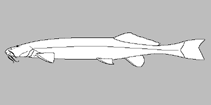 No image available for this species;
drawing shows typical species in Trichomycteridae.
imej Google
drawing shows typical species in Trichomycteridae.
klasifikasi / Nama Nama-nama umum | Sinonim (persamaan) | Catalog of Fishes(Marga, Jenis) | ITIS | CoL | WoRMS | Cloffa
> Siluriformes (Catfishes) > Trichomycteridae (Pencil or parasitic catfishes) > Trichomycterinae
Etymology: Scleronema: Greek, skleros = hard + Greek,nema = filament (Ref. 45335); macanuda: Named after the word ‘macanuda’, a regional adjective to describe a ’large and strong’ person, referring to the species being the largest of the genus.
Etymology: Scleronema: Greek, skleros = hard + Greek,nema = filament (Ref. 45335); macanuda: Named after the word ‘macanuda’, a regional adjective to describe a ’large and strong’ person, referring to the species being the largest of the genus.
Lingkungan: lingkungan / zona iklim / kisaran kedalaman / jangkauan distribusi Ekologi
; air tawar dasar (demersal). Tropical
Penyebaran Wilayah | Daerah-daerah FAO | Ekosistem | Kemunculan | peta titik | Introduksi | Faunafri
South America: widely distributed in rivers and streams that drain to laguna dos Patos (Brazil) and lagoa Mirim (Brazil and Uruguay); and in small Atlantic coastal drainages of Uruguay.
Ukuran / Berat / umur
deskripsi pendek Kunci identifiaksi (pengenalan) | Morfologi | Morfometrik
duri punggung lunak (Keseluruhan (total)) : 10 - 14; Sirip dubur lunak: 6 - 7; vertebrata, bertulang belakang: 35 - 36. This species is distinguished from all its congeners, except operculatum by the following characters: maxillary barbel is smaller than half-length of the head (vs. larger than half-length of the head); tips of pectoral-fin rays extending beyond the interadial membrane (vs. not extending beyond interadial membrane); skin flap in the posterior margin of the opercle pointed and long (vs. round an short); fleshy flap at the base of the maxillary barbel located anteriorly, it is thick, prolonged up to the snout and with distal margin straight (vs. fleshy flap located posteriorly, thin, restricted to the maxilla and with distal margin rounded); caudal fin with a transversal black bar distally (vs. no black bar) differs S. operculatum by having a midlateral line of 6-9 rounded black blotches larger than opercle (vs. midlateral line of 10-14 rounded black blotches as large as or smaller than opercle), tip of nasal barbel usually extending beyond anterior margin of eye (vs. never reaching anterior margin of eye), tip of maxillary barbel extending between anterior and posterior margins of interopercle (vs. tip never surpassing anterior margin of interopercle) (Ref. 122319).
Cross section: oval.
Cross section: oval.
Inhabits rivers and streams usually with sandy bottoms. Collected syntopically with S. minutum in some localities. Stomachs of eleven specimens were analyzed where 6 had immature aquatic Diptera (Chironomidae), Oligochaeta, unidentified plant fragments and sand. A study showed that the diet of immature individuals was composed of Chironomidae and Ephemeroptera. Individuals larger than 3.5 cm SL are reported to be capable of spawning and thus are considered adults (Ref. 122319).
Siklus hidup dan perilaku kawin Kematangan | Reproduksi, perkembang biakan | Pemijahan | telur-telur | Fekunditas | Larva
rujukan utama
Unggah referensi Anda | Acuan | Koordinator : Pinna, Mário de | mitra
Ferrer, J. and L.R. Malabarba, 2020. Systematic revision of the Neotropical catfish genus Scleronema (Siluriformes: Trichomycteridae), with descriptions of six new species from Pampa grasslands. Neotrop. Ichthyol. 18(2):1-81. (Ref. 122319)
CITES
Not Evaluated
ancaman kepada manusia
Harmless
penggunaan manusia
FAO - Publication: search | FishSource |
informasi lanjut
Ekologi trofik
Item makanan (mangsa)
Komposisi makanan
Konsumsi makanan
Ransum makanan
Pemangsa
Item makanan (mangsa)
Komposisi makanan
Konsumsi makanan
Ransum makanan
Pemangsa
Ekologi
Ekologi
Ekologi
Dinamika populasi
Parameter pertumbuhan
Maks. usia / ukuran
Panjang-berat rel.
Panjang-panjang rel.
ukuran frekuensi
Konversi massa
pemulihan
Kelimpahan
Parameter pertumbuhan
Maks. usia / ukuran
Panjang-berat rel.
Panjang-panjang rel.
ukuran frekuensi
Konversi massa
pemulihan
Kelimpahan
Siklus hidup
Reproduksi, perkembang biakan
Kematangan
Kedewasaan / insang rel.
Fekunditas
Pemijahan
Agregasi pemijahan
telur-telur
pekembangan telor
Larva
Dinamika larva
Reproduksi, perkembang biakan
Kematangan
Kedewasaan / insang rel.
Fekunditas
Pemijahan
Agregasi pemijahan
telur-telur
pekembangan telor
Larva
Dinamika larva
Anatomi
Area insang
Otak
Otolith
Area insang
Otak
Otolith
Fisiologi
Komposisi tubuh
Nutrisi
Konsumsi oksigen
Jenis renang
Kecepatan berenang
Pigmen visual
Suara ikan
Penyakit & Parasit
Toksisitas (LC50)
Komposisi tubuh
Nutrisi
Konsumsi oksigen
Jenis renang
Kecepatan berenang
Pigmen visual
Suara ikan
Penyakit & Parasit
Toksisitas (LC50)
Genetika
genom
Genetika
Heterozigositas
Diturunkan
Keanekaragaman Genetik
genom
Genetika
Heterozigositas
Diturunkan
Keanekaragaman Genetik
Yang berhubungan dengan manusia
Sistem akuakultur
profil budidaya air
Strain
Kasus Ciguatera
Perangko, koin, dll.
Sistem akuakultur
profil budidaya air
Strain
Kasus Ciguatera
Perangko, koin, dll.
Alat, peralatan
E-book | Penuntun lapangan | tanda freqkuenci panjang | peringkat sejarah hidup | peta titik |
Tangkap-MSY |
laporan khas
muat turun XML
Sumber internet
AFORO (otoliths) | Aquatic Commons | BHL | Cloffa | Websites from users | semak peneliti ikan | CISTI | Catalog of Fishes: Marga, Jenis | DiscoverLife | ECOTOX | FAO - Publication: search | Faunafri | Fishipedia | Fishtrace | GloBI | Google Books | Google Scholar | Google | IGFA World Record | Pangkalan data nasional | OneZoom | Open Tree of Life | Otolith Atlas of Taiwan Fishes | PubMed | Reef Life Survey | Socotra Atlas | TreeBase | Tree of Life | Wikipedia: pergi, Cari | World Records Freshwater Fishing | Zoobank | Catatan Zoologi
Estimasi berdasarkan model
Indeks keanekaragaman filogenetik (Acuan 82804): PD50 = 0.5020 [Uniqueness, from 0.5 = low to 2.0 = high].
Bayesian length-weight: a=0.00759 (0.00337 - 0.01709), b=3.00 (2.81 - 3.19), in cm total length, based on LWR estimates for this (Sub)family-body shape (Ref. 93245).
Tingkat Trofik (Acuan 69278): 3.2 ±0.4 se; based on size and trophs of closest relatives