This website uses cookies to enhance your browsing experience and ensure the functionality of our site. For more detailed information about the types of cookies we use and how we protect your privacy, please visit our Privacy Information page.
×
Cookie Settings
This website uses different types of cookies to enhance your experience. Please select your preferences below:
> Gobiiformes (Gobies) > Gobiidae (Gobies) > Gobiinae
Etymology: Priolepis:Greek, prio = to saw + Greek,lepis = scale (Ref. 45335); billbrooksi:Named for William (“Bill”) Mathews Brooks, the third author’s son. Eponymy: William ‘Bill’ Mathews Brooks is the third author’s son. (Also see Jack Brooks and Stuart (Brooks) & Berry (Levy)) (Ref. 128868), visit book page.
Ambiente: milieu / zona climatica / distribuzione batimetrica / gamma di distribuzione Ecologia
marino demersale; distribuzione batimetrica ? - 30 m. Tropical
Western Pacific: Papua New Guinea. Most likely to be more widespread in the East Indian region
Dimensione / Peso / Età
Maturità: Lm? range ? - ? cm Max length : 2.3 cm SL maschio/sesso non determinato; (Ref. 118649); 2.3 cm SL (female)
Breve descrizione Chiavi di identificazione | Morfologia | Morfometria
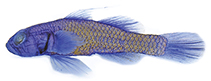
Spine dorsali (totale) : 7; Raggi dorsali molli (totale) : 9 - 10; Raggi anali molli: 8 - 9; Vertebre: 26. This species is distinguished by the following set of characters: D VI+I,9-10 (usually 9), with second dorsal-fin spine forming an elongate filament extending to between base of fourth and last segmented dorsal-fin ray when adpressed; A I,8–9 (usually 9); pectoral-fin rays 18; relatively broad interorbital (75-91% pupil diameter); 10-12 papillae in posterior transverse interorbital row; the upper part of opercle with about 10-12 scales arranged in 3 or 4 transverse rows; pelvic without frenum. Colour when fresh is generally yellow (including iris, except opercle, upper part of cheek, and area
immediately behind eye sometimes pinkish); head, body, and fins covered with numerous pepper-like melanophores, most prominent on side of body; fins yellow, except pelvic fins translucent; second dorsal fin, caudal fin, and anal fin with blue margin, widest on anal fin; dorsal fins with narrow blue stripe at base, second dorsal fin also with longitudinal row of blue spots just above stripe; filamentous extension of second dorsal-fin spine blue (Ref. 118649). Cross section: oval.
Specimens were collected using rotenone in a sheltered bay on a mainly flat mud bottom in 30 m depth. Seldom collected due to its small size and predilection for seldom-dived, mud-bottom habitat. It is likely to live in the burrows of larger mud-dwelling fishes such as jawfish or Oxymetopon ribbongobies (for P. aithiops found at the type locality also shelters in the burrows of Oxymetopon compressus) (Ref. 118649).
Ciclo vitale e comportamento di accoppiamento Maturità | Riproduzione | Deposizione | Uova | Fecondità | Larve
Allen, G.R., M.V. Erdmann and W.M. Brooks, 2018. A new species of Priolepis (Pisces: Gobiidae) from Papua New Guinea. J. Ocean Sci. Found. 31:32-37. (Ref. 118649)
Stato della Lista Rossa IUCN (Ref. 130435: Version 2025-2 (Global))
Dinamica della popolazione Parametri di crescita Età massima / dimensioni massime Rapporto lunghezza-peso. Lunghezza-lunghezza rel. Lunghezza-frequenze Conversione di massa Reclutamento Abbondanza
Ciclo di vita Riproduzione Maturità Maturità/Gli occhielli sono relativi. Fecondità Deposizione Aggregazioni riproduttive Uova Sviluppo delle uova Larve Dinamica popolazioni larvali
Distribuzione Territories Aree FAO Ecosistemi Presenze Introduzioni BRUVS - Video
Anatomia Area branchiale Cervello Otolite
Fisiologia Composizione corporea Nutrienti Consumo di ossigeno Tipo di nuoto Velocità di nuoto Pigmenti visivi Suono del pesce Malattie e parassiti Tossicità (LC50)
Indice di diversità filogenetica (Fonte Biblio. 82804): PD50 = 0.5000 [Uniqueness, from 0.5 = low to 2.0 = high].
Bayesian length-weight: a=0.00741 (0.00347 - 0.01582), b=3.09 (2.91 - 3.27), in cm total length, based on LWR estimates for this (Sub)family-body shape (Ref. 93245).
Livello trofico (Fonte Biblio. 69278): 3.1 ±0.3 se; based on size and trophs of closest relatives
Resilienza (Fonte Biblio. 120179): Alto, tempo minimo di raddoppiamento della popolazione meno di 15 mesi (Preliminary K or Fecundity.).
Vulnerabilità della pesca (Ref. 59153): Low vulnerability (10 of 100). 🛈