



Orthochromis indermauri Schedel, Vreven, Katemo Manda, Abwe, Chocha Manda & Schliewen, 2018
Carregue seu(sua) Fotos e vídeos
Imagem do Google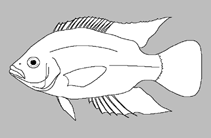 No image available for this species;
drawing shows typical species in Cichlidae.
Imagem do Google
drawing shows typical species in Cichlidae.
Classificação / Nomes Nomes comuns | Sinônimos | Catalog of Fishes(Gênero, Espécies) | ITIS | CoL | WoRMS | Cloffa
> Cichliformes (Cichlids, convict blennies) > Cichlidae (Cichlids) > Pseudocrenilabrinae
Etymology: Orthochromis: Greek, ortho = straight + Greek, chromis = a fish, perhaps a perch (Ref. 45335); indermauri: The species name indermauri honours the Swiss ichthyologist Dr. Adrian Indermaur, who was the first to document this new species with underwater photographs, videos, and with aquarium observations, thereby contributing to a large extent to our knowledge of behaviour and ecology of this species (Ref. 122085).
Eponymy: Dr Adrian Indermaur (d: 1984) is a Swiss ichthyologist who is (2014) Head of the animal facility at the Waler Salzburger Laboratory. [...] (Ref. 128868), visit book page.
Etymology: Orthochromis: Greek, ortho = straight + Greek, chromis = a fish, perhaps a perch (Ref. 45335); indermauri: The species name indermauri honours the Swiss ichthyologist Dr. Adrian Indermaur, who was the first to document this new species with underwater photographs, videos, and with aquarium observations, thereby contributing to a large extent to our knowledge of behaviour and ecology of this species (Ref. 122085).
Eponymy: Dr Adrian Indermaur (d: 1984) is a Swiss ichthyologist who is (2014) Head of the animal facility at the Waler Salzburger Laboratory. [...] (Ref. 128868), visit book page.
Meio ambiente: milieu / Zona climática / intervalo de profundidade / faixa de distribuição Ecologia
; Água doce bentopelágico; pH range: 8.0 - 8.6. Tropical; 23°C - 28°C (Ref. 122085)
Distribuição Territórios | Áreas da FAO | Ecossistemas | Ocorrências | Mapa de pontos | Introduções | Faunafri
Africa: lower reaches of Lufubu River, tributary of Lake Tanganyika, in Zambia (Ref. 122085).
Tamanho / Peso / Idade
Descrição suscinta Chaves de identificação | Morfologia | Morfometria
Espinhos dorsais (total) : 17 - 18; Raios dorsais (total) : 8 - 10; Espinhos anais: 3; Raios anais : 7 - 9; Vértebras: 28 - 29. Diagnosis: Orthochromis indermauri is distinguished from all species currently placed in Orthochromis, except O. torrenticola, by having hypurals 1 and 2 clearly separated or separated by distinct seam vs. always fused (Ref. 122085). It is further distinguished from Malagarasi-Orthochromis species, except O. mazimeroensis, O. malagaraziensis, and O. rubrolabialis, by having fewer caudal vertebrae, 14-15 vs. 16-18, and total vertebrae, 28-29 vs. 30-32; it is also distinguished from O. luichensis, O. malagaraziensis, O. mazimeroensis, O. mosoensis by having more inner series of teeth in upper jaw, 3-5 vs. 1-2; moreover, it differs from O. kasuluensis by having fewer anal-fin rays, 7-9 vs. 10; from O. malagaraziensis by having more scales between upper lateral line and dorsal-fin origin, 5-7 vs. 3-4, and by having more ceratobranchial gill rakers, 8-11 vs. 6-7; from O. mazimeroensis by having more abdominal vertebrae, 14-15 vs. 12-13; from O. mosoensis and O. rubrolabialis by having more ceratobranchial gill rakers, 8-11 vs. 5-7, and total gill rakers, 11-15 vs. 8-10; from O. uvinzae by having fewer horizontal line scales, 25-29 vs. 30-32, fewer dorsal-fin spines, 17-18 vs. 19-20, and by position of pterygiophore supporting last dorsal-fin spine, vertebral count 16-17 vs. 18-19 (Ref. 122085). It is distinguished from O. kalungwishiensis, O. luongoensis, and O. torrenticola by having fewer horizontal line scales, 28-29 vs. 30-32, and by having fewer caudal vertebrae, 14-15 vs. 17-18; further, it differs from O. luongoensis and O. machadoi by having fewer series of scales on cheek, 0-1 vs. 2-5; from O. kalungwishiensis by having fewer total vertebrae, 28-29 vs. 31-33 (Ref. 122085). It is distinguished from Schwetzochromis neodon by having fewer horizontal line scales, 28-29 vs. 30-31, more circumpeduncular scales, 16 vs. 12, fewer caudal vertebrae, 14-15 vs. 16-17, fewer total vertebrae, 28-29 vs. 30-32, fewer dorsal-fin rays, 8-10 vs. 11-12, and by having hypurals 1 and 2 clearly separated or separated by distinct seam vs. fused; it differs from Haplochromis snoeksi by having fewer scales on cheek, 0-1 vs. 2-3, fewer horizontal line scales, 25-29 vs. 30-31, more abdominal vertebrae, 14-15 vs. 13, fewer caudal vertebrae, 14-15 vs. 17, fewer total vertebrae, 28-29 vs. 30, more anal-fin rays, 7-9 vs. 5-6, more dorsal-fin spines, 17-18 vs. 16, more ceratobranchial gill rakers, 8-11 vs. 6, and total gill rakers, 11-15 vs. 9; from Haplochromis bakongo by having more inner series of teeth, 3-5 vs. 1-2, more dorsal-fin spines, 17-18 vs. 14-15, and in position of pterygiophore supporting last dorsal-fin spine, vertebral count 16-18 vs. 13-14; from Haplochromis moeruensis by having hypurals 1 and 2 clearly separated or separated by distinct seam vs. always fused; meristic values of O. indermauri overlap with those of Haplochromis vanheusdeni but is distinguished in head mask, nostril stripe present vs. absent, caudal corner of cheek with blackish element vs. no such element present, and by size and colouration of eggspot-like maculae on anal fin, deep red centre vs. orange centre in Haplochromis vanheusdeni (Ref. 122085). It is distinguished from O. mporokoso and O. katumbii by having fewer caudal vertebrae, 14-15 vs. 16-17, fewer total vertebrae, 28-29 vs. 30-31, and by having hypurals 1 and 2 and hypurals 3 and 4 clearly separated or separated by distinct seam vs. always fused; further from O. mporokoso by having fewer series of scales on cheek, 0-1 vs. 2-4; from O. katumbii by having fewer horizontal line scales, 25-29 vs. 30-31; it is distinguished from O. kimpala by having fewer series of scales on cheek, 0-1 vs. 3-4, and by having more dorsal-fin spines, 17-18 vs. 15-16; meristic values of O. indermauri overlap with those of O. gecki but is distinguished by having a wider interorbital width, 13.5-18.2% of head length vs. 9.6-12.9% (Ref. 122085).
Body shape (shape guide): fusiform / normal.
Body shape (shape guide): fusiform / normal.
Found in part of river which is rocky with some patches of sand and gravel, about 20 meters wide and on average 50 cm deep (Ref. 122085). This species is benthic-rheophilic and prefers stretches of fast flowing water where it is found between and among large rocks or patches of gravel (Ref. 122085). It is a maternal mouthbrooder (Ref. 122085).
Ciclo de vida ou comportamento de acasalamento Maturidade | Reprodução | Desova | Ovos | Fecundidade | Larvas
Referência principal
Carregar suas referências | Referências | Coordenador : Kullander, Sven O. | Colaboradores
Schedel, F.D.B., E.J.W.M.N. Vreven, B. Katemo Manda, E. Abwe, A. Chocha Manda and U.K. Schliewen, 2018. Description of five new rheophilic Orthochromis species (Teleostei: Cichlidae) from the Upper Congo drainage in Zambia and the Democratic Republic of the Congo. Zootaxa 4461(3):301-349. (Ref. 122085)
CITES
Not Evaluated
Ameaça para os humanos
Harmless
Uso pelos humanos
FAO - Publication: search | FishSource |
Mais informação
Ecologia Trófica
Itens alimentares (presas)
Composição da dieta
Consumo alimentar
Rações alimentares
Predadores
Itens alimentares (presas)
Composição da dieta
Consumo alimentar
Rações alimentares
Predadores
Dinâmica populacional
Parâmetros de crescimento
Idade máxima / tamanhos
Relação comprimento-peso.
Relação comprimento-comprimento.
Frequências de comprimento
Conversão de massa
Recrutamento
Abundância
Parâmetros de crescimento
Idade máxima / tamanhos
Relação comprimento-peso.
Relação comprimento-comprimento.
Frequências de comprimento
Conversão de massa
Recrutamento
Abundância
Ciclo de vida
Reprodução
Maturidade
Maturidade/Rel. das guelras
Fecundidade
Desova
Agregações de desova
Ovos
Desenvolvimento dos ovos
Larvas
Dinâmica larval
Reprodução
Maturidade
Maturidade/Rel. das guelras
Fecundidade
Desova
Agregações de desova
Ovos
Desenvolvimento dos ovos
Larvas
Dinâmica larval
Anatomia
Área branquial
Cérebro
Otólito
Área branquial
Cérebro
Otólito
Fisiologia
Composição corporal
Nutrientes
Consumo de oxigênio
Tipo de natação
Velocidade de natação
Pigmentos visuais
Som de peixe
Doenças e Parasitas
Toxicidade (LC50s)
Composição corporal
Nutrientes
Consumo de oxigênio
Tipo de natação
Velocidade de natação
Pigmentos visuais
Som de peixe
Doenças e Parasitas
Toxicidade (LC50s)
Genética
genoma
Genética
Heterozigosidade
Hereditariedade
Diversidade genética
genoma
Genética
Heterozigosidade
Hereditariedade
Diversidade genética
Relacionado a humanos
Sistemas de aquicultura
Perfis para aquacultura
Estirpes
Casos de Ciguatera
Selos, moedas, diversos.
Sistemas de aquicultura
Perfis para aquacultura
Estirpes
Casos de Ciguatera
Selos, moedas, diversos.
Ferramentas
Livro eletrônico | Guia de campo | Ferramenta auxiliar de frequências de comprimento | Ferramenta sobre a história de vida | Mapa de pontos |
Catch-MSY |
Relatórios especiais
Checar Manutenção em Aquário | Checar Planilhas de Fatos sobre as Espécies | Checar Planilhas de Fatos sobre Aquicultura
Baixar XML
Fontes da internet
AFORO (otoliths) | Aquatic Commons | BHL | Cloffa | Websites from users | Checar Observador de Peixes (FishWatcher) | CISTI | Catalog of Fishes: Gênero, Espécies | DiscoverLife | ECOTOX | FAO - Publication: search | Faunafri | Fishipedia | Fishtrace | GloBI | Google Books | Google Scholar | Google | IGFA World Record | OneZoom | Open Tree of Life | Otolith Atlas of Taiwan Fishes | PubMed | Reef Life Survey | Socotra Atlas | TreeBase | Árvore da vida | Wikipedia: Ir para, procura | World Records Freshwater Fishing | Zoobank | Registro zoológico
Estimativas baseadas em modelos
Índice de diversidade filogenética (Ref. 82804): PD50 = 0.5000 [Uniqueness, from 0.5 = low to 2.0 = high].
Bayesian length-weight: a=0.00389 (0.00180 - 0.00842), b=3.12 (2.94 - 3.30), in cm total length, based on all LWR estimates for this body shape (Ref. 93245).
Resiliência (Ref. 120179): Elevada, tempo mínimo de duplicação da população menor que 15 meses (Preliminary K or Fecundity.).