



Cyphocharax boiadeiro Melo, 2017
Hochladen Photos und videos
Google Bild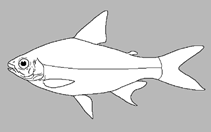 No image available for this species;
drawing shows typical species in Curimatidae.
Google Bild
drawing shows typical species in Curimatidae.
Klassifizierung / Names Namen | Synonyme | Catalog of Fishes(Gattung, Arten) | ITIS | CoL | WoRMS | Cloffa
> Characiformes (Characins) > Curimatidae (Toothless characins)
Etymology: Cyphocharax: Greek, kyphos = curved, humpback + Greek, charax = a marine fish without identification (Ref. 45335); boiadeiro: Named for one of the paratype localities, the rio Boiadeiro, located near municipality of Alto Araguaia, Mato Grosso, Brazil. Named also after the boiadeiros (cowboys in English and vaqueros in Spanish), cattle handlers mounted on horseback who perform multiple ranch-related tasks. Boiadeiros from central Brazil has preserved their classic traditions and influenced regional lifestyles, food and music. A noun in apposition.
Etymology: Cyphocharax: Greek, kyphos = curved, humpback + Greek, charax = a marine fish without identification (Ref. 45335); boiadeiro: Named for one of the paratype localities, the rio Boiadeiro, located near municipality of Alto Araguaia, Mato Grosso, Brazil. Named also after the boiadeiros (cowboys in English and vaqueros in Spanish), cattle handlers mounted on horseback who perform multiple ranch-related tasks. Boiadeiros from central Brazil has preserved their classic traditions and influenced regional lifestyles, food and music. A noun in apposition.
Umwelt: Milieu / Klimazone / Tiefenbereich / Verbreitungsgebiet Ökologie
; süßwasser benthopelagisch. Tropical
Verbreitung Territorien | FAO Gebiete | Ökosysteme | Vorkommen | Punkt Karte | Einführungen | Faunafri
South America: Rio Araguaia, Amazon basin in central Brazil.
Größe / Gewicht / Alter
Kurzbeschreibung Bestimmungsschlüssel | Morphologie | Morphometrie
Rückenflossenweichstrahlen (insgesamt) : 12; Afterflossenweichstrahlen: 10 - 11; Wirbelzahl: 28 - 29. Cyphocharax boiadeiro is distinguished from all members of the genus, with the exception of C. saladensis, C. signatus and C. spilotus, by having a distinct longitudinal dark stripe running from supracleithrum to the caudal peduncle, stripe interrupted in some specimens, and with a gradual fading of that pigmentation at the vertical line through insertion of the adipose fin to anterior margin of the dark mark on the caudal peduncle (vs. such pigmentation pattern absent). It differs from C. saladensis by having the dark patch of pigmentation restricted to the midlateral surface of the caudal peduncle in specimens longer than 4.0 cm SL (vs. dark patch of pigmentation on caudal peduncle more elongate and rounded, extending anteriorly to vertical line through or anterior to adipose fin in specimens longer than 4.0 cm SL); from C. signatus by having 13-16 rays in pectoral fin (vs. 10-12), anal-fin rays not elongated(vs. relatively elongated) and the caudal peduncle not shortened (vs. caudal peduncle relatively short); and from C. spilotus by having nine branched rays in dorsal fin (vs. 10-12 branched rays). It is distinct from all congeners, except C. aninha, C. gangamon, C. punctatus, C. saladensis, C. signatus, and C. vexillapinnus, by having a truncate laterosensory system that results in specimens with incomplete pored scales that increase in larger specimens (vs. laterosensory system developed with complete lateral line). It is further distinguished from C. laticlavius, C. modestus and C. naegelii by having a rounded to horizontally elongated patch of dark pigmentation restricted to the midlateral surface of the caudal peduncle (vs. prolongation of the dark stripe of the midlateral surface of body into the caudal peduncle). It can be separated from C. helleri, C. multilineatus and C. pantostictus by the presence of a single dark stripe along the midlateral surface of the body (vs. multiple series of longitudinal dark stripes or spot rows running between scale rows in the midlateral surface of the body). It differs also from C. biocellatus, C. jagunco, C. lundi, C. punctatus, C. vanderi and C. voga by having a well-defined dark stripe (vs. presence of two or more dark spots along the lateral surface of body) (Ref. 117339).
Body shape (shape guide): fusiform / normal.
Body shape (shape guide): fusiform / normal.
Lebenszyklus und Paarungsverhalten Geschlechtsreife | Fortpflanzung | Ablaichen | Eier | Fruchtbarkeit | Larven
Hauptreferenz
Laden Sie Ihre Referenzen hoch | Referenzen | Koordinator : Vari, Richard P. | Partner
Melo, B.F., 2017. Cyphocharax boiadeiro, a new species from the upper rio Araguaia, Amazon basin, Brazil (Characiformes: Curimatidae). Zootaxa 4247(2):114-120. (Ref. 117339)
CITES
Not Evaluated
Bedrohung für Menschen
Harmless
Nutzung durch Menschen
FAO - Publication: search | FishSource |
Mehr Information
Trophische Ökologie
Lebensmittel (Beutetiere)
Nahrungszusammensetzung
Nahrungsaufnahme
Lebensmittelrationen
Räuber
Lebensmittel (Beutetiere)
Nahrungszusammensetzung
Nahrungsaufnahme
Lebensmittelrationen
Räuber
Populationsdynamik
Wachstumsparameter
Max. Alter/Größen
Länge-Gewicht-Rel.
Länge-Länge-Verhältnis.
Längenhäufigkeiten
Massenkonvertierung
Rekrutierung
Dichte
Wachstumsparameter
Max. Alter/Größen
Länge-Gewicht-Rel.
Länge-Länge-Verhältnis.
Längenhäufigkeiten
Massenkonvertierung
Rekrutierung
Dichte
Lebenszyklus
Fortpflanzung
Geschlechtsreife
Reifung/Kiemen rel.
Fruchtbarkeit
Ablaichen
Laichaggregationen
Eier
Eientwicklung
Larven
Larven Pop.Dyn.
Fortpflanzung
Geschlechtsreife
Reifung/Kiemen rel.
Fruchtbarkeit
Ablaichen
Laichaggregationen
Eier
Eientwicklung
Larven
Larven Pop.Dyn.
Anatomie
Kiemenoberfläche
Gehirn
Otolith
Kiemenoberfläche
Gehirn
Otolith
Physiologie
Körperliche Zusammensetzung
Nährstoffe
Sauerstoffverbrauch
Schwimmart
Schwimmgeschwindigkeit
Visuelle Pigmente
Fischgeräusche
Krankheiten und Parasiten
Toxizität (LC50s)
Körperliche Zusammensetzung
Nährstoffe
Sauerstoffverbrauch
Schwimmart
Schwimmgeschwindigkeit
Visuelle Pigmente
Fischgeräusche
Krankheiten und Parasiten
Toxizität (LC50s)
Genetik
Genom
Genetik
Heterozygotie
Vererbbarkeit
Genetische Vielfalt
Genom
Genetik
Heterozygotie
Vererbbarkeit
Genetische Vielfalt
Menschenbezogen
Aquakultur-Systeme
Aquakultur Profile
Zuchtlinien
Ciguatera-Fälle
Briefmarken, Münzen, Verschiedenes.
Aquakultur-Systeme
Aquakultur Profile
Zuchtlinien
Ciguatera-Fälle
Briefmarken, Münzen, Verschiedenes.
Tools
Zusatzinformationen
Download XML
Zusammenfassung | Punktdaten | Namen | Photos
Internet Quellen
AFORO (otoliths) | Aquatic Commons | BHL | Cloffa | Websites from users | FishWatcher Einträge suchen | CISTI | Catalog of Fishes: Gattung, Arten | DiscoverLife | ECOTOX | FAO - Publication: search | Faunafri | Fishipedia | Fishtrace | GloBI | Google Books | Google Scholar | Google | IGFA World Record | OneZoom | Open Tree of Life | Otolith Atlas of Taiwan Fishes | PubMed | Reef Life Survey | Socotra Atlas | TreeBase | Tree of Life | Wikipedia: Gehe zu, Suchen | World Records Freshwater Fishing | Zoobank | Zoologischer Rekord
Schätzungen auf der Grundlage von Modellen
Phylogenetischer Diversitätsindex (Ref. 82804): PD50 = 0.5000 [Uniqueness, from 0.5 = low to 2.0 = high].
Bayesian length-weight: a=0.01445 (0.00642 - 0.03257), b=3.02 (2.84 - 3.20), in cm total length, based on LWR estimates for this Genus-body shape (Ref. 93245).
Widerstandsfähigkeit (Ref. 120179): hoch, Verdopplung der Population dauert weniger als 15 Monate. (Preliminary K or Fecundity.).