



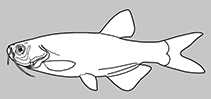
分类 / 名称 俗名 | 同种异名 | Catalog of Fishes(属, 种) | ITIS | CoL | WoRMS | Cloffa
Teleostei > Cypriniformes (Carps) > Danionidae (Danios) > Danioninae
Etymology: Devario: Bangla/Bengali:‘debari’, local name for these fishes; also meaning ‘brother in law’ (Ref. 2031); fangae: Named for Fang Fang (1962-2010), who singled out this species for description as new including separation of the holotype, as the proper discoverer, and also for recognizing her deep personal interest in the freshwater fishes of Myanmar. A noun in the genitive case.
Eponymy: Dr Fang Kullander née Fang (1962–2010) was a Chinese ichthyologist. [...] (Ref. 128868), visit book page.
Etymology: Devario: Bangla/Bengali:‘debari’, local name for these fishes; also meaning ‘brother in law’ (Ref. 2031); fangae: Named for Fang Fang (1962-2010), who singled out this species for description as new including separation of the holotype, as the proper discoverer, and also for recognizing her deep personal interest in the freshwater fishes of Myanmar. A noun in the genitive case.
Eponymy: Dr Fang Kullander née Fang (1962–2010) was a Chinese ichthyologist. [...] (Ref. 128868), visit book page.
环境:氛围 / 气候带 / 深度上下限 / 分布范围 生态学
; 淡水 底中水层性.
分布 领土 | FAO区域 | 生态系 | 标本纪录 | 分布图 | 简介 | Faunafri
Asia: Ayeyarwaddy River drainage in Myanmar.
大小 / 重量 / 年龄
简单描述 检索表 | 型态特徵 | 形态测量图
背的软条 (总数) : 12 - 14; 臀鳍软条: 12 - 14; 脊椎骨: 31 - 34. Devario fangae shares uniquely with D. browni and D. kakhienensis in having an anterior expansion in width of the P stripe. It is distinguished from both species in having a broad P stripe, wider than adjacent interstripes (vs. narrow, as wide as or narrower than interstripes). It is further similar to species of Devario characterized by three dark stripes (P, P+1, P-1) along the side, but can be differentiated from these in having all three stripes wide and of similar width (vs. P stripe wide and P+1 and P-1 stripes much narrower as in D. aequipinnatus, D. acrostomus, D. deruptotalea, D. fangfangae, D. fraseri, and D. gibber). Both D. regina and D. malabaricus possess stripes that are relatively wide but not wider than interspaces and the P stripe is split anteriorly by a short light interspace.
Both D. assamensis (Barman, 1984) from the Brahmaputra River in southern Assam, and D. ostreographus (M’Clelland, 1839), without locality, are extremely deep-bodied, and thus can be easily distinguished from D. fangae. D. fangae differs from D. devario by having infraorbital process and rostral barbell (vs. absent); distinct danionine notch (vs. very shallow); dorsal fin rays with 9½-11½ rays (vs. 15½-17½ rays); lateral line with 30-32 scales (vs. 42-47); and 12 circumpeduncular scales (vs. 16). D. fangae can be differentiated from nominal species D. affinis, D. annandalei, D. strigillifer, D. spinosus and D. yuensis in Myanmar by having fewer scales in the lateral line (30-32, vs. 35-53); fewer circumpeduncular scales (12 vs. 14-20); and absence of a supraorbital process. It can be separated from D. xyrops in having a continuous P stripe (vs. P stripe separated into two blotches); and from D. myitkyinae by the color pattern consisting of three dark, straight horizontal stripes on the middle of the side (vs. up to five irregular stripes), branched dorsal-fin rays 9½-10½, exceptionally 11½, vs. 11½-13½, exceptionally 10½, and branched anal-fin rays 9½-11½ vs. 12½-13½, exceptionally 11½ or 14½. Devario fangae can be distinguished from all remaining species of Devario also by the striped color pattern (vs. a pattern of large blotches as in D. kysonensis, D. pathirana, or smaller blotches as in D. quangbinhensis; a very narrow posterior P stripe as in D. chrysotaeniatus, D. laoensis, D. leptos, D. micronema, D. neilgherriensis; vertical bars as in D. apogon, D. apopyris, D. auropurpureus, D. interruptus, D. jayarami, D. maetaengensis, D. salmonatus, D. shanensis; uniform, with or without a thin dark stripe posteriorly on the side as in D. acuticephala and D. sondhii; P stripe separated into two blotches as in D. anomalus; or wide P stripe posteriorly on side, but no other dark stripes as in D. naganensis). D. fangae differs further from barred devarios, D. fraseri, and D. malabaricus, by having infraorbital process (vs. absent) (Ref. 117334).
Body shape (shape guide): fusiform / normal.
Body shape (shape guide): fusiform / normal.
Found in small hillstreams. During the time of sampling in the low water season, the streams were shallow with depth mostly less than 0.5 m, width rarely more than 3 m, clear water running over gravel, rocks or sand, and relatively fast velocity, including frequent riffles. Syntopic with the following fishes: Amblyceps murraystuarti (Amblycipitidae), Barilius barnoides, Danio flagrans, Garra sp., Pethia tiantian, Puntius compressus (Cyprinidae), Badis pyema (Badidae), Batasio procerus (Bagridae), Heteropneustes fossilis (Clariidae), Mastacembelus armatus (Mastacembelidae), Acanthocobitis sp., Schistura sp. (Nemacheilidae), and Psilorhynchus brachyrhynchus (Psilorhynchidae) (Ref. 117334).
生命周期和交配行为 成熟度 | 繁殖 | 产卵场 | 卵 | 孕卵数 | 仔鱼
主要参考文献
上传您的参考资料 | 参考文献 | 合作者 | 合作者
Kullander, S.O., 2017. Devario fangae and Devario myitkyinae, two new species of danionin cyprinids from northern Myanmar (Teleostei: Cyprinidae: Danioninae). Zootaxa 4227(3):407-421. (Ref. 117334)
CITES
Not Evaluated
对人类的威胁
人类利用
FAO - Publication: search | FishSource |
更多信息
解剖学
鳃区
大脑
耳石
鳃区
大脑
耳石
生理学
身体成分
营养素
耗氧量
游泳类型
游泳速度
视觉色素
鱼声
疾病与寄生虫
毒性(半数致死浓度)
身体成分
营养素
耗氧量
游泳类型
游泳速度
视觉色素
鱼声
疾病与寄生虫
毒性(半数致死浓度)
遗传学
基因组
遗传学
异质性
遗传率
基因多样性
基因组
遗传学
异质性
遗传率
基因多样性
工具
特别资料
下载 XML
网络资源
AFORO (otoliths) | Aquatic Commons | BHL | Cloffa | Websites from users | 核实 FishWatcher | CISTI | Catalog of Fishes: 属, 种 | DiscoverLife | ECOTOX | FAO - Publication: search | Faunafri | Fishipedia | Fishtrace | GloBI | Google Books | Google Scholar | Google | IGFA World Record | OneZoom | Open Tree of Life | Otolith Atlas of Taiwan Fishes | PubMed | Reef Life Survey | Socotra Atlas | TreeBase | 树状分类阶层 | Wikipedia: 转至, 搜寻 | World Records Freshwater Fishing | Zoobank | 动物学的记录
基于模型的估算
系统发育多样性指数 (参考文献 82804): PD50 = 0.5000 [Uniqueness, from 0.5 = low to 2.0 = high].
Bayesian length-weight: a=0.00977 (0.00422 - 0.02262), b=3.04 (2.84 - 3.24), in cm total length, based on LWR estimates for this (Sub)family-body shape (Ref. 93245).
营养阶层 (参考文献 69278): 3.0 ±0.4 se; based on size and trophs of closest relatives
回复力 (参考文献 120179): 高度, 族群倍增时间少于 15个月 (Preliminary K or Fecundity.).