



Allomogurnda multicincta Allen & Hoese, 2017
Uploaden van uw Foto's en video's
Google afbeelding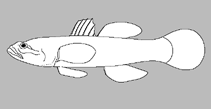 No image available for this species;
drawing shows typical species in Eleotridae.
Google afbeelding
drawing shows typical species in Eleotridae.
Classificatie / Namen Lokale namen | Synoniemen | Catalog of Fishes(Genus, Soort(en)) | ITIS | CoL | WoRMS | Cloffa
> Gobiiformes (Gobies) > Eleotridae (Bully sleepers)
Etymology: multicincta: Name from Latin 'multicincta' meaning many bars or bands; referring to the diagnostic colour pattern of the species.
Etymology: multicincta: Name from Latin 'multicincta' meaning many bars or bands; referring to the diagnostic colour pattern of the species.
Milieu: milieu / Klimaatzone / Diepte / verspreidingsgebied Ecologie
; zoet water benthopelagisch. Tropical
Verspreiding Gebieden | FAO regio's | Ecosystemen | Voorkomen | Verspreidingskaart | Introducties | Faunafri
Western Pacific: Papua New Guinea.
Grootte / Gewicht / Leeftijd
Korte beschrijving Determinatiesleutels | Morfologie | Morfometrie
Dorsale stekels (totaal) : 8 - 9; Dorsale zachte stralen (totaal) : 10 - 12; Anale stekels: 1; Anale zachte stralen: 9 - 11; Wervels: 30 - 32. This species is distinguished by the following characters: D VII-VIII+I,10-12; A I,9-11; pectoral-fin rays 13-15, scales in longitudinal series 35-41; predorsal scales 15-18; no head pores; cycloid predorsal scales, increasing in size anteriorly, reaching forward to above posterior half of eye, the anteriormost 1-3 scales with reverse scale orientation featuring exposed anterior margin; dorsalmost two-thirds of operculum covered with large cycloid scales, in 4-5 rows; naked cheek or with few embedded cycloid scales posterior to eye; the gill opening extends anteroventrally to almost reach the posterior preopercular margin; colour pattern with stripes on lower and middle cheek, short oblique band posterior to dorsoposterior corner of eye, and series of 10-14 vertical brown bars (Ref. 116997).
Body shape (shape guide): elongated; Cross section: compressed.
Body shape (shape guide): elongated; Cross section: compressed.
Occurs in a narrow rainforest creek with slow-flowing sections interrupted by occasional rapids where the fish congregated among branches of submerged logs. The stream has a typical assemblage of small-stream dwelling fishes including Tandanus gjellerupi, Chilatherina fasciata, Melanotaenia affinis, Glossamia gjellerupi, Hephaestus transmontanus, Mogurnda aurofodinae, and Oxyeleotris fimbriata. In 2007, a collection done at the same site by P. Unmack yielded two additional species including Glossogobius torrentis and introduced tilapia Oreochromis mossambica (Ref. 116997).
Levenscyclus en paargedrag Maturiteit | Voortplanting | Paaien | Eieren | Fecunditeit | Larven
Hoofdreferentie
Upload uw referenties | Referenties | Coördinator | Medewerkers
Allen, G.R. and D.F. Hoese, 2017. A new species of Allomogurnda (Gobioidei; Eleotridae) from the Sepik River system of Papua New Guinea. Cybium 41(2):171-177. (Ref. 116997)
Status op de Rode Lijst van het IUCN (Ref. 130435: Version 2025-2 (Global))
Ernstig bedreigd (CR) (B2ab(iii)); Date assessed: 03 December 2019
CITES
Not Evaluated
Gevaar voor de mens
Harmless
Gebruik door de mens
FAO - Publication: search | FishSource |
Meer informatie
Trofische ecologie
Voedsel (prooien)
Dieetsamenstelling
Voedselconsumptie
Voedselrantsoenen
Predatoren
Voedsel (prooien)
Dieetsamenstelling
Voedselconsumptie
Voedselrantsoenen
Predatoren
Ecologie
Ecologie
Ecologie
Populatiedynamica
Groeiparameters
Max. leeftijden / maten
Lengte-gewicht rel.
Lengte-lengte rel.
Lengtefrequenties
Massaconversie
Rekrutering
Abundantie
Groeiparameters
Max. leeftijden / maten
Lengte-gewicht rel.
Lengte-lengte rel.
Lengtefrequenties
Massaconversie
Rekrutering
Abundantie
Levenscyclus
Voortplanting
Maturiteit
Rijpheid/kieuwen rel.
Fecunditeit
Paaien
Paaibestanden
Eieren
Ontwikkeling van de eieren
Larven
Larvale populatiedynamiek
Voortplanting
Maturiteit
Rijpheid/kieuwen rel.
Fecunditeit
Paaien
Paaibestanden
Eieren
Ontwikkeling van de eieren
Larven
Larvale populatiedynamiek
Anatomie
Kieuwoppervlak
Hersenen
Otoliet
Kieuwoppervlak
Hersenen
Otoliet
Fysiologie
Lichaamssamenstelling
Voedingsstoffen
Zuurstofverbruik
Type zwemmen
Zwemsnelheid
Visuele pigmenten
Vis geluid
Ziekten en parasieten
Toxiciteit (LC50)
Lichaamssamenstelling
Voedingsstoffen
Zuurstofverbruik
Type zwemmen
Zwemsnelheid
Visuele pigmenten
Vis geluid
Ziekten en parasieten
Toxiciteit (LC50)
Genetica
genoom
Genetica
Heterozygositeit
Erfelijkheid
Genetische diversiteit
genoom
Genetica
Heterozygositeit
Erfelijkheid
Genetische diversiteit
Menselijk gerelateerd
Aquacultuursystemen
Aquacultuurprofielen
Kweeklijnen
Ciguatera gevallen
Postzegels, munten, diversen.
Aquacultuursystemen
Aquacultuurprofielen
Kweeklijnen
Ciguatera gevallen
Postzegels, munten, diversen.
Tools
Speciale rapporten
Bekijk gegevens voor het houden in een aquarium | Bekijk Fact Sheets voor de soort | Bekijk Aquacultuur Fact Sheets
Download XML
Internetbronnen
AFORO (otoliths) | Aquatic Commons | BHL | Cloffa | Websites from users | Bekijk FishWatcher | CISTI | Catalog of Fishes: Genus, Soort(en) | DiscoverLife | ECOTOX | FAO - Publication: search | Faunafri | Fishipedia | Fishtrace | GloBI | Google Books | Google Scholar | Google | IGFA World Record | OneZoom | Open Tree of Life | Otolith Atlas of Taiwan Fishes | PubMed | Reef Life Survey | Socotra Atlas | TreeBase | Tree of Life | Wikipedia: ga naar, zoek | World Records Freshwater Fishing | Zoobank | Zoological Record
Schattingen op basis van modellen
Fylogenetische diversiteitsindex (Ref. 82804): PD50 = 0.5020 [Uniqueness, from 0.5 = low to 2.0 = high].
Bayesian length-weight: a=0.00741 (0.00323 - 0.01701), b=3.13 (2.94 - 3.32), in cm total length, based on LWR estimates for this (Sub)family-body shape (Ref. 93245).
Trofisch niveau (Ref. 69278): 3.1 ±0.5 se; based on size and trophs of closest relatives
Weerstandsvermogen (Ref. 120179): Hoog, minimale populatieverdubbelingstijd minder dan 15 maanden (Preliminary K or Fecundity.).