Classification / Names
Nomi Comuni | Sinonimi | Catalog of Fishes(Genere, Specie) | ITIS | CoL | WoRMS | Cloffa
>
Gobiiformes (Gobies) >
Gobiidae (Gobies) > Gobionellinae
Etymology: Oxyurichthys: Greek, oxys = sharpen + Greek, oura = tail + Greek, ichthys = fish (Ref. 45335); zeta: Name from the Greek ζήτα (zeta) which gave rise to the last letter of the Roman alphabet u; this elusive species is known from only two specimens and several photographs and is the last species in this revision, although it is unlikely to be the last species described for this genus.
Environment: milieu / climate zone / distribuzione batimetrica / distribution range
Ecologia
marino demersale; distribuzione batimetrica 12 - 38 m (Ref. 103856). Subtropical
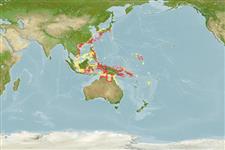
Pacific Ocean: from Japan, Palau, Indonesia, Papua New Guinea and the Solomon Islands.
Size / Peso / Age
Maturità: Lm ? range ? - ? cm
Max length : 4.9 cm SL (female)
Short description
Chiavi di identificazione | Morfologia | Morfometria
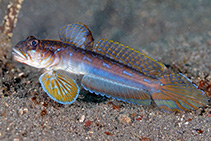
Spine dorsali (totale) : 7; Raggi dorsali molli (totale) : 12; Spine anali: 1; Raggi anali molli: 13. This species is distinguished by the following characters: dorsoposterior of eye without tentacle, cornification or spot; no constriction at premaxillary symphysis of upper lip; first dorsal-fin spines are short, posteriormost spines reaching just beyond second element of second dorsal fin when appressed; anterior nares in small tube and not darkly pigmented; nape has a low membranous crest; absence of gular spots; not spots on scales on dorsum; when alive, with a large blackish blotch on posterior part of first dorsal fin and 4 large diffuse spots along the mid-side of body and one spot on caudal-fin base, also indistinct; no saddle on caudal peduncle; cycloid (reduced ctenoid) scales; naked prepelvic region; lateral scales 100-112; pectoral-fin rays 22; pelvic fins are dusky, not barred or mottled (Ref. 103856).
Body shape (shape guide): elongated; Cross section: compressed.
Specimens are photographed hovering over a dark soft substrate. One individual at Lovina Beach, Bali, appears to be at the entrance of a large burrow (made by another organism).
Life cycle and mating behavior
Maturità | Riproduzione | Deposizione | Uova | Fecundity | Larve
Pezold, P.L. and H.K. Larson, 2015. A revision of the fish genus Oxyurichthys (Gobioidei: Gobiidae) with descriptions of four new species. Zootaxa 3988(1):1-95. (Ref. 103856)
IUCN Red List Status (Ref. 130435: Version 2025-1)
Threat to humans
Harmless
Human uses
Strumenti
Special reports
Download XML
Fonti Internet
Estimates based on models
Phylogenetic diversity index (Fonte Biblio.
82804): PD
50 = 0.5000 [Uniqueness, from 0.5 = low to 2.0 = high].
Bayesian length-weight: a=0.00724 (0.00338 - 0.01553), b=3.05 (2.87 - 3.23), in cm total length, based on LWR estimates for this (Sub)family-body shape (Ref.
93245).
Trophic level (Fonte Biblio.
69278): 3.4 ±0.5 se; based on size and trophs of closest relatives
Resilienza (Fonte Biblio.
120179): Alto, tempo minimo di raddoppiamento della popolazione meno di 15 mesi (Preliminary K or Fecundity.).
Fishing Vulnerability (Ref.
59153): Low vulnerability (10 of 100).
🛈