



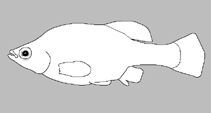
分类 / 名称 俗名 | 同种异名 | Catalog of Fishes(属, 种) | ITIS | CoL | WoRMS | Cloffa
Teleostei > Cyprinodontiformes (Rivulines, killifishes and live bearers) > Goodeidae (Splitfins) > Goodeinae
Etymology: Xenotoca: Greek, xenos = strange + Greek, tokos, oy = birth (Ref. 45335); doadrioi: Named for Dr. Ignacio Doadrio, Museo Nacional de Ciencias Naturales, Spain, who has strongly contributed to the study and knowledge of Mesoamerican fish diversity. An adjective.
Eponymy: Dr Ignacio Doadrio (d: 1957) is a Spanish ichthyologist at the National Museum of Natural Science. [...] (Ref. 128868), visit book page.
Etymology: Xenotoca: Greek, xenos = strange + Greek, tokos, oy = birth (Ref. 45335); doadrioi: Named for Dr. Ignacio Doadrio, Museo Nacional de Ciencias Naturales, Spain, who has strongly contributed to the study and knowledge of Mesoamerican fish diversity. An adjective.
Eponymy: Dr Ignacio Doadrio (d: 1957) is a Spanish ichthyologist at the National Museum of Natural Science. [...] (Ref. 128868), visit book page.
环境:氛围 / 气候带 / 深度上下限 / 分布范围 生态学
; 淡水 底中水层性.
分布 领土 | FAO区域 | 生态系 | 标本纪录 | 分布图 | 简介 | Faunafri
Central America: endemic to the endorheic region of Etzatlan in Jalisco, Mexico.
大小 / 重量 / 年龄
简单描述 检索表 | 型态特徵 | 形态测量图
背的软条 (总数) : 12 - 14; 臀鳍软条: 13 - 15. Xenotoca doadrioi differs from other congeners of the Xenotoca eiseni group and other Xenotoca species occurring in the Pacific Coast drainages by the combination of the following characters (none unique to the species): females with 14 dorsal rays (vs. 15 or 16 in X. melanosoma and 13 in X. lyonsi), 14 anal fin rays (vs. 5 or 16 in X. melanosoma), 12 pectoral fin rays (vs. 13 in Xenotoca eiseni), 8 caudal peduncle scales (vs. 9 in Xenotoca eiseni and X. melanosoma), 32 scales in a lateral series (vs. 31 in Xenotoca lyonsi), and 10 suparorbital pores (vs. 9 in Xenotoca eiseni and X. lyonsi). Females of X. doadrioi have large caudal peduncle (standard length/end of the anal fin-hypural plate distance = 3.8, vs. 4.1-4.2 in X. eiseni and X. lyonsi) and SL/end of dorsal fin-hypural plate distance = 3.6 (vs. 3.9-4.2 in X. eiseni and X. lyonsi), large eye (Head length/Eye Diameter = 3, vs. 3.5-3.7 in X. eiseni and X. lyonsi). Males possess 14 dorsal rays (vs. 15 or 16 in X. melanosoma and 13 in X. lyonsi), 14 anal fin rays (vs. 15 or 16 in X. melanosoma), 12 pectoral rays (vs. 13 in Xenotoca eiseni), 8 caudal peduncle scales (vs. 9 in Xenotoca eiseni and X. melanosoma), 11 transversal scales (vs. 9 in X. lyonsi), 32 scales in a lateral series (vs. 31 in Xenotoca lyonsi) and 10 suprorbital pores (vs. 9 in Xenotoca eiseni and X. lyonsi). It has a smaller head (Head Length/Head High = 1.4, vs. 1.1-1.2 in Xenotoca eiseni and X. lyonsi), the body is less high (Standard Length/pelvic-pectoral fin distance = 4.7 vs. 4-4.4 in Xenotoca eiseni and X. lyonsi) and large caudal peduncle (Standard length/ end of the anal fin-hypural plate distance = 3.8 vs. 4-4.2 in Xenotoca eiseni and X. lyonsi), and standard length /end of dorsal fin-hypural plate distance 3.8 (vs. 4.1-4.3 in Xenotoca eiseni and X. lyonsi) (Ref. 117630).
Body shape (shape guide): fusiform / normal.
Body shape (shape guide): fusiform / normal.
This species occurs in permanent pond, spring, reservoir, and seasonally affected streams. The type locality is a permanent pond where this species inhabits an area with turbid and shallow water of no more than 1.5 m deep and with bottom comprising of mud and gravel and no water plants present. Other fishes collected in the area are the following: Xenotoca melanosoma, Goodea atripinnis, Poeciliopsis infans, and the introduced Xiphophorus variatus and Oreochromis sp.. In the El Moloya Spring, this species inhabits clear water with gravel to muddy bottom and water plants. The following species are found in this pond: X. melanosoma, Zoogoneticus purepechus, Ameca splendens, G. atripinnis, P. infans, and the introduced Oreochromis sp. In Oconahua Dam, this species live in turbid water with a muddy bottom and with few water plants. Other species occurring in this dam include the following: X. melanosoma, G. atripinnis, P. infans, as well as the introduced Lepomis macrochirus, and Cyprinus carpio. This species is also collected in a seasonally fluctuating stream (San Marcos stream) that is dry for most of the year, but when water is present the surface of the stream is totally cover with Eichhornia crassipes Martius, Thypa sp., and Cyperus sp. and the water at this site is highly polluted by organic matter and is turbid. This species is also found in Sahuaripa stream, an irrigation channel totally modified and fed by a water pump. Other species collected in San Marcos and Sahuaripa streams are X. melanosoma, Allotoca sp., G. atripinnis, P. infans, and Oreochromis sp. (Ref. 117630).
生命周期和交配行为 成熟度 | 繁殖 | 产卵场 | 卵 | 孕卵数 | 仔鱼
主要参考文献
上传您的参考资料 | 参考文献 | 合作者 | 合作者
Domínguez-Domínguez, O., D.M. Bernal-Zuñiga and K.R. Piller, 2016. Two new species of the genus Xenotoca Hubbs and Turner, 1939 (Teleostei; Goodeidae) from the central-western Mexico. Zootaxa 4189(1):81-98. (Ref. 117630)
世界自然保护联盟红皮书 (Ref. 130435: Version 2025-2 (Global))
极度濒危 (CR) (B1ab(i,ii,iii,iv)); Date assessed: 14 March 2017
CITES
Not Evaluated
对人类的威胁
人类利用
渔业: 没有兴趣
FAO - Publication: search | FishSource |
更多信息
解剖学
鳃区
大脑
耳石
鳃区
大脑
耳石
生理学
身体成分
营养素
耗氧量
游泳类型
游泳速度
视觉色素
鱼声
疾病与寄生虫
毒性(半数致死浓度)
身体成分
营养素
耗氧量
游泳类型
游泳速度
视觉色素
鱼声
疾病与寄生虫
毒性(半数致死浓度)
遗传学
基因组
遗传学
异质性
遗传率
基因多样性
基因组
遗传学
异质性
遗传率
基因多样性
工具
特别资料
下载 XML
网络资源
AFORO (otoliths) | Aquatic Commons | BHL | Cloffa | Websites from users | 核实 FishWatcher | CISTI | Catalog of Fishes: 属, 种 | DiscoverLife | ECOTOX | FAO - Publication: search | Faunafri | Fishipedia | Fishtrace | GloBI | Google Books | Google Scholar | Google | IGFA World Record | OneZoom | Open Tree of Life | Otolith Atlas of Taiwan Fishes | PubMed | Reef Life Survey | Socotra Atlas | TreeBase | 树状分类阶层 | Wikipedia: 转至, 搜寻 | World Records Freshwater Fishing | Zoobank | 动物学的记录
基于模型的估算
系统发育多样性指数 (参考文献 82804): PD50 = 0.5312 [Uniqueness, from 0.5 = low to 2.0 = high].
Bayesian length-weight: a=0.01202 (0.00468 - 0.03088), b=3.01 (2.79 - 3.23), in cm total length, based on LWR estimates for this (Sub)family-body shape (Ref. 93245).
营养阶层 (参考文献 69278): 2.1 ±0.1 se; based on size and trophs of closest relatives