Классификация / Names
народные названия | синонимы | Catalog of Fishes(род, виды) | ITIS | CoL | WoRMS | Cloffa
>
Siluriformes (Catfishes) >
Loricariidae (Armored catfishes) > Hypostominae
Etymology: Cryptancistrus: Derived from the Greek names kryptos (hidden), and ankistron (hook), in reference to the genera Ancistrus, type genus of the tribe Ancistrini to which it and Guyanancistrus, to which it is externally the most similar, belong; similis: From the Latin similis, meaning similar, in reference to the strong morphological resemblance between the new species of Cryptancistrus and the type species of Guyanancistrus, G. brevispinis.
Environment: milieu / climate zone / пределы глубины / distribution range
экология
; пресноводный демерсальный. Tropical
South America: Upper Parú de Oeste River in Brazil based on a single specimen.
Size / Вес / Возраст
половая зрелость: Lm ? range ? - ? cm
Max length : 6.2 cm SL самец/пол неопределен; (Ref. 116863)
Краткое описание
определительные ключи | морфология | морфометрия
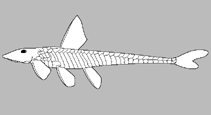
колючие лучи спинного плавника (общее число) : 2; членистые (мягкие) лучи спинного плавника (общее число) : 7; членистые (мягкие) лучи анального плавника: 6. Cryptancistrus similis is diagnosed by having a unique barcode sequence (GBOL736-14). It differs from all other species under Hypostominae by the following combination of characters : dorsoventrally depressed head and body; no prominent ridge or crest formed on head and body plates; rounded snout, covered with contiguous plates except tip region, and posterior part of lateral margin of snout; latter area forming a soft fleshy border, and bearing slightly enlarged odontodes associated with small fleshy tentacules sensu; odontodes over a broad area on the opercle present; numerous enlarged cheek odontodes supported by evertible plates present; odontodes straight with tips slightly curved, as opposed to strongly hook-shaped; whisker-like cheek odontodes lacking; enlarged odontodes along snout margin absent; dorsal iris operculum present; lips forming an oval disk; numerous viliform and bicuspid teeth on dentary and premaxillary; a small buccal papilla present, enlarged dentary papilla absent; dorsal fin with seven branched rays; adipose fin present; membranous extension between end of dorsal fin and adipose fin absent; five series of lateral plates extending to caudal fin; lateral plates not keeled and not bearing enlarged odontodes; angular but not keeled lateral plates of ventral series on caudal peduncle; abdominal region entirely naked. It morphologically closely resembles species of Guyanancistrus but it differs from them primarily by the fleshy posterior part of lateral margin of snout bearing slightly enlarged odontodes associated with small fleshy tentacules (vs. plates along margin of snout forming a rigid armour covered with minute odontodes, absence of tentacules). It can be further diagnosed from all species of Guyanancistrus by a skin region bordering the exposed portion of opercle roughly as large as the latter (vs. distinctly narrower than the latter) (Ref. 116863).
Body shape (shape guide): elongated.
Life cycle and mating behavior
половая зрелость | размножение | нерест | икра | Fecundity | личинки
Fisch-Muller, S., J.H.A. Mol and R. Covain, 2018. An integrative framework to reevaluate the Neotropical catfish genus Guyanancistrus (Siluriformes: Loricariidae) with particular emphasis on the Guyanancistrus brevispinis complex. Plos ONE 13(1):e0189789. (Ref. 116863)
Статус Красного Списка МСОП (Ref. 130435: Version 2025-1)
Угроза для людей
Harmless
Использование человеком
дополнительная информация
инструменты
Специальные отчеты
Скачать в формате XML
ресурсы в Интернет
Estimates based on models
Phylogenetic diversity index (ссылка
82804): PD
50 = 1.0000 [Uniqueness, from 0.5 = low to 2.0 = high].
Bayesian length-weight: a=0.01549 (0.00719 - 0.03336), b=2.98 (2.81 - 3.15), in cm total length, based on LWR estimates for this (Sub)family-body shape (Ref.
93245).
устойчивость к внешним воздействиям (ссылка
120179): высокий, минимальное время удвоения популяции до 15 месяцев (Preliminary K or Fecundity.).
Fishing Vulnerability (Ref.
59153): Low vulnerability (10 of 100).
🛈