This website uses cookies to enhance your browsing experience and ensure the functionality of our site. For more detailed information about the types of cookies we use and how we protect your privacy, please visit our Privacy Information page.
×
Cookie Settings
This website uses different types of cookies to enhance your experience. Please select your preferences below:
> Gobiiformes (Gobies) > Gobiidae (Gobies) > Gobiinae
Etymology: Trimma:Greek, trimma, -atos = something crushed (Ref. 45335); nauagium:Name from the Greek ‘nauagia’ meaning shipwreck, referring to the type locality and only known habitat.
Environnement : milieu / zone climatique / profondeur / gamme de distribution Écologie
marin récifal; profondeur 23 - 28 m (Ref. 100512). Tropical
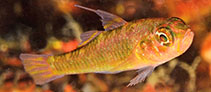
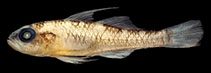
Épines dorsales (Total) : 7; Rayons mous dorsaux (Total) : 8; Épines anales: 1; Rayons mous anaux: 8. This species is distinguished by the following set of characters: D VI + I, 8, the second and third spines elongated, reaching to base of fifth or sixth segmented ray of second dorsal fin when adpressed; A I,8; pectoral rays 16; the fifth pelvic ray branched, 56-64% length of fourth pelvic ray; the bony interorbital about equal to pupil diameter; the predorsal, cheek, and opercle are fully scaled; pattern of cephalic sensory papillae includes 5 transverse rows below eye; colour in life brownish with pink zone along upper side and 7 darker brown saddles on back interspersed with smaller golden saddles, a narrow white bar behind eye, and a yellowish bar at the base of pectoral fin (Ref. 100512). Body shape (shape guide): elongated; Cross section: oval.
Numerous individuals were found along the vertical, stern section of the outer hull of the vessel in about 23-28 m depth. The iron hull was completely encrusted with marine growth, especially algae, gorgonians, tunicates, and sponges. The fishes either rested on the bottom or hovered in midwater usually in small groups (Ref. 100512).
Cycle de vie et comportement reproducteur Maturité | Reproduction | Frai | Œufs | Fécondité | Larves
Dynamique des populations Paramètres de croissance Âges / tailles maximales Longueur-poids rel. Rel. longueur-longueur. Fréquences de longueurs Conversion de masse Recrutement Abondance
Cycle de vie Reproduction Maturité Maturité/épines rel. Fécondité Frai Agrégats de frai Œufs Développement de l'œuf Larves Dynamique des populations larvaires
Physiologie Composition corporelle Nutriments Consommation d'oxygène Type de natation Vitesse de nage Pigments visuels Son de poisson Maladies et parasites Toxicité (CL50)
Indice de diversité phylogénétique (Réf. 82804): PD50 = 0.5000 [Uniqueness, from 0.5 = low to 2.0 = high].
Bayesian length-weight: a=0.00741 (0.00347 - 0.01582), b=3.09 (2.91 - 3.27), in cm total length, based on LWR estimates for this (Sub)family-body shape (Ref. 93245).
Résilience (Réf. 120179): Haut, temps minimum de doublement de population inférieur à 15 mois (Preliminary K or Fecundity.).
Vulnérabilité de la pêche (Ref. 59153): Low vulnerability (10 of 100). 🛈