



Brachyhypopomus provenzanoi Crampton, de Santana, Waddell & Lovejoy, 2017
Ladda upp din foton och Videor
Google image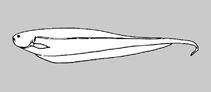 No image available for this species;
drawing shows typical species in Hypopomidae.
Google image
drawing shows typical species in Hypopomidae.
Klassificering / Namn Populärnamn | synonymer | Catalog of Fishes(Släkte, Arter) | ITIS | CoL | WoRMS | Cloffa
> Gymnotiformes (Knifefishes) > Hypopomidae (Bluntnose knifefishes)
Etymology: Brachyhypopomus: Greek, brachys, eia = short + Greek, hypo = under + Greek, poma, -atos = cover (Ref. 45335); provenzanoi: Named for Francisco Provenzano Rizzi, Venezuelan ichthyologist, for his contributions to Neotropical ichthyology. A noun in the genitive case.
Eponymy: Dr Francisco Provenzano Rizzi is an ichthyologist at Museum of Biology, Instituto de Zoología Tropical de la Universidad Central de Venezuela, where both his bachelor’s degree (1980) and his doctorate (2012) were awarded. [...] (Ref. 128868), visit book page.
Etymology: Brachyhypopomus: Greek, brachys, eia = short + Greek, hypo = under + Greek, poma, -atos = cover (Ref. 45335); provenzanoi: Named for Francisco Provenzano Rizzi, Venezuelan ichthyologist, for his contributions to Neotropical ichthyology. A noun in the genitive case.
Eponymy: Dr Francisco Provenzano Rizzi is an ichthyologist at Museum of Biology, Instituto de Zoología Tropical de la Universidad Central de Venezuela, where both his bachelor’s degree (1980) and his doctorate (2012) were awarded. [...] (Ref. 128868), visit book page.
Miljö: miljö / Klimatzon / djupintervall / distributionsområde Ekologi
; sötvatten bentopelagisk; pH range: 3.1 - 4.0. Tropical; 26°C - 28°C (Ref. 116763)
Utbredning Territorier | FAO områden | Ekosystem | Förekomster | Prickkarta | Utplanteringar | Faunafri
South America: upper Orinoco and upper Negro (Amazonas drainage) in Venezuela.
Storlek / Vikt / Ålder
Könsmognad: Lm ? range ? - ? cm
Max length : 9.4 cm TL hane/ej könsbestämd; (Ref. 116763); 11.0 cm TL (female)
Max length : 9.4 cm TL hane/ej könsbestämd; (Ref. 116763); 11.0 cm TL (female)
Kort beskrivning Bestämningsnycklar | Morfologi | Morfometri
Mjukstrålar i analfenan: 162 - 195. Brachyhypopomus provenzanoi is distinguished from other species of the genus Brachyhypopomus by the absence of scales in middorsal region of anterior third of body (vs. presence in all congeners except B. benjamini) and by its dorsal surface of body with irregular pattern of distinct dark blotches on depigmented tan-colored background (vs. speckled with small brown chromatophores on light brown background in B. benjamini) (Ref. 116763)
Body shape (shape guide): elongated.
Body shape (shape guide): elongated.
Facultative air-breathing in the genus (Ref. 126274); Found in small, gently flowing, low-conductivity clearwater terra firme forest and savanna streams, and in static leaf-litter choked blackwater streams and swamps in Mauritia palm swamps. Most specimens in streams were observed sheltering in submerged and marginal aquatic vegetation growing in sandy beds, and those in Mauritia palm swamps were collected from dense leaf litter banks and root mats. Sympatric and syntopic with Brachyhypopomus bullocki, B. brevirostris, and B. sullivani in the type locality region. Food items food in the stomach contents were aquatic insect larvae and other small aquatic invertebrates (Ref. 116763).
Livscykel och parningsbeteende Könsmognad | Reproduktion | Lek | Ägg | Fekunditet | Larver
Huvudreferens
Ladda upp dina referenser | referenser | Koordinator : Albert, James S. | Medarbetare
Crampton, W.G.R., C.D. de Santana, J.C. Waddell and N.R. Lovejoy, 2017. A taxonomic revision of the Neotropical electric fish genus Brachyhypopomus (Ostariophysi: Gymnotiformes: Hypopomidae), with descriptions of 15 new species. Neotrop. ichthyol. 14(4):e150146. (Ref. 116763)
Status på IUCN:s rödlista (Ref. 130435: Version 2025-2 (Global))
Data deficient (DD) ; Date assessed: 07 September 2020
CITES
Not Evaluated
Hot mot människor
Harmless
Mänskliga användningsområden
Fiskeri: saknar intresse
FAO - Publication: search | FishSource |
Ytterligare information
Trofisk ekologi
Livsmedelsartiklar (preys)
Födosammansättning
Födointag
Matransoner
Predatorer
Livsmedelsartiklar (preys)
Födosammansättning
Födointag
Matransoner
Predatorer
Populationsdynamik
Tillväxtparametrar
Max. åldrar / storlekar
Längd-vikt rel.
Längd-längd rel.
Längd-frekvenser
Massakonvertering
Rekrytering
Abundans
Tillväxtparametrar
Max. åldrar / storlekar
Längd-vikt rel.
Längd-längd rel.
Längd-frekvenser
Massakonvertering
Rekrytering
Abundans
Livscykel
Reproduktion
Könsmognad
Mognad/Gills rel.
Fekunditet
Lek
Lekande aggregat
Ägg
Utveckling av ägg
Larver
Larvdynamik
Reproduktion
Könsmognad
Mognad/Gills rel.
Fekunditet
Lek
Lekande aggregat
Ägg
Utveckling av ägg
Larver
Larvdynamik
Anatomi
Gälyta
Hjärna
Otolit
Gälyta
Hjärna
Otolit
Fysiologi
Kroppssammansättning
Näringsämnen
Syreförbrukning
Typ av simning
Simhastighet
Visuella pigment
Ljud från fisk
Sjukdomar & Parasiter
Toxicitet (LC50)
Kroppssammansättning
Näringsämnen
Syreförbrukning
Typ av simning
Simhastighet
Visuella pigment
Ljud från fisk
Sjukdomar & Parasiter
Toxicitet (LC50)
Genetik
Genom
Genetik
Heterozygositet
Ärftlighet
Genetisk mångfald
Genom
Genetik
Heterozygositet
Ärftlighet
Genetisk mångfald
Människorelaterad
Vattenbrukssystem
Vattenbruksprofiler
Avelslinjer
Ciguatera-fall
Frimärken, mynt, diverse.
Vattenbrukssystem
Vattenbruksprofiler
Avelslinjer
Ciguatera-fall
Frimärken, mynt, diverse.
Verktyg
Särskilda rapporter
Kontrollera för underhåll av akvarium | Kontrollera om det finns faktablad om arter | Kontrollera om det finns faktablad om vattenbruk
Ladda ner XML
Internet-källor
AFORO (otoliths) | Aquatic Commons | BHL | Cloffa | Websites from users | Check FishWatcher | CISTI | Catalog of Fishes: Släkte, Arter | DiscoverLife | ECOTOX | FAO - Publication: search | Faunafri | Fishipedia | Fishtrace | GloBI | Google Books | Google Scholar | Google | IGFA World Record | OneZoom | Open Tree of Life | Otolith Atlas of Taiwan Fishes | PubMed | Reef Life Survey | Socotra Atlas | TreeBase | Tree of Life | Wikipedia: Go, sök | World Records Freshwater Fishing | Zoobank | Zoologiskt register
Uppskattningar baserade på modeller
Index för fylogenetisk mångfald (Ref. 82804): PD50 = 0.5000 [Uniqueness, from 0.5 = low to 2.0 = high].
Bayesian length-weight: a=0.00372 (0.00141 - 0.00980), b=3.06 (2.83 - 3.29), in cm total length, based on LWR estimates for this (Sub)family-body shape (Ref. 93245).
Trofisk nivå (Ref. 69278): 3.1 ±0.4 se; based on size and trophs of closest relatives