



Brachyhypopomus palenque Crampton, de Santana, Waddell & Lovejoy, 2017
分類 / 名前 共通名の | 類義語 | Catalog of Fishes(部類, 種) | ITIS | CoL | WoRMS | Cloffa
> Gymnotiformes (Knifefishes) > Hypopomidae (Bluntnose knifefishes)
Etymology: Brachyhypopomus: Greek, brachys, eia = short + Greek, hypo = under + Greek, poma, -atos = cover (Ref. 45335); palenque: Derived from the río Palenque, a Pacific Ocean drainage of Ecuador, where the type series was collected. A noun in apposition.
Etymology: Brachyhypopomus: Greek, brachys, eia = short + Greek, hypo = under + Greek, poma, -atos = cover (Ref. 45335); palenque: Derived from the río Palenque, a Pacific Ocean drainage of Ecuador, where the type series was collected. A noun in apposition.
環境:環境 / 気候帯 / 深さの範囲 / 分布範囲 生態学
; 新鮮な水 底生の漂泳性; pH range: 6.5 - ?. Tropical; 24°C - 24°C (Ref. 116763)
分布 領土 | 国連食糧農業機関の区域 | エコシステム | 事件 | 目的のマップ | 導入 | Faunafri
South America: Ecuador.
サイズ / 重さ / 年齢
簡単な記述 検索表 | 形態学 | 形態計測学
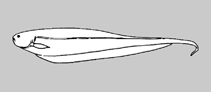
臀鰭: 180 - 229. Brachyhypopomus palenque is distinguished from other species of the genus Brachyhypopomus by the following combination of characters: caudal filament length 7.4-14.0% of length to end of anal fin (vs. 14.1-83.1% in B. alberti, B. batesi, B. benjamini, B. brevirostris, B. bullocki, B. cunia, B. draco, B. gauderio, B. hamiltoni, B. hendersoni, B. janeiroensis, B. jureiae, B. menezesi, B. pinnicaudatus, B. provenzanoi, B. sullivani, and B. walteri); pale stripe along middorsal region absent (vs. prominent pale uninterrupted middorsal stripe from occipital region to base of caudal filament present in B. arrayae, B. beebei, and B. belindae); mouth width 25.1-37.8% HL (vs. 15.9-23.2% in B. bennetti and B. flavipomus); accessory electric organ over the opercular region absent (vs. present in B. bombilla and B. regani); 19-22 precaudal vertebrae (vs. 24-26 in B. verdii); continuous or discontinuous dark vertical or diagonally oriented bars or saddles on body surface dorsal to lateral line absent (vs. present in B. diazi and B. palenque) (Ref. 116763).
Body shape (shape guide): elongated.
Body shape (shape guide): elongated.
Facultative air-breathing in the genus (Ref. 126274); Inhabits small streams and rivers to an altitude of ca. 650 m. Collected from leaf litter or submerged root mats, usually up against or under logs or large rocks. Omnivorous. Feeds on aquatic invertebrates, predominantly larval Chironomidae and Coleoptera in the type locality (Ref. 116763).
ライフサイクルと交尾行動 成熟 | 繁殖 | 放精 | 卵 | 生産力 | 幼生
主な参考文献
参考文献のアップロード | 参考文献 | コーディネーター : Albert, James S. | 協力者
Crampton, W.G.R., C.D. de Santana, J.C. Waddell and N.R. Lovejoy, 2017. A taxonomic revision of the Neotropical electric fish genus Brachyhypopomus (Ostariophysi: Gymnotiformes: Hypopomidae), with descriptions of 15 new species. Neotrop. ichthyol. 14(4):e150146. (Ref. 116763)
CITES
Not Evaluated
人間に対する脅威
Harmless
人間の用途
水産業: 興味がない
FAO - Publication: search | FishSource |
より多くの情報
ライフサイクル
繁殖
成熟
成熟度/エラ
生産力
放精
産卵群
卵
卵の開発
幼生
幼生の動力
繁殖
成熟
成熟度/エラ
生産力
放精
産卵群
卵
卵の開発
幼生
幼生の動力
解剖学
カマ
脳
オトリス
カマ
脳
オトリス
生理学
体組成
栄養素
酸素消費
水泳タイプ
泳ぐ速さ
視覚色素
フィッシュ・サウンド
病気と寄生虫
毒性(LC50)
体組成
栄養素
酸素消費
水泳タイプ
泳ぐ速さ
視覚色素
フィッシュ・サウンド
病気と寄生虫
毒性(LC50)
遺伝子の
ゲノム
遺伝子の
ヘテロ接合性
遺伝
遺伝的多様性
ゲノム
遺伝子の
ヘテロ接合性
遺伝
遺伝的多様性
用具
特記事項
XMLをダウンロードして下さい
インターネットの情報源
AFORO (otoliths) | Aquatic Commons | BHL | Cloffa | Websites from users | Check FishWatcher | CISTI | Catalog of Fishes: 部類, 種 | DiscoverLife | ECOTOX | FAO - Publication: search | Faunafri | Fishipedia | Fishtrace | GloBI | Google Books | Google Scholar | Google | IGFA World Record | OneZoom | Open Tree of Life | Otolith Atlas of Taiwan Fishes | PubMed | Reef Life Survey | Socotra Atlas | TreeBase | 生命の木 | Wikipedia: 行く, 検索する | World Records Freshwater Fishing | Zoobank | 動物に関する記録
モデルに基づく推定値
系統多様性指数 (参照 82804): PD50 = 0.5000 [Uniqueness, from 0.5 = low to 2.0 = high].
Bayesian length-weight: a=0.00372 (0.00141 - 0.00980), b=3.06 (2.83 - 3.29), in cm total length, based on LWR estimates for this (Sub)family-body shape (Ref. 93245).
栄養段階 (参照 69278): 3.2 ±0.4 se; based on size and trophs of closest relatives