



Brachyhypopomus cunia Crampton, de Santana, Waddell & Lovejoy, 2017
muatnaik fotos/gambar dan video
imej Google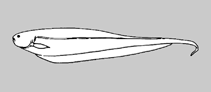 No image available for this species;
drawing shows typical species in Hypopomidae.
imej Google
drawing shows typical species in Hypopomidae.
klasifikasi / Nama Nama-nama umum | Sinonim (persamaan) | Catalog of Fishes(Marga, Jenis) | ITIS | CoL | WoRMS | Cloffa
> Gymnotiformes (Knifefishes) > Hypopomidae (Bluntnose knifefishes)
Etymology: Brachyhypopomus: Greek, brachys, eia = short + Greek, hypo = under + Greek, poma, -atos = cover (Ref. 45335); cunia: Named for the its type locality, lago Cuniã, a floodplain lake of the lower rio Madeira inside the Reserva Extrativista do lago do Cuniã. A noun in apposition.
Etymology: Brachyhypopomus: Greek, brachys, eia = short + Greek, hypo = under + Greek, poma, -atos = cover (Ref. 45335); cunia: Named for the its type locality, lago Cuniã, a floodplain lake of the lower rio Madeira inside the Reserva Extrativista do lago do Cuniã. A noun in apposition.
Lingkungan: lingkungan / zona iklim / kisaran kedalaman / jangkauan distribusi Ekologi
; air tawar bentopelagis; pH range: 7.1 - ?. Tropical; 28°C - ? (Ref. 116763)
Penyebaran Wilayah | Daerah-daerah FAO | Ekosistem | Kemunculan | peta titik | Introduksi | Faunafri
South America: Rio Madeira, Brazil.
Ukuran / Berat / umur
deskripsi pendek Kunci identifiaksi (pengenalan) | Morfologi | Morfometrik
Sirip dubur lunak: 177 - 224. Brachyhypopomus cunia is distinguished from other species of the genus Brachyhypopomus by the following combination of characters: 16-17 precaudal vertebrae (vs. 18-26 in B. alberti, B. arrayae, B. beebei, B. belindae, B. brevirostris, B. draco, B. flavipomus, B. gauderio, B. hamiltoni, B. janeiroensis, B. jureiae, B. palenque, B. pinnicaudatus, and B. verdii; head depth at eye 47.8-60.0% HL (vs. 36.3-47.7% in B. batesi, B. bombilla, B. provenzanoi, B. regani, and B. sullivani); presence of scales in middorsal region of anterior third of body (vs. absence in B. benjamini; pectoral fin with 10-13 rays (vs. 14-20 in B. bennetti, B. diazi, B. menezesi, and B. occidentalis); mouth width 24.8- 38.0% HL (vs. 15.7-22.6% in B. hendersoni). It has overlapping meristic counts and morphological measurements with B. bullocki and B. walteri, but can be diagnosed by having a very distinctive pigmentation pattern consisting of ventral portions of the flank, over the anal-fin pterygiophores, darkly pigmented, forming a dark stripe along the base of the anal fin (also shared with B. hendersoni), and numerous discrete dark spots (each has a cluster of dark chromatophores) which are scattered over the anal-fin pterygiophores, and in some specimens form an irregular dotted line along the lateral line (vs. absence of dark stripe along the anal-fin base and absence of discrete dark spots over the ventral flank in B. bullocki and B. walteri) (Ref. 116763).
Body shape (shape guide): elongated.
Body shape (shape guide): elongated.
Facultative air-breathing in the genus (Ref. 126274); Occurs in floodplain habitats with low conductivity. Occurs sympatrically above the major series of rapids and falls in the lower Madeira with Brachyhypopomus alberti, B. arrayae, B. bombilla, B. brevirostris, B. pinnicaudatus, B. sullivani, and B. walteri; and sympatrically and syntopically below the lower Madeira rapids with B. brevirostris, B. pinnicaudatus, and B. walteri (Ref. 116763). Feeds on aquatic insect larvae and other small aquatic invertebrates (Ref. 116763).
Siklus hidup dan perilaku kawin Kematangan | Reproduksi, perkembang biakan | Pemijahan | telur-telur | Fekunditas | Larva
rujukan utama
Unggah referensi Anda | Acuan | Koordinator : Albert, James S. | mitra
Crampton, W.G.R., C.D. de Santana, J.C. Waddell and N.R. Lovejoy, 2017. A taxonomic revision of the Neotropical electric fish genus Brachyhypopomus (Ostariophysi: Gymnotiformes: Hypopomidae), with descriptions of 15 new species. Neotrop. ichthyol. 14(4):e150146. (Ref. 116763)
Status IUCN Red List (Ref. 130435: Version 2025-2 (Global))
kurang bimbang (LC) ; Date assessed: 09 November 2020
CITES
Not Evaluated
ancaman kepada manusia
Harmless
penggunaan manusia
FAO - Publication: search | FishSource |
informasi lanjut
Ekologi trofik
Item makanan (mangsa)
Komposisi makanan
Konsumsi makanan
Ransum makanan
Pemangsa
Item makanan (mangsa)
Komposisi makanan
Konsumsi makanan
Ransum makanan
Pemangsa
Dinamika populasi
Parameter pertumbuhan
Maks. usia / ukuran
Panjang-berat rel.
Panjang-panjang rel.
ukuran frekuensi
Konversi massa
pemulihan
Kelimpahan
Parameter pertumbuhan
Maks. usia / ukuran
Panjang-berat rel.
Panjang-panjang rel.
ukuran frekuensi
Konversi massa
pemulihan
Kelimpahan
Siklus hidup
Reproduksi, perkembang biakan
Kematangan
Kedewasaan / insang rel.
Fekunditas
Pemijahan
Agregasi pemijahan
telur-telur
pekembangan telor
Larva
Dinamika larva
Reproduksi, perkembang biakan
Kematangan
Kedewasaan / insang rel.
Fekunditas
Pemijahan
Agregasi pemijahan
telur-telur
pekembangan telor
Larva
Dinamika larva
Anatomi
Area insang
Otak
Otolith
Area insang
Otak
Otolith
Fisiologi
Komposisi tubuh
Nutrisi
Konsumsi oksigen
Jenis renang
Kecepatan berenang
Pigmen visual
Suara ikan
Penyakit & Parasit
Toksisitas (LC50)
Komposisi tubuh
Nutrisi
Konsumsi oksigen
Jenis renang
Kecepatan berenang
Pigmen visual
Suara ikan
Penyakit & Parasit
Toksisitas (LC50)
Genetika
genom
Genetika
Heterozigositas
Diturunkan
Keanekaragaman Genetik
genom
Genetika
Heterozigositas
Diturunkan
Keanekaragaman Genetik
Yang berhubungan dengan manusia
Sistem akuakultur
profil budidaya air
Strain
Kasus Ciguatera
Perangko, koin, dll.
Sistem akuakultur
profil budidaya air
Strain
Kasus Ciguatera
Perangko, koin, dll.
Alat, peralatan
E-book | Penuntun lapangan | tanda freqkuenci panjang | peringkat sejarah hidup | peta titik |
Tangkap-MSY |
laporan khas
muat turun XML
Sumber internet
AFORO (otoliths) | Aquatic Commons | BHL | Cloffa | Websites from users | semak peneliti ikan | CISTI | Catalog of Fishes: Marga, Jenis | DiscoverLife | ECOTOX | FAO - Publication: search | Faunafri | Fishipedia | Fishtrace | GloBI | Google Books | Google Scholar | Google | IGFA World Record | OneZoom | Open Tree of Life | Otolith Atlas of Taiwan Fishes | PubMed | Reef Life Survey | Socotra Atlas | TreeBase | Tree of Life | Wikipedia: pergi, Cari | World Records Freshwater Fishing | Zoobank | Catatan Zoologi
Estimasi berdasarkan model
Indeks keanekaragaman filogenetik (Acuan 82804): PD50 = 0.5000 [Uniqueness, from 0.5 = low to 2.0 = high].
Bayesian length-weight: a=0.00372 (0.00141 - 0.00980), b=3.06 (2.83 - 3.29), in cm total length, based on LWR estimates for this (Sub)family-body shape (Ref. 93245).
Tingkat Trofik (Acuan 69278): 3.1 ±0.4 se; based on size and trophs of closest relatives