



Paramormyrops ntotom Rich, Sullivan & Hopkins, 2017
分类 / 名称 俗名 | 同种异名 | Catalog of Fishes(属, 种) | ITIS | CoL | WoRMS | Cloffa
Teleostei > Osteoglossiformes (Bony tongues) > Mormyridae (Elephantfishes)
Etymology: Paramormyrops: Greek, para = near + Greek, mormyros = a fish (Sparus sp) (Ref. 45335); ntotom: The species name, ntotom, is the word for mormyrid fish in the language of the Fang people from northern Gabon, Equatorial Guinea and southern Cameroon (Ref. 116799).
Etymology: Paramormyrops: Greek, para = near + Greek, mormyros = a fish (Sparus sp) (Ref. 45335); ntotom: The species name, ntotom, is the word for mormyrid fish in the language of the Fang people from northern Gabon, Equatorial Guinea and southern Cameroon (Ref. 116799).
环境:氛围 / 气候带 / 深度上下限 / 分布范围 生态学
; 淡水 底中水层性.
分布 领土 | FAO区域 | 生态系 | 标本纪录 | 分布图 | 简介 | Faunafri
Africa: Ogowe River in Gabon (Ref. 116799).
大小 / 重量 / 年龄
简单描述 检索表 | 型态特徵 | 形态测量图
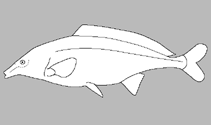
背棘 (总数) : 0; 背的软条 (总数) : 19 - 21; 臀棘: 0; 臀鳍软条: 24 - 26; 脊椎骨: 41 - 44. Diagnosis: Paramormyrops ntotom is distinguished from all other Lower-Guinea Paramormyrops by a combination of morphological and electrical characteristics: 5 teeth in upper-jaw, 6 in lower; 12 circumpeduncular scales; V-shaped snout profile viewed from above, snout angle 38-50°, corresponding to an interorbital width 0.8-1.05 times the snout length; body depth 14.9-18.1% of standard length, 81-91.6% of body depth at urogenital pore; eye diameter 12.4-14.7% of head length measured to end of opercular bone; snout length 23.8-28.3% of head length; ratio of head length to depth 1.25-1.40; head length 20.4-24.6% of standard length; EOD waveform with two phases, head positive then negative, duration 4.78 ± 1.10 ms with a corresponding peak power spectral frequency, 265 ± 67 Hz; electric organ composed of type NPp electrocytes (Ref. 116799). With its 5/6 teeth, 12 circumpeduncular scales and sharp snout, Paramormyrops ntotom differs from all other described Paramormyrops except P. curvifrons and P. spekodes (Ref. 116799). Five morphological characters distinguish P. ntotom from P. curvifrons: ratio of head length to standard length shorter in P. ntotom compared with P. curvifrons; slight concave depression in the forehead in advance of the orbit and a relatively compact snout compared to P. curvifrons which has a longer snout, downward sloping, often with a slightly protruding chin and upper lip; shorter prepectoral distance relative to predorsal distance; snout angle greater in P. ntotom than P. curvifrons; and the head depth relative to head length greater in P. ntotom than in P. curvifrons; EOD duration slightly longer in P. ntotom compared with P. curvifrons, with extensive overlap; both species have type NPp electrocytes in the electric organ and both exhibit sex differences in EOD duration (Ref. 116799). Paramormyrops ntotom differs from P. sphekodes in the six following morphological characters: larger overall size at sexual maturity; head more elongate and less rounded; snout reduced; larger caudal peduncle depth to length ratio; the smaller eye diameter relative to head length; and the greater EOD duration; when alive P. ntotom is most easily distinguished from P. sphekodes by its longer EOD duration and a correspondingly lower peak spectral frequency; the EODs of P. ntotom and P. sphekodes also differ in shape, with the width of first and second phase being equal for P. ntotom, while W1 is longer than W2 in P. sphekodes; living specimens of these two species also differ in colouration: dorsal and anal fin pigmentation tends to be darker in P. ntotom than P. sphekodes, and the ground colour of the skin tends to be darker chocolate brown compared to yellow brown in P. sphekodes (Ref. 116799).
Body shape (shape guide): elongated.
Body shape (shape guide): elongated.
生命周期和交配行为 成熟度 | 繁殖 | 产卵场 | 卵 | 孕卵数 | 仔鱼
主要参考文献
上传您的参考资料 | 参考文献 | 合作者 | 合作者
Rich, M., J.P. Sullivan and C.D. Hopkins, 2017. Rediscovery and description of Paramormyrops sphekodes (Sauvage, 1879) and a new cryptic Paramormyrops (Mormyridae: Osteoglossiformes) from the Ogooué River of Gabon using morphometrics, DNA sequencing and electrophysiology. Zool. J. Linn. Soc. 180:613-646. (Ref. 116799)
CITES
Not Evaluated
对人类的威胁
人类利用
FAO - Publication: search | FishSource |
更多信息
营养生态学
食物(猎物)
食性组成
食物消耗量
口粮
捕食者
食物(猎物)
食性组成
食物消耗量
口粮
捕食者
生态学
生态学
生态学
人口动态
成长参数
最大年龄/尺寸
长度-重量关系
长短关系
体长-频率
质量转换
入添量
丰度
成长参数
最大年龄/尺寸
长度-重量关系
长短关系
体长-频率
质量转换
入添量
丰度
解剖学
鳃区
大脑
耳石
鳃区
大脑
耳石
生理学
身体成分
营养素
耗氧量
游泳类型
游泳速度
视觉色素
鱼声
疾病与寄生虫
毒性(半数致死浓度)
身体成分
营养素
耗氧量
游泳类型
游泳速度
视觉色素
鱼声
疾病与寄生虫
毒性(半数致死浓度)
遗传学
基因组
遗传学
异质性
遗传率
基因多样性
基因组
遗传学
异质性
遗传率
基因多样性
工具
特别资料
下载 XML
网络资源
AFORO (otoliths) | Aquatic Commons | BHL | Cloffa | Websites from users | 核实 FishWatcher | CISTI | Catalog of Fishes: 属, 种 | DiscoverLife | ECOTOX | FAO - Publication: search | Faunafri | Fishipedia | Fishtrace | GloBI | Google Books | Google Scholar | Google | IGFA World Record | OneZoom | Open Tree of Life | Otolith Atlas of Taiwan Fishes | PubMed | Reef Life Survey | Socotra Atlas | TreeBase | 树状分类阶层 | Wikipedia: 转至, 搜寻 | World Records Freshwater Fishing | Zoobank | 动物学的记录
基于模型的估算
系统发育多样性指数 (参考文献 82804): PD50 = 0.5010 [Uniqueness, from 0.5 = low to 2.0 = high].
Bayesian length-weight: a=0.00562 (0.00248 - 0.01273), b=3.05 (2.85 - 3.25), in cm total length, based on LWR estimates for this (Sub)family-body shape (Ref. 93245).
营养阶层 (参考文献 69278): 3.2 ±0.3 se; based on size and trophs of closest relatives
回复力 (参考文献 120179): 高度, 族群倍增时间少于 15个月 (Preliminary K or Fecundity.).