



Brachyhypopomus arrayae Crampton, de Santana, Waddell & Lovejoy, 2017
Hochladen Photos und videos
Google Bild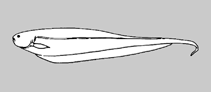 No image available for this species;
drawing shows typical species in Hypopomidae.
Google Bild
drawing shows typical species in Hypopomidae.
Klassifizierung / Names Namen | Synonyme | Catalog of Fishes(Gattung, Arten) | ITIS | CoL | WoRMS | Cloffa
> Gymnotiformes (Knifefishes) > Hypopomidae (Bluntnose knifefishes)
Etymology: Brachyhypopomus: Greek, brachys, eia = short + Greek, hypo = under + Greek, poma, -atos = cover (Ref. 45335); arrayae: Named for the Bolivian biologist Mariana Arraya for her assistance in collecting the type series in Bolivia.
Eponymy: Mariana Arraya is a Bolivian biologist at Unidad de Limnologia y Recursos Acuaticos, Universidad Mayor de San Simon. She was thanked in the etymology “…for her assistance in collecting the type series in Bolivia.” (Ref. 128868), visit book page.
Etymology: Brachyhypopomus: Greek, brachys, eia = short + Greek, hypo = under + Greek, poma, -atos = cover (Ref. 45335); arrayae: Named for the Bolivian biologist Mariana Arraya for her assistance in collecting the type series in Bolivia.
Eponymy: Mariana Arraya is a Bolivian biologist at Unidad de Limnologia y Recursos Acuaticos, Universidad Mayor de San Simon. She was thanked in the etymology “…for her assistance in collecting the type series in Bolivia.” (Ref. 128868), visit book page.
Umwelt: Milieu / Klimazone / Tiefenbereich / Verbreitungsgebiet Ökologie
; süßwasser benthopelagisch; pH range: 7.5 - 7.6. Tropical; 27°C - 28°C (Ref. 116763)
Verbreitung Territorien | FAO Gebiete | Ökosysteme | Vorkommen | Punkt Karte | Einführungen | Faunafri
South America: upper Madeira River basin in Bolivia, Brazil, and Peru.
Größe / Gewicht / Alter
Geschlechtsreife: Lm ? range ? - ? cm
Max length : 16.0 cm TL Männchen/unbestimmt; (Ref. 116763); 13.3 cm TL (female)
Max length : 16.0 cm TL Männchen/unbestimmt; (Ref. 116763); 13.3 cm TL (female)
Kurzbeschreibung Bestimmungsschlüssel | Morphologie | Morphometrie
Afterflossenweichstrahlen: 175 - 212. Brachyhypopomus arrayae can be distinguished from other species of the genus Brachyhypopomus by the following combination of characters: presence of prominent pale uninterrupted middorsal stripe from occipital region to base of caudal filament (vs. absence in all congeners except B. beebei, B. belindae, B. flavipomus, B. gauderio, B. pinnicaudatus, and B. verdii); anal-fin with 174-212 rays (vs. 214-230 in B. beebei; precaudal vertebrae 20-23 (vs. 24-26 in B. belindae and B. verdii); pectoral fin with 16-19 rays, mode 16 (vs. 12-15, mode 13 for B. gauderio (except populations from Uruguay drainages) and vs. 13-15, mode 14 for B. pinnicaudatus (except populations from coastal French Guiana). It has similar pigmentation and overlapping meristic counts and morphometric proportions with some populations of B. gauderio and B. pinnicaudatus from which it can be distinguished by the contact of a small ascending process on the endopterygoid (mesopterygoid of Mago-Leccia, 1978) with the orbitosphenoid (Arratia & Schultze, 1991; de Santana & Crampton, 2011), (vs. the lack of a contact between the ascending process on the endopterygoid and the orbitosphenoid in B. gauderio and B. pinnicaudatus (Ref. 116763).
Body shape (shape guide): elongated.
Body shape (shape guide): elongated.
Facultative air-breathing in the genus (Ref. 126274); The type series was sampled from high-conductivity whitewater floodplain sites and from the lower, seasonally inundated reaches of terra firme streams. Found most commonly in marginal root
mats, and in emergent or submerged aquatic vegetation. The recorded water parameters at the sampling sites were the following: conductivity 150-160 μScm-1, dissolved oxygen 5.0-6.0 mgl-1, temperature 27-28°C, and pH 7.5-7.6. Adults in spawning condition were observed during the dry season in June-July 2007. Aquatic insect larvae and other small aquatic invertebrates were found in the stomach contents of specimens from the type locality. Brachyhypopomus arrayae co-occurs in geographical sympatry and ecological syntopy with whitewater floodplain-occurring species such as B. bombilla, B. brevirostris, B. pinnicaudatus, and B. walteri. Largely allotopic in the region of the type locality with the following terra firme stream occurring species: B. alberti and B. sullivani, although B. arrayae was found with B. alberti at the ecotone between terra firme streams and floodplain systems (Ref. 116763).
Lebenszyklus und Paarungsverhalten Geschlechtsreife | Fortpflanzung | Ablaichen | Eier | Fruchtbarkeit | Larven
Hauptreferenz
Laden Sie Ihre Referenzen hoch | Referenzen | Koordinator : Albert, James S. | Partner
Crampton, W.G.R., C.D. de Santana, J.C. Waddell and N.R. Lovejoy, 2017. A taxonomic revision of the Neotropical electric fish genus Brachyhypopomus (Ostariophysi: Gymnotiformes: Hypopomidae), with descriptions of 15 new species. Neotrop. ichthyol. 14(4):e150146. (Ref. 116763)
CITES
Not Evaluated
Bedrohung für Menschen
Harmless
Nutzung durch Menschen
Fischereien: nicht kommerziell
FAO - Publication: search | FishSource |
Mehr Information
Trophische Ökologie
Lebensmittel (Beutetiere)
Nahrungszusammensetzung
Nahrungsaufnahme
Lebensmittelrationen
Räuber
Lebensmittel (Beutetiere)
Nahrungszusammensetzung
Nahrungsaufnahme
Lebensmittelrationen
Räuber
Populationsdynamik
Wachstumsparameter
Max. Alter/Größen
Länge-Gewicht-Rel.
Länge-Länge-Verhältnis.
Längenhäufigkeiten
Massenkonvertierung
Rekrutierung
Dichte
Wachstumsparameter
Max. Alter/Größen
Länge-Gewicht-Rel.
Länge-Länge-Verhältnis.
Längenhäufigkeiten
Massenkonvertierung
Rekrutierung
Dichte
Lebenszyklus
Fortpflanzung
Geschlechtsreife
Reifung/Kiemen rel.
Fruchtbarkeit
Ablaichen
Laichaggregationen
Eier
Eientwicklung
Larven
Larven Pop.Dyn.
Fortpflanzung
Geschlechtsreife
Reifung/Kiemen rel.
Fruchtbarkeit
Ablaichen
Laichaggregationen
Eier
Eientwicklung
Larven
Larven Pop.Dyn.
Anatomie
Kiemenoberfläche
Gehirn
Otolith
Kiemenoberfläche
Gehirn
Otolith
Physiologie
Körperliche Zusammensetzung
Nährstoffe
Sauerstoffverbrauch
Schwimmart
Schwimmgeschwindigkeit
Visuelle Pigmente
Fischgeräusche
Krankheiten und Parasiten
Toxizität (LC50s)
Körperliche Zusammensetzung
Nährstoffe
Sauerstoffverbrauch
Schwimmart
Schwimmgeschwindigkeit
Visuelle Pigmente
Fischgeräusche
Krankheiten und Parasiten
Toxizität (LC50s)
Genetik
Genom
Genetik
Heterozygotie
Vererbbarkeit
Genetische Vielfalt
Genom
Genetik
Heterozygotie
Vererbbarkeit
Genetische Vielfalt
Menschenbezogen
Aquakultur-Systeme
Aquakultur Profile
Zuchtlinien
Ciguatera-Fälle
Briefmarken, Münzen, Verschiedenes.
Aquakultur-Systeme
Aquakultur Profile
Zuchtlinien
Ciguatera-Fälle
Briefmarken, Münzen, Verschiedenes.
Tools
Zusatzinformationen
Download XML
Zusammenfassung | Punktdaten | Namen | Photos
Internet Quellen
AFORO (otoliths) | Aquatic Commons | BHL | Cloffa | Websites from users | FishWatcher Einträge suchen | CISTI | Catalog of Fishes: Gattung, Arten | DiscoverLife | ECOTOX | FAO - Publication: search | Faunafri | Fishipedia | Fishtrace | GloBI | Google Books | Google Scholar | Google | IGFA World Record | OneZoom | Open Tree of Life | Otolith Atlas of Taiwan Fishes | PubMed | Reef Life Survey | Socotra Atlas | TreeBase | Tree of Life | Wikipedia: Gehe zu, Suchen | World Records Freshwater Fishing | Zoobank | Zoologischer Rekord
Schätzungen auf der Grundlage von Modellen
Phylogenetischer Diversitätsindex (Ref. 82804): PD50 = 0.5000 [Uniqueness, from 0.5 = low to 2.0 = high].
Bayesian length-weight: a=0.00372 (0.00141 - 0.00980), b=3.06 (2.83 - 3.29), in cm total length, based on LWR estimates for this (Sub)family-body shape (Ref. 93245).
Trophische Ebene (Ref. 69278): 3.1 ±0.4 se; based on size and trophs of closest relatives