



Diplomystes incognitus Arratia & Quezada-Romegialli, 2017
Hochladen Photos und videos
Google Bild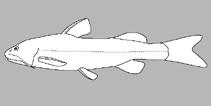 No image available for this species;
drawing shows typical species in Diplomystidae.
Google Bild
drawing shows typical species in Diplomystidae.
Klassifizierung / Names Namen | Synonyme | Catalog of Fishes(Gattung, Arten) | ITIS | CoL | WoRMS | Cloffa
> Siluriformes (Catfishes) > Diplomystidae (Velvet catfishes)
Etymology: Diplomystes: Greek, diploos = twice + Greek, mystax, -akos = lip (Ref. 45335); incognitus: The specific epithet incognitus is in reference that recognition of the species was obscured by the assumption that Diplomystes chilensis also extended south of Maipo Basin.
Etymology: Diplomystes: Greek, diploos = twice + Greek, mystax, -akos = lip (Ref. 45335); incognitus: The specific epithet incognitus is in reference that recognition of the species was obscured by the assumption that Diplomystes chilensis also extended south of Maipo Basin.
Umwelt: Milieu / Klimazone / Tiefenbereich / Verbreitungsgebiet Ökologie
; süßwasser demersal. Tropical
Verbreitung Territorien | FAO Gebiete | Ökosysteme | Vorkommen | Punkt Karte | Einführungen | Faunafri
South America: Rapel, Mataquito, Maule, and Itata Basins in Chile.
Größe / Gewicht / Alter
Kurzbeschreibung Bestimmungsschlüssel | Morphologie | Morphometrie
Rückenflossenstacheln (insgesamt) : 2; Rückenflossenweichstrahlen (insgesamt) : 6 - 7; Afterflossenweichstrahlen: 13; Wirbelzahl: 40. Diplomystes incognitus can be diagnosed from other species of the genus Diplomystes by having the following characters: skin of head, body, and fins densely covered by round, short papillae giving the skin a blackberry-like or verrucose aspect in large individuals; with a short head, slightly squarish and as long as broad (vs. slightly longer more triangular-shaped head); height of dorsal fin, ca. 20% of SL (range 17-25%) and triangularly-shaped (vs. slightly rhomboidal); maxilla with 7-9 teeth (vs. 8-13 in D. chilensis, 11-3 in D. nahuelbutaensis, and 12-19 in D. camposensis); with 10 infraorbital bones, as in D. nahuelbutaensis, but the dorsalmost compound bone is absent; urogenital pore and anus placed between posterior tips of pelvic fins as in D. chilensis (vs. urogenital pore and anus placed between pelvic fins or in between the distal tips of pelvics and anal fin); lack of pores of axillary gland with occasionally four on one side of body (vs. two or three pores) (Ref. 116749).
Lebenszyklus und Paarungsverhalten Geschlechtsreife | Fortpflanzung | Ablaichen | Eier | Fruchtbarkeit | Larven
Hauptreferenz
Laden Sie Ihre Referenzen hoch | Referenzen | Koordinator : Ferraris, Jr., Carl J. | Partner
Arratia, G. and C. Quezada-Romegialli, 2017. Understanding morphological variability in a taxonomic context in Chilea diplomystids (Teleostei: Siluriformes), including the description of a new species. PeerJ 5:e2991. (Ref. 116749)
IUCN Rote Liste Status (Ref. 130435: Version 2025-2 (Global))
stark gefährdet (EN) (A2c+4c); Date assessed: 16 March 2021
CITES
Not Evaluated
Bedrohung für Menschen
Harmless
Nutzung durch Menschen
FAO - Publication: search | FishSource |
Mehr Information
Trophische Ökologie
Lebensmittel (Beutetiere)
Nahrungszusammensetzung
Nahrungsaufnahme
Lebensmittelrationen
Räuber
Lebensmittel (Beutetiere)
Nahrungszusammensetzung
Nahrungsaufnahme
Lebensmittelrationen
Räuber
Populationsdynamik
Wachstumsparameter
Max. Alter/Größen
Länge-Gewicht-Rel.
Länge-Länge-Verhältnis.
Längenhäufigkeiten
Massenkonvertierung
Rekrutierung
Dichte
Wachstumsparameter
Max. Alter/Größen
Länge-Gewicht-Rel.
Länge-Länge-Verhältnis.
Längenhäufigkeiten
Massenkonvertierung
Rekrutierung
Dichte
Lebenszyklus
Fortpflanzung
Geschlechtsreife
Reifung/Kiemen rel.
Fruchtbarkeit
Ablaichen
Laichaggregationen
Eier
Eientwicklung
Larven
Larven Pop.Dyn.
Fortpflanzung
Geschlechtsreife
Reifung/Kiemen rel.
Fruchtbarkeit
Ablaichen
Laichaggregationen
Eier
Eientwicklung
Larven
Larven Pop.Dyn.
Anatomie
Kiemenoberfläche
Gehirn
Otolith
Kiemenoberfläche
Gehirn
Otolith
Physiologie
Körperliche Zusammensetzung
Nährstoffe
Sauerstoffverbrauch
Schwimmart
Schwimmgeschwindigkeit
Visuelle Pigmente
Fischgeräusche
Krankheiten und Parasiten
Toxizität (LC50s)
Körperliche Zusammensetzung
Nährstoffe
Sauerstoffverbrauch
Schwimmart
Schwimmgeschwindigkeit
Visuelle Pigmente
Fischgeräusche
Krankheiten und Parasiten
Toxizität (LC50s)
Genetik
Genom
Genetik
Heterozygotie
Vererbbarkeit
Genetische Vielfalt
Genom
Genetik
Heterozygotie
Vererbbarkeit
Genetische Vielfalt
Menschenbezogen
Aquakultur-Systeme
Aquakultur Profile
Zuchtlinien
Ciguatera-Fälle
Briefmarken, Münzen, Verschiedenes.
Aquakultur-Systeme
Aquakultur Profile
Zuchtlinien
Ciguatera-Fälle
Briefmarken, Münzen, Verschiedenes.
Tools
Zusatzinformationen
Download XML
Zusammenfassung | Punktdaten | Namen | Photos
Internet Quellen
AFORO (otoliths) | Aquatic Commons | BHL | Cloffa | Websites from users | FishWatcher Einträge suchen | CISTI | Catalog of Fishes: Gattung, Arten | DiscoverLife | ECOTOX | FAO - Publication: search | Faunafri | Fishipedia | Fishtrace | GloBI | Google Books | Google Scholar | Google | IGFA World Record | OneZoom | Open Tree of Life | Otolith Atlas of Taiwan Fishes | PubMed | Reef Life Survey | Socotra Atlas | TreeBase | Tree of Life | Wikipedia: Gehe zu, Suchen | World Records Freshwater Fishing | Zoobank | Zoologischer Rekord
Schätzungen auf der Grundlage von Modellen
Phylogenetischer Diversitätsindex (Ref. 82804): PD50 = 0.5703 [Uniqueness, from 0.5 = low to 2.0 = high].
Bayesian length-weight: a=0.00457 (0.00174 - 0.01201), b=3.12 (2.90 - 3.34), in cm total length, based on LWR estimates for this (Sub)family-body shape (Ref. 93245).
Trophische Ebene (Ref. 69278): 3.3 ±0.5 se; based on size and trophs of closest relatives