



Nansenia boreacrassicauda Poulsen, 2015
Uploaden van uw Foto's en video's
Google afbeelding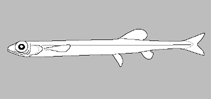 No image available for this species;
drawing shows typical species in Microstomatidae.
Google afbeelding
drawing shows typical species in Microstomatidae.
Classificatie / Namen Lokale namen | Synoniemen | Catalog of Fishes(Genus, Soort(en)) | ITIS | CoL | WoRMS | Cloffa
> Argentiniformes (Marine smelts) > Microstomatidae (Pencil smelts)
Etymology: boreacrassicauda: Name from Latin 'boreas' for Subarctic or to the north (referring to distribution of type materials); 'crassus' for fat or stout and 'cauda' for tail (referring to the stubby caudal peduncle).
Eponymy: Fridtjof Nansen (1861–1930) was a Norwegian explorer, scientist, diplomat and later recipient of the Nobel Peace Prize. [...] (Ref. 128868), visit book page.
Etymology: boreacrassicauda: Name from Latin 'boreas' for Subarctic or to the north (referring to distribution of type materials); 'crassus' for fat or stout and 'cauda' for tail (referring to the stubby caudal peduncle).
Eponymy: Fridtjof Nansen (1861–1930) was a Norwegian explorer, scientist, diplomat and later recipient of the Nobel Peace Prize. [...] (Ref. 128868), visit book page.
Milieu: milieu / Klimaatzone / Diepte / verspreidingsgebied Ecologie
marien pelagic-oceanic; diepte 382 - 400 m (Ref. 104906). Deep-water
Verspreiding Gebieden | FAO regio's | Ecosystemen | Voorkomen | Verspreidingskaart | Introducties | Faunafri
Northeast Atlantic: Greenland. Temperate and subarctic.
Grootte / Gewicht / Leeftijd
Maturiteit: Lm ? range ? - ? cm
Max length : 26.8 cm SL mannelijk / geslacht onbekend; (Ref. 104906)
Max length : 26.8 cm SL mannelijk / geslacht onbekend; (Ref. 104906)
Korte beschrijving Determinatiesleutels | Morfologie | Morfometrie
This species is distinguished by the following characters: a 'stubby caudal species' with PCL/PCD ratio 1.20-1.31; predorsal length <50% SL; dentition extensive, falling into high-number teeth group, often noted for the dentary resembling a closely-spaced picket fence; curved vomerine teeth; large eye, approximately 40% of HL; a large crescent of white tissue on posterior half of eye; with large circumorbitals; with concave indentation in posterior margin of operculum (opercular tube), somewhat variable between type materials; with a large
ventral strip of bioluminescent tissue associated with large scales, running from isthmus to vent, appearing dark in preservative; with large patches of distinct whitish, fatty tissue present on anterior and posterior parts of preorbital bone, elongated patch bordering all opercular bones, long strip dorsally separating cranial bones from nape, all patches fading in preservative; large and modified lateral-line scales, showing two pointed projections at posterolateral margins below adipose fin, extending several scales onto caudal fin rays; crumenal organ with relatively small accessory cartilage between fifth cerato- and epibranchial, fourth epibranchial with uncinate process, gill rakers on accessory cartilage 6-7, on fifth ceratobranchial 9-10 (total 16), epibranchial-5 + ceratobranchial-4 with 16 gill rakers in total; adipose fin is large, proximal part heavily pigmented; large pineal window present between eyes; with aphakic gap, acorn- or oval shaped; pseudobranch filaments 15-21; otoliths lanceolate, approximately 7.0 mm (3.0% SL) assembled (each broken into two), rostrum long, ventral margin denticles broad and deep, appearing highly convoluted; body colour golden-brownish, scales strongly iridescent when freshly caught, dull brown after preservation in alcohol/formaldehyde (Ref. 104906).
Body shape (shape guide): fusiform / normal; Cross section: oval.
Body shape (shape guide): fusiform / normal; Cross section: oval.
Levenscyclus en paargedrag Maturiteit | Voortplanting | Paaien | Eieren | Fecunditeit | Larven
Hoofdreferentie
Upload uw referenties | Referenties | Coördinator | Medewerkers
Poulsen, J.Y., 2015. A new species of pencil smelt Nansenia boreacrassicauda (Microstomatidae, Argentiniformes) from the North Atlantic Ocean. Zootaxa 4020(3):517-532. (Ref. 104906)
CITES
Not Evaluated
Gevaar voor de mens
Harmless
Gebruik door de mens
FAO - Publication: search | FishSource |
Meer informatie
Trofische ecologie
Voedsel (prooien)
Dieetsamenstelling
Voedselconsumptie
Voedselrantsoenen
Predatoren
Voedsel (prooien)
Dieetsamenstelling
Voedselconsumptie
Voedselrantsoenen
Predatoren
Ecologie
Ecologie
Ecologie
Populatiedynamica
Groeiparameters
Max. leeftijden / maten
Lengte-gewicht rel.
Lengte-lengte rel.
Lengtefrequenties
Massaconversie
Rekrutering
Abundantie
Groeiparameters
Max. leeftijden / maten
Lengte-gewicht rel.
Lengte-lengte rel.
Lengtefrequenties
Massaconversie
Rekrutering
Abundantie
Levenscyclus
Voortplanting
Maturiteit
Rijpheid/kieuwen rel.
Fecunditeit
Paaien
Paaibestanden
Eieren
Ontwikkeling van de eieren
Larven
Larvale populatiedynamiek
Voortplanting
Maturiteit
Rijpheid/kieuwen rel.
Fecunditeit
Paaien
Paaibestanden
Eieren
Ontwikkeling van de eieren
Larven
Larvale populatiedynamiek
Anatomie
Kieuwoppervlak
Hersenen
Otoliet
Kieuwoppervlak
Hersenen
Otoliet
Fysiologie
Lichaamssamenstelling
Voedingsstoffen
Zuurstofverbruik
Type zwemmen
Zwemsnelheid
Visuele pigmenten
Vis geluid
Ziekten en parasieten
Toxiciteit (LC50)
Lichaamssamenstelling
Voedingsstoffen
Zuurstofverbruik
Type zwemmen
Zwemsnelheid
Visuele pigmenten
Vis geluid
Ziekten en parasieten
Toxiciteit (LC50)
Genetica
genoom
Genetica
Heterozygositeit
Erfelijkheid
Genetische diversiteit
genoom
Genetica
Heterozygositeit
Erfelijkheid
Genetische diversiteit
Menselijk gerelateerd
Aquacultuursystemen
Aquacultuurprofielen
Kweeklijnen
Ciguatera gevallen
Postzegels, munten, diversen.
Aquacultuursystemen
Aquacultuurprofielen
Kweeklijnen
Ciguatera gevallen
Postzegels, munten, diversen.
Tools
Speciale rapporten
Bekijk gegevens voor het houden in een aquarium | Bekijk Fact Sheets voor de soort | Bekijk Aquacultuur Fact Sheets
Download XML
Internetbronnen
AFORO (otoliths) | Aquatic Commons | BHL | Cloffa | Websites from users | Bekijk FishWatcher | CISTI | Catalog of Fishes: Genus, Soort(en) | DiscoverLife | ECOTOX | FAO - Publication: search | Faunafri | Fishipedia | Fishtrace | GloBI | Google Books | Google Scholar | Google | IGFA World Record | OneZoom | Open Tree of Life | Otolith Atlas of Taiwan Fishes | PubMed | Reef Life Survey | Socotra Atlas | TreeBase | Tree of Life | Wikipedia: ga naar, zoek | World Records Freshwater Fishing | Zoobank | Zoological Record
Schattingen op basis van modellen
Fylogenetische diversiteitsindex (Ref. 82804): PD50 = 0.5000 [Uniqueness, from 0.5 = low to 2.0 = high].
Bayesian length-weight: a=0.01122 (0.00514 - 0.02450), b=3.04 (2.87 - 3.21), in cm total length, based on all LWR estimates for this body shape (Ref. 93245).
Trofisch niveau (Ref. 69278): 3.4 ±0.4 se; based on size and trophs of closest relatives