



Carica il tuo foto e Video
Immagini | Google image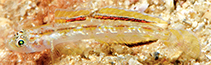 Grallenia dimorpha
Male Immagine di Allen, G.R. & M.V. Erdmann
Immagini | Google image
Male Immagine di Allen, G.R. & M.V. Erdmann
Classificazione / Nomi Nomi Comuni | Sinonimi | Catalog of Fishes(Genere, Specie) | ITIS | CoL | WoRMS | Cloffa
> Gobiiformes (Gobies) > Gobiidae (Gobies) > Gobiinae
Etymology: Grallenia: Named for Gerald R. Allen, (G+R+Allen+suffix '-ia'), in honor of his great contribution to our knowledge of the diversity of coral-reef fishes; dimorpha: Name from Latin 'dimorpha' meaning 'two shapes'; referring to the sexual dimorphism in relation to dorsal-fin shape; treated as a feminine singular adjective.
Eponymy: Dr Gerald Ray Allen (d: 1942) The genus was named to honour “…his great contribution to our knowledge of the diversity of coral-reef fishes.” (See Allen, GR) (Ref. 128868), visit book page.
Etymology: Grallenia: Named for Gerald R. Allen, (G+R+Allen+suffix '-ia'), in honor of his great contribution to our knowledge of the diversity of coral-reef fishes; dimorpha: Name from Latin 'dimorpha' meaning 'two shapes'; referring to the sexual dimorphism in relation to dorsal-fin shape; treated as a feminine singular adjective.
Eponymy: Dr Gerald Ray Allen (d: 1942) The genus was named to honour “…his great contribution to our knowledge of the diversity of coral-reef fishes.” (See Allen, GR) (Ref. 128868), visit book page.
Ambiente: milieu / zona climatica / distribuzione batimetrica / gamma di distribuzione Ecologia
marino associati a barriera corallina; distribuzione batimetrica 8 - 18 m (Ref. 116128). Tropical
Distribuzione Territories | Aree FAO | Ecosistemi | Presenze | Mappa dei ritrovamenti | Introduzioni | Faunafri
Western Pacific: Papua New Guinea.
Dimensione / Peso / Età
Maturità: Lm ? range ? - ? cm
Max length : 1.5 cm SL maschio/sesso non determinato; (Ref. 116128); 1.6 cm SL (female)
Max length : 1.5 cm SL maschio/sesso non determinato; (Ref. 116128); 1.6 cm SL (female)
Breve descrizione Chiavi di identificazione | Morfologia | Morfometria
Spine dorsali (totale) : 7; Raggi dorsali molli (totale) : 8 - 11; Spine anali: 1; Raggi anali molli: 9 - 11; Vertebre: 27. This species is distinguished by the following characters: D VI + I,8-11 (usually 10); A I,9-11 (usually10); fully erect first dorsal fin of male differs from female, male fin rectangular with fifth spine longest and female fin triangular with first spine forming elongate filament; no pelvic frenum nor head pores; longitudinal scales 25-30, often continuous from posterior pectoral-fin base to caudal-fin base, but anterior half of body mainly scaleless; body depth at pelvic-fin origin 13.4-15.6% SL; colour of male in life translucent with a mid-lateral row of five widely separated and progressively shorter posteriorly, horizontal, orange-brown lines, each surrounded by yellowish hue and with a faint, narrow, vertical, brown line extending ventrally, forming overall T-shaped marking; dorsal fins with a pair of prominent stripes, the outermost relatively broad and yellow-orange, inner stripe situated just above fin base, narrower and orange-red with black margin; anal fin yellowish with distinctive black margin; caudal fin is yellowish with irregular translucent areas mainly on upper part of basal half; female similar, but fins translucent without both the distinctive stripes on dorsal fins and black margin on anal fin; series of five ovate, progressively smaller, brown blotches along lower side interspersed with brilliant white markings, beginning at pectoral-fin base, continuing to posterior caudal peduncle (Ref. 116128).
Body shape (shape guide): elongated.
Body shape (shape guide): elongated.
Lives on sandy substrate (Ref. 116128).
Ciclo vitale e comportamento di accoppiamento Maturità | Riproduzione | Deposizione | Uova | Fecondità | Larve
Riferimento principale
Caricare le referenze | Bibliografia | Coordinatore | Collaboratori
Allen, G.R. and M.V. Erdmann, 2017. Descriptions of five new species of marine gobies (Teleostei: Gobiidae) of the genus Grallenia) from the tropical western Pacific Ocean. J. Ocean Sci. Found. 27:20-47. (Ref. 116128)
Stato della Lista Rossa IUCN (Ref. 130435: Version 2025-2 (Global))
Least Concern (LC) ; Date assessed: 19 March 2024
CITES
Not Evaluated
Minaccia per l'uomo
Harmless
Usi umani
FAO - Publication: search | FishSource |
Informazioni ulteriori
Ecologia trofica
Articoli alimentari (prede)
Alimentazione
Consumo di cibo
Razioni alimentari
Predatori
Articoli alimentari (prede)
Alimentazione
Consumo di cibo
Razioni alimentari
Predatori
Ecologia
Ecologia
Ecologia
Dinamica della popolazione
Parametri di crescita
Età massima / dimensioni massime
Rapporto lunghezza-peso.
Lunghezza-lunghezza rel.
Lunghezza-frequenze
Conversione di massa
Reclutamento
Abbondanza
Parametri di crescita
Età massima / dimensioni massime
Rapporto lunghezza-peso.
Lunghezza-lunghezza rel.
Lunghezza-frequenze
Conversione di massa
Reclutamento
Abbondanza
Ciclo di vita
Riproduzione
Maturità
Maturità/Gli occhielli sono relativi.
Fecondità
Deposizione
Aggregazioni riproduttive
Uova
Sviluppo delle uova
Larve
Dinamica popolazioni larvali
Riproduzione
Maturità
Maturità/Gli occhielli sono relativi.
Fecondità
Deposizione
Aggregazioni riproduttive
Uova
Sviluppo delle uova
Larve
Dinamica popolazioni larvali
Anatomia
Area branchiale
Cervello
Otolite
Area branchiale
Cervello
Otolite
Fisiologia
Composizione corporea
Nutrienti
Consumo di ossigeno
Tipo di nuoto
Velocità di nuoto
Pigmenti visivi
Suono del pesce
Malattie e parassiti
Tossicità (LC50)
Composizione corporea
Nutrienti
Consumo di ossigeno
Tipo di nuoto
Velocità di nuoto
Pigmenti visivi
Suono del pesce
Malattie e parassiti
Tossicità (LC50)
Genetica
Genome
Genetica
Eterozigosi
Ereditarietà
Diversità genetica
Genome
Genetica
Eterozigosi
Ereditarietà
Diversità genetica
Legato all'uomo
Sistemi di acquacoltura
Profili di acquacoltura
Varietà
Casi di Ciguatera
Francobolli, monete, materiale vario.
Sistemi di acquacoltura
Profili di acquacoltura
Varietà
Casi di Ciguatera
Francobolli, monete, materiale vario.
Strumenti
Libro elettronico | Giuda pratica | Generatore frequenze di lunghezza | Strumento Parametri Biologici | Mappa dei ritrovamenti |
Cattura-MSY |
Rapporti speciali
Controllo della manutenzione dell'acquario | Verificare la presenza di schede informative sulle specie | Verifica delle schede informative sull'acquacoltura
Scarica XML
Fonti Internet
AFORO (otoliths) | Aquatic Commons | BHL | Cloffa | Websites from users | Check FishWatcher | CISTI | Catalog of Fishes: Genere, Specie | DiscoverLife | ECOTOX | FAO - Publication: search | Faunafri | Fishipedia | Fishtrace | GloBI | Google Books | Google Scholar | Google | IGFA World Record | OneZoom | Open Tree of Life | Otolith Atlas of Taiwan Fishes | PubMed | Reef Life Survey | Socotra Atlas | TreeBase | Tree of Life | Wikipedia: Go, ricerca | World Records Freshwater Fishing | Zoobank | Record zoologico
Stime basate su modelli
Indice di diversità filogenetica (Fonte Biblio. 82804): PD50 = 0.5020 [Uniqueness, from 0.5 = low to 2.0 = high].
Bayesian length-weight: a=0.00741 (0.00347 - 0.01582), b=3.09 (2.91 - 3.27), in cm total length, based on LWR estimates for this (Sub)family-body shape (Ref. 93245).
Livello trofico (Fonte Biblio. 69278): 3.0 ±0.3 se; based on size and trophs of closest relatives
Resilienza (Fonte Biblio. 120179): Alto, tempo minimo di raddoppiamento della popolazione meno di 15 mesi (Preliminary K or Fecundity.).