



Hypostomus melanephelis Zawadzki, Oliveira, Oliveira & Py-Daniel, 2015
muatnaik fotos/gambar dan video
imej Google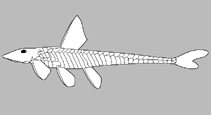 No image available for this species;
drawing shows typical species in Loricariidae.
imej Google
drawing shows typical species in Loricariidae.
klasifikasi / Nama Nama-nama umum | Sinonim (persamaan) | Catalog of Fishes(Marga, Jenis) | ITIS | CoL | WoRMS | Cloffa
> Siluriformes (Catfishes) > Loricariidae (Armored catfishes) > Hypostominae
Etymology: Hypostomus: Greek, hypo = under + Greek, stoma = mouth (Ref. 45335); melanephelis: The specific epithet, melanephelis, from the greek melanos meaning dark or black, and ephelis, meaning freckle, in allusion to the color pattern formed by tiny dark dots along the head and body (Ref. 103391).
Etymology: Hypostomus: Greek, hypo = under + Greek, stoma = mouth (Ref. 45335); melanephelis: The specific epithet, melanephelis, from the greek melanos meaning dark or black, and ephelis, meaning freckle, in allusion to the color pattern formed by tiny dark dots along the head and body (Ref. 103391).
Lingkungan: lingkungan / zona iklim / kisaran kedalaman / jangkauan distribusi Ekologi
; air tawar dasar (demersal). Tropical
Penyebaran Wilayah | Daerah-daerah FAO | Ekosistem | Kemunculan | peta titik | Introduksi | Faunafri
South America: currently known only from the rio Tapajós basin, near Itaituba city, Pará State, Brazil (Ref. 103391).
Ukuran / Berat / umur
deskripsi pendek Kunci identifiaksi (pengenalan) | Morfologi | Morfometrik
Duri punggung (Keseluruhan (total)) : 2; duri punggung lunak (Keseluruhan (total)) : 7; Duri dubur: 0; Sirip dubur lunak: 5; vertebrata, bertulang belakang: 29. Diagnosis: Hypostomus melanephelis is distinguished from the congeners, except H. interruptus, H. paucimaculatus, H. micropunctatus, H. nigropunctatus, and H. rhantos, by having conspicuous dark, roundish and tiny (smaller than eye pupil) set of dark spots on trunk (vs. medium to large pale or dark spots [larger than eye pupil], or transversally elongated dark spots); Hypostomus melanephelis is distinguished from H. interruptus, H. paucimaculatus, H. micropunctatus, H. nigropunctatus, and H. rhantos by the naked to partially plated abdomen (vs. abdomen completely covered by platelets); it is further diagnosed from H. interruptus by a larger mandibular ramus, 18-22 % HL (vs. 11.6-17.5 % HL; from H. paucimaculatus by having villiform bicuspid non spoon-shaped teeth with the lateral cusps not fused to the mesial tooth (vs. massive spoon-shaped teeth with lateral cusps usually fused to the mesial tooth); from H. micromaculatus by having usually 1 row of spots on each interradial membrane of dorsal fin (vs. 4-5) moderately distant from each other on flanks (vs. densely settled spots); from H. nigropunctatus by having just 1 plate posteriorly bordering supraoccipital (vs. 3); and from H. rhantos by having a more depressed head 49-56 % SL (vs. a more deeper head 64.3-83.2 % HL (Ref. 103391).
Body shape (shape guide): elongated.
Body shape (shape guide): elongated.
Facultative air-breathing in the genus (Ref. 126274); Collection area included different sections of running waters on large extensions of rocky substrate (Ref. 103391).
Siklus hidup dan perilaku kawin Kematangan | Reproduksi, perkembang biakan | Pemijahan | telur-telur | Fekunditas | Larva
rujukan utama
Unggah referensi Anda | Acuan | Koordinator : Fisch-Muller, Sonia | mitra
Zawadzki, C.H., A.S. Oliveira, R.R. de Oliveira and L.H. Rapp Py-Daniel, 2015. Hypostomus melanephelis a new armored catfish species from the rion Tapajós basin, Brazil (Teleostei: Loricariidae). Ichthyol. Explor. Freshwat. 26(1):49-58. (Ref. 103391)
CITES
Not Evaluated
ancaman kepada manusia
Harmless
penggunaan manusia
Perikanan: tidak ada kepentingan
FAO - Publication: search | FishSource |
informasi lanjut
Ekologi trofik
Item makanan (mangsa)
Komposisi makanan
Konsumsi makanan
Ransum makanan
Pemangsa
Item makanan (mangsa)
Komposisi makanan
Konsumsi makanan
Ransum makanan
Pemangsa
Dinamika populasi
Parameter pertumbuhan
Maks. usia / ukuran
Panjang-berat rel.
Panjang-panjang rel.
ukuran frekuensi
Konversi massa
pemulihan
Kelimpahan
Parameter pertumbuhan
Maks. usia / ukuran
Panjang-berat rel.
Panjang-panjang rel.
ukuran frekuensi
Konversi massa
pemulihan
Kelimpahan
Siklus hidup
Reproduksi, perkembang biakan
Kematangan
Kedewasaan / insang rel.
Fekunditas
Pemijahan
Agregasi pemijahan
telur-telur
pekembangan telor
Larva
Dinamika larva
Reproduksi, perkembang biakan
Kematangan
Kedewasaan / insang rel.
Fekunditas
Pemijahan
Agregasi pemijahan
telur-telur
pekembangan telor
Larva
Dinamika larva
Anatomi
Area insang
Otak
Otolith
Area insang
Otak
Otolith
Fisiologi
Komposisi tubuh
Nutrisi
Konsumsi oksigen
Jenis renang
Kecepatan berenang
Pigmen visual
Suara ikan
Penyakit & Parasit
Toksisitas (LC50)
Komposisi tubuh
Nutrisi
Konsumsi oksigen
Jenis renang
Kecepatan berenang
Pigmen visual
Suara ikan
Penyakit & Parasit
Toksisitas (LC50)
Genetika
genom
Genetika
Heterozigositas
Diturunkan
Keanekaragaman Genetik
genom
Genetika
Heterozigositas
Diturunkan
Keanekaragaman Genetik
Yang berhubungan dengan manusia
Sistem akuakultur
profil budidaya air
Strain
Kasus Ciguatera
Perangko, koin, dll.
Sistem akuakultur
profil budidaya air
Strain
Kasus Ciguatera
Perangko, koin, dll.
Alat, peralatan
E-book | Penuntun lapangan | tanda freqkuenci panjang | peringkat sejarah hidup | peta titik |
Tangkap-MSY |
laporan khas
muat turun XML
Sumber internet
AFORO (otoliths) | Aquatic Commons | BHL | Cloffa | Websites from users | semak peneliti ikan | CISTI | Catalog of Fishes: Marga, Jenis | DiscoverLife | ECOTOX | FAO - Publication: search | Faunafri | Fishipedia | Fishtrace | GloBI | Google Books | Google Scholar | Google | IGFA World Record | OneZoom | Open Tree of Life | Otolith Atlas of Taiwan Fishes | PubMed | Reef Life Survey | Socotra Atlas | TreeBase | Tree of Life | Wikipedia: pergi, Cari | World Records Freshwater Fishing | Zoobank | Catatan Zoologi
Estimasi berdasarkan model
Indeks keanekaragaman filogenetik (Acuan 82804): PD50 = 0.5000 [Uniqueness, from 0.5 = low to 2.0 = high].
Bayesian length-weight: a=0.01585 (0.00726 - 0.03460), b=2.95 (2.78 - 3.12), in cm total length, based on LWR estimates for this Genus-body shape (Ref. 93245).
Daya lenting (Acuan 120179): sedang, Waktu penggandaan populasi minimum 1.4 - 4.4 tahun (Preliminary K or Fecundity.).