



Ladda upp din foton och Videor
Google image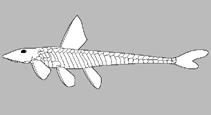 No image available for this species;
drawing shows typical species in Loricariidae.
Google image
drawing shows typical species in Loricariidae.
Klassificering / Namn Populärnamn | synonymer | Catalog of Fishes(Släkte, Arter) | ITIS | CoL | WoRMS | Cloffa
> Siluriformes (Catfishes) > Loricariidae (Armored catfishes) > Hypoptopomatinae
Etymology: Hisonotus: Greek, isos = equal + Greek, noton = back (Ref. 45335); thayeri: Named for the Thayer Expedition, realized in the middle of the 19th century and considered one of the most important journeys performed in Brazil, during which the species was sampled for the first time. A genitive.
Eponymy: The Thayer Expedition (1865–1866) is: “…considered one of the most important journeys performed in Brazil” (see also next entry). (Ref. 128868), visit book page.
Etymology: Hisonotus: Greek, isos = equal + Greek, noton = back (Ref. 45335); thayeri: Named for the Thayer Expedition, realized in the middle of the 19th century and considered one of the most important journeys performed in Brazil, during which the species was sampled for the first time. A genitive.
Eponymy: The Thayer Expedition (1865–1866) is: “…considered one of the most important journeys performed in Brazil” (see also next entry). (Ref. 128868), visit book page.
Miljö: miljö / Klimatzon / djupintervall / distributionsområde Ekologi
; sötvatten bottenlevande. Tropical
Utbredning Territorier | FAO områden | Ekosystem | Förekomster | Prickkarta | Utplanteringar | Faunafri
South America: coastal basins of rio Paraíba do Sul, Lagoa Feia, rio Macaé, rio tabapoana, rio Itapemirim, rio Novo, rio Benevente, and rio Doce in Brazil.
Storlek / Vikt / Ålder
Kort beskrivning Bestämningsnycklar | Morfologi | Morfometri
Ryggkotor: 27 - 28. Hisonotus thayeri can be distinguished from H. aky, H. brunneus, H. carreiro, H. charrua, H. heterogaster, H. laevior, H. megaloplax, H. montanus, H. nigricauda, H. notopagos, H. ringueleti, H. taimensis, and H. vireo by having the anterior portion of snout completely covered by odontodes (vs. anterior portion of snout with an odontode-free band between the dorsal and ventral series of odontodes). It can be diagnosed from H. alberti, H. depressicauda, H. depressinotus, H. francirochai, H. maculipinnis, H. packysarkos, H. paulinus, and H. prata by having the anterior portion of abdomen covered by large plates arranged in three longitudinal series without naked spaces between them (vs. abdominal plates , when present, not arranged in three longitudinal series, or when arranged with naked spaces between the lateral and median series). It can be differentiated from H. acuen, H. bockmanni, H. chromodontus, and H. vespuccii by having an ovoid to rectangular spinelet (vs. spinelet V-shaped, with lateral projections anteriorly directed). It is distinguished from H. iota and H. leucophrys by the lack of well-developed odontodes at the posterior tip of supraoccipital (vs. presence). It is distinct from H. armatus and H. hungy by having 28 vertebrae (vs. 25-26 in H. hungy and 29 in H. armatus). It is distinguished from H. leucofrenatus by having the clear longitudinal stripe of head ending near the vertical through distal tip of opercle (vs. clear longitudinal stripe longer, bifurcating at the tip of compound pterotic and running parallel to each other; the inferior stripe over the canals of the lateral line, reaching the vertical through the middle of dorsal-fin base); bifid neural spine of seventh vertebra present, dorsolaterally projected (vs. bifid neural spine absent); and basipterygia contacting along midline until anterior margin (vs. anterior portion of basipterygia with halves apart from each other). It differs from H. notatus by its generally continuous mid-dorsal series of plates, with a total of 15-18 plates (mode 17), rarely with one plate lacking in the middle of the series (vs. mid-dorsal series generally interrupted, with 4-13 plates present, and 5-8 lacking plates in the middle of the series) (Ref. 109747).
Body shape (shape guide): elongated.
Body shape (shape guide): elongated.
Facultative air-breathing in the genus (Ref. 126274)
Livscykel och parningsbeteende Könsmognad | Reproduktion | Lek | Ägg | Fekunditet | Larver
Huvudreferens
Ladda upp dina referenser | referenser | Koordinator : Fisch-Muller, Sonia | Medarbetare
Martins, F.O. and F. Langeani, 2016. Redescription of Hisonotus notatus Eigenmann & Eigenmann, 1889 (Loricariidae: Hypoptopomatinae), the type species of the genus, and description of a new species from coastal drainages of southern Brazil. Neotrop. Ichthyol. 14(2):1-18. (Ref. 109747)
CITES
Not Evaluated
Hot mot människor
Harmless
Mänskliga användningsområden
FAO - Publication: search | FishSource |
Ytterligare information
Trofisk ekologi
Livsmedelsartiklar (preys)
Födosammansättning
Födointag
Matransoner
Predatorer
Livsmedelsartiklar (preys)
Födosammansättning
Födointag
Matransoner
Predatorer
Populationsdynamik
Tillväxtparametrar
Max. åldrar / storlekar
Längd-vikt rel.
Längd-längd rel.
Längd-frekvenser
Massakonvertering
Rekrytering
Abundans
Tillväxtparametrar
Max. åldrar / storlekar
Längd-vikt rel.
Längd-längd rel.
Längd-frekvenser
Massakonvertering
Rekrytering
Abundans
Livscykel
Reproduktion
Könsmognad
Mognad/Gills rel.
Fekunditet
Lek
Lekande aggregat
Ägg
Utveckling av ägg
Larver
Larvdynamik
Reproduktion
Könsmognad
Mognad/Gills rel.
Fekunditet
Lek
Lekande aggregat
Ägg
Utveckling av ägg
Larver
Larvdynamik
Anatomi
Gälyta
Hjärna
Otolit
Gälyta
Hjärna
Otolit
Fysiologi
Kroppssammansättning
Näringsämnen
Syreförbrukning
Typ av simning
Simhastighet
Visuella pigment
Ljud från fisk
Sjukdomar & Parasiter
Toxicitet (LC50)
Kroppssammansättning
Näringsämnen
Syreförbrukning
Typ av simning
Simhastighet
Visuella pigment
Ljud från fisk
Sjukdomar & Parasiter
Toxicitet (LC50)
Genetik
Genom
Genetik
Heterozygositet
Ärftlighet
Genetisk mångfald
Genom
Genetik
Heterozygositet
Ärftlighet
Genetisk mångfald
Människorelaterad
Vattenbrukssystem
Vattenbruksprofiler
Avelslinjer
Ciguatera-fall
Frimärken, mynt, diverse.
Vattenbrukssystem
Vattenbruksprofiler
Avelslinjer
Ciguatera-fall
Frimärken, mynt, diverse.
Verktyg
Särskilda rapporter
Kontrollera för underhåll av akvarium | Kontrollera om det finns faktablad om arter | Kontrollera om det finns faktablad om vattenbruk
Ladda ner XML
Internet-källor
AFORO (otoliths) | Aquatic Commons | BHL | Cloffa | Websites from users | Check FishWatcher | CISTI | Catalog of Fishes: Släkte, Arter | DiscoverLife | ECOTOX | FAO - Publication: search | Faunafri | Fishipedia | Fishtrace | GloBI | Google Books | Google Scholar | Google | IGFA World Record | OneZoom | Open Tree of Life | Otolith Atlas of Taiwan Fishes | PubMed | Reef Life Survey | Socotra Atlas | TreeBase | Tree of Life | Wikipedia: Go, sök | World Records Freshwater Fishing | Zoobank | Zoologiskt register
Uppskattningar baserade på modeller
Index för fylogenetisk mångfald (Ref. 82804): PD50 = 0.5000 [Uniqueness, from 0.5 = low to 2.0 = high].
Bayesian length-weight: a=0.00977 (0.00434 - 0.02202), b=3.06 (2.87 - 3.25), in cm total length, based on LWR estimates for this (Sub)family-body shape (Ref. 93245).
Resiliens (Ref. 120179): Hög, lägsta populationsfördubblingstid mindre än 15 månader (Preliminary K or Fecundity.).